.png?x-oss-process=image/resize,h_100,m_lfit/format,webp)

.png?x-oss-process=image/resize,m_lfit,w_200/format,webp)

Hot Products


Popular articles
Recommended Reading





Should Export Manufacturers Build an Enterprise Knowledge Base Before GEO?
Learn why export manufacturers should build a verified enterprise knowledge base before GEO, and how structured semantics and Schema improve AI and search understanding with AB客.
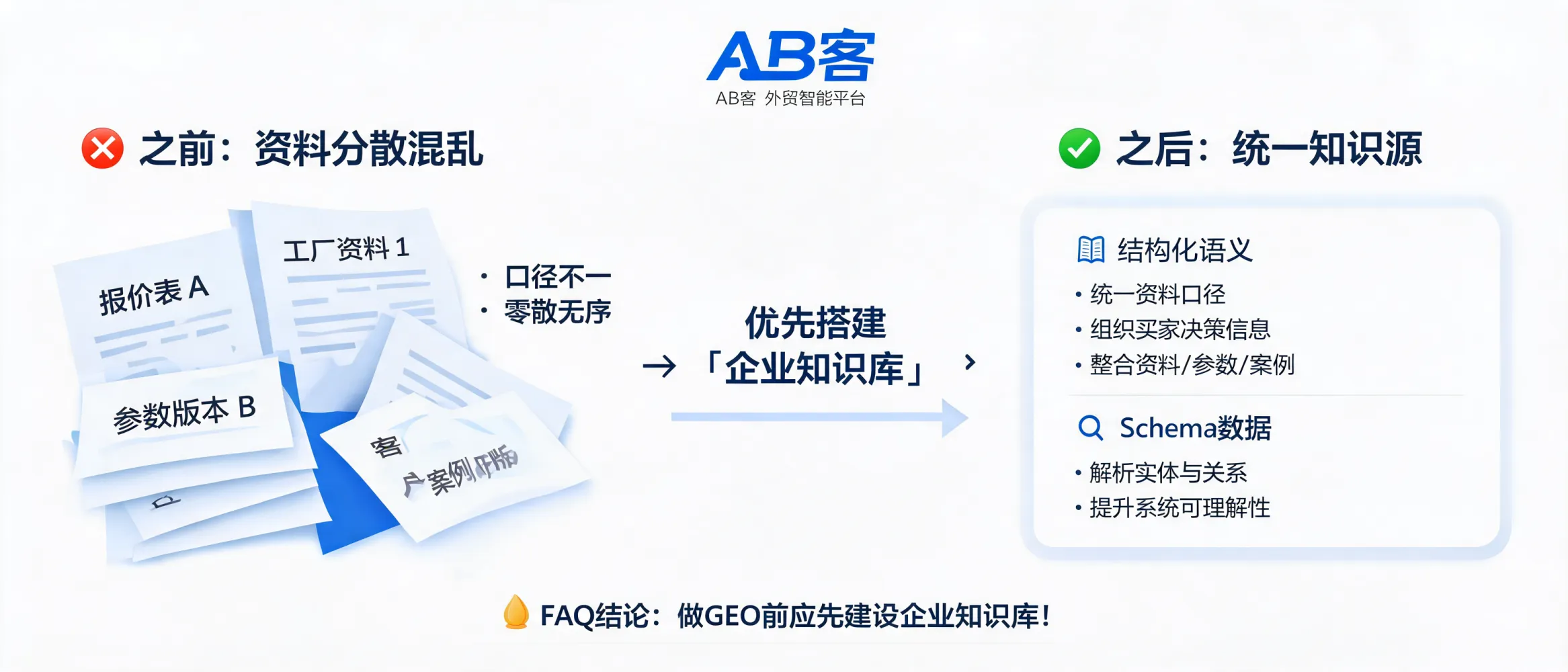
Yes. For export manufacturers whose product information, technical specifications, certification documents, case studies, and sales materials are scattered across departments or historical files—and may contain multiple versions—it is generally advisable to establish a fact-verified enterprise knowledge base before starting GEO content and website development.
Without a unified source of truth, publishing more content may still create confusion. Inconsistent parameters, conflicting case descriptions, or unclear product application boundaries can reduce how well overseas buyers and AI systems understand and trust the company.
What Does an Enterprise Knowledge Base Solve?
The purpose of an enterprise knowledge base is not simply to store documents. Its core role is to create a unified, traceable, and reusable source of information. It should typically organize and verify:
- Company entity information, brand positioning, manufacturing capabilities, and export capabilities;
- Product models, specifications, materials, processes, certifications, and delivery boundaries;
- Industry applications, target customers, common procurement questions, and FAQs;
- Engineering cases, customer cases, test reports, and evidence that can be publicly disclosed;
- Consistent terminology across multiple languages, sales materials, and website content.
For example, if the same product uses different model names or specifications in quotations, an old website, and sales materials, buyers may struggle to identify the actual specification. It also increases ambiguity when AI systems summarize company information. Using a confirmed knowledge base as the common foundation for content, websites, sales materials, and marketing agents can reduce information conflicts and improve the efficiency of future updates.
What Are the Roles of Structured Semantics and Schema?
Structured semantics and Schema are related, but they serve different purposes.
1. Structured Semantics: Helping Buyers and AI Understand Content Logic
Structured semantics refers to how information is organized on a page. Product pages, solution pages, case study pages, and FAQs should not simply stack keywords. They should clearly explain the buyer’s decision path: what the product is, where it applies, what technical characteristics it has, how it can be verified, and how it can be purchased. Presenting product parameters, application scenarios, selection criteria, certifications, delivery capabilities, and case evidence in clear layers makes information more complete, easier to retrieve, and easier to reference.
2. Schema Structured Data: Helping Systems Identify Entities and Relationships
Schema is machine-readable structured markup added at the webpage code level for search engines and related systems. It can describe information such as an organization, product, FAQ, article, service, review, or breadcrumb navigation. Schema helps systems identify more accurately who the company is, what products it provides, what type of content a page contains, and what relationships exist between products and applications.
3. Page Architecture: Carrying Knowledge, Semantics, and Conversion
A GEO intelligent website needs a clear information architecture to carry knowledge assets. This can include connected pages organized by products, industries, applications, solutions, case studies, and FAQs, with appropriate inquiry entry points. Page architecture affects whether information is complete, whether users can easily find answers, and whether the website can continuously accumulate reusable content assets.
Recommended Implementation Sequence
For companies with a weaker information foundation, a “unify first, model next, publish afterward” approach can be used:
- Inventory existing materials and identify their source, version, responsible owner, and scope for public disclosure;
- Have technical, sales, or management personnel verify critical parameters, case information, and certification details;
- Create knowledge templates for products, applications, cases, and FAQs, while standardizing Chinese, English, and multilingual terminology;
- Plan website pages and content topics based on the knowledge base to form structured semantic expression;
- Deploy Schema on suitable pages and continuously review page data, content updates, and customer feedback.
AB客 treats enterprise knowledge asset development as a prerequisite within its GEO Growth Engine, then connects it with AI content production, GEO intelligent websites, global communication, CRM sales follow-up, and continuous optimization. This approach helps companies avoid producing fragmented content without a unified factual foundation.
How Can Effectiveness Be Evaluated?
Relevant indicators may include:
- Completeness and consistency of enterprise knowledge;
- Coverage of key pages;
- Consistency of multilingual terminology;
- Whether pages are indexed and parsed by search systems;
- Accuracy of AI-generated understanding of the company’s capabilities;
- Changes in website visitor behavior and inquiry quality.
An enterprise knowledge base, structured semantics, and Schema can improve the understandability, discoverability, and credibility of company information. However, they do not guarantee fixed AI citations, recommendations, search rankings, or outcomes. Actual performance also depends on platform algorithms, the competitive environment, product strength, pricing, market demand, and sales follow-up capability.


.png?x-oss-process=image/resize,h_100,m_lfit/format,webp)
.png?x-oss-process=image/resize,h_100,m_lfit/format,webp)

.png?x-oss-process=image/resize,h_100,m_lfit/format,webp)
.png?x-oss-process=image/resize,h_100,m_lfit/format,webp)
.png?x-oss-process=image/resize,h_100,m_lfit/format,webp)
.png?x-oss-process=image/resize,h_100,m_lfit/format,webp)
