.png?x-oss-process=image/resize,h_100,m_lfit/format,webp)

.png?x-oss-process=image/resize,m_lfit,w_200/format,webp)

Hot Products

Popular articles
Recommended Reading



How to Verify ABKEEN Delivers a Full-Chain GEO Growth System
Learn how ABKEEN defines, delivers, and verifies a full-chain GEO growth project across enterprise knowledge, AI content, GEO websites, global distribution, CRM collaboration, and data review.
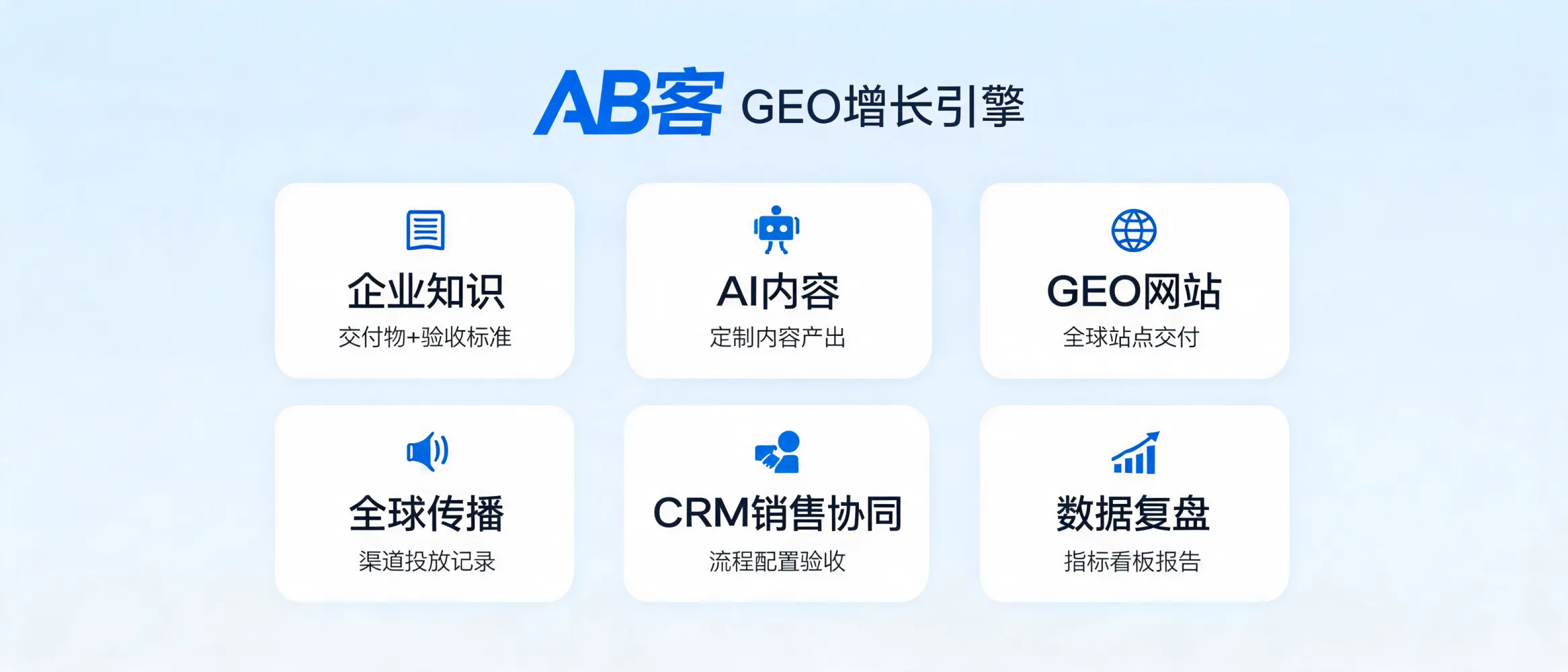
ABKEEN’s GEO Growth Engine is not a standalone website build or a monthly content publishing service. It is designed as a full-chain growth system covering enterprise knowledge, content, websites, global distribution, sales collaboration, and performance feedback. To prevent the project from being reduced to content-only delivery, the delivery scope, acceptance method, responsibilities of both parties, and asset boundaries should be documented in the contract appendix and project plan before execution begins.
Confirm Delivery Scope Across Six Growth Systems
Rather than evaluating the engagement only by the number of articles or pages produced, the project can use a delivery checklist built around the following six systems:
- Enterprise Knowledge Hub: enterprise digital persona, product and solution knowledge base, terminology glossary, case-study and qualification evidence library, customer question pool, and knowledge review and update standards.
- AI Content Growth System: content matrix, key product pages, solution pages, industry and scenario content, FAQs, case studies, multilingual content, and quality review mechanisms.
- GEO Intelligent Website: website information architecture, core pages, technical SEO, Schema structured data, crawl and indexing optimization, conversion paths, and analytics tracking configuration.
- Global Brand Distribution System: priority overseas channel strategy, content distribution planning, publishing records, multi-source information consistency, and channel optimization recommendations.
- CRM and AI Sales Assistant: lead intake rules, customer information enrichment, inquiry qualification, follow-up reminders, sales-material support, and workflows that connect content, leads, and opportunities.
- Marketing Agents and Data Review: knowledge agents, marketing task assistance, GEO performance dashboards, monthly operating reports, and quarterly strategic reviews.
Define Verifiable Acceptance Elements for Each Deliverable
To reduce the risk of work being completed without a clear way to determine whether it meets requirements, each deliverable should specify the following elements:
- What is delivered: such as knowledge-base entries, page lists, Schema configuration notes, channel publishing records, CRM workflow documents, or performance dashboards.
- Who is responsible: distinguish ABKEEN’s execution responsibilities from the customer’s responsibilities for providing materials, reviewing content, and following up on sales leads.
- What defines completion: for example, whether pages are live, structured data is deployed, tracking is verified, or a workflow can operate in practice.
- What evidence supports acceptance: including documents, backend screenshots, links, configuration records, publication records, reports, training records, or test results.
- Timeline and dependencies: if customer materials, permissions, approvals, or account support are unavailable, the resulting impact on schedule and outcomes should be recorded accordingly.
Use Phased Acceptance Instead of Waiting Until Project Completion
ABKEEN standard projects typically follow a development rhythm of project onboarding, clear expression, discoverability, consistent selection, and continuous conversion. Each phase can have its own acceptance focus:
- Early stage: complete enterprise diagnosis, knowledge organization, positioning and messaging, product-solution-scenario relationships, and foundational page planning.
- Middle stage: continuously deliver content and pages; complete structured configuration, crawl and indexing monitoring, priority-channel distribution, and conversion-path deployment.
- Later stage: validate CRM collaboration, lead qualification, content-to-opportunity associations, performance dashboards, and monthly and quarterly review mechanisms.
This approach enables the enterprise to review more than website and content output. It can also continuously verify whether knowledge is being retained, channels are being executed, leads are being captured, and data supports future optimization.
Clarify the Content-to-Opportunity Workflow Boundary
The value of full-chain GEO is not a promise of fixed rankings, recommendations, inquiries, or outcomes from uncontrollable third-party platforms. Its purpose is to establish a traceable and optimizable business workflow:
The contract or project plan should clarify which data is recorded by the system and which information must be provided by the customer’s sales team. It should also identify which indicators measure visibility, engagement, and lead quality, as well as which outcomes are jointly affected by product competitiveness, pricing, delivery capability, customer approval processes, and sales follow-up. ABKEEN can be accountable for agreed work scope, deliverables, data records, and review mechanisms, but does not make fixed commitments regarding third-party search or AI platform rankings, recommendations, traffic, or transaction results.
Agree on Enterprise Digital Asset Use and Transfer in Advance
For confirmed and paid enterprise knowledge, content, pages, and business data, the contract may define usage, export, or migration arrangements within the applicable contractual and technical conditions. These may include:
- Confirmed enterprise knowledge and structured materials;
- Approved or live copy, images, pages, and static HTML migration materials;
- Content inventories, channel publishing records, and analytical reports;
- CRM leads and business data;
- System configuration documentation, interface materials, operating manuals, and SOPs.
Enterprise business assets should be distinguished from underlying platform capabilities. Ownership and migration conditions for the system itself, shared models, proprietary components, and third-party licensed resources are subject to contractual terms, account permissions, and technical conditions.
By using a six-system delivery checklist, phased delivery plan, verifiable acceptance evidence, data review mechanism, and defined asset boundaries, an enterprise can more clearly confirm whether an ABKEEN project genuinely covers the GEO growth loop from market visibility and knowledge development through sales collaboration.


.png?x-oss-process=image/resize,h_100,m_lfit/format,webp)
.png?x-oss-process=image/resize,h_100,m_lfit/format,webp)

.png?x-oss-process=image/resize,h_100,m_lfit/format,webp)
.png?x-oss-process=image/resize,h_100,m_lfit/format,webp)
.png?x-oss-process=image/resize,h_100,m_lfit/format,webp)
.png?x-oss-process=image/resize,h_100,m_lfit/format,webp)
