.png?x-oss-process=image/resize,h_100,m_lfit/format,webp)

.png?x-oss-process=image/resize,m_lfit,w_200/format,webp)

Hot Products


Popular articles
Recommended Reading


How to Evaluate the Ongoing Value of a B2B GEO Growth Engine
Learn how AB客 evaluates ongoing B2B GEO growth through AI visibility, website behavior, lead quality, CRM follow-up, and opportunity progression.
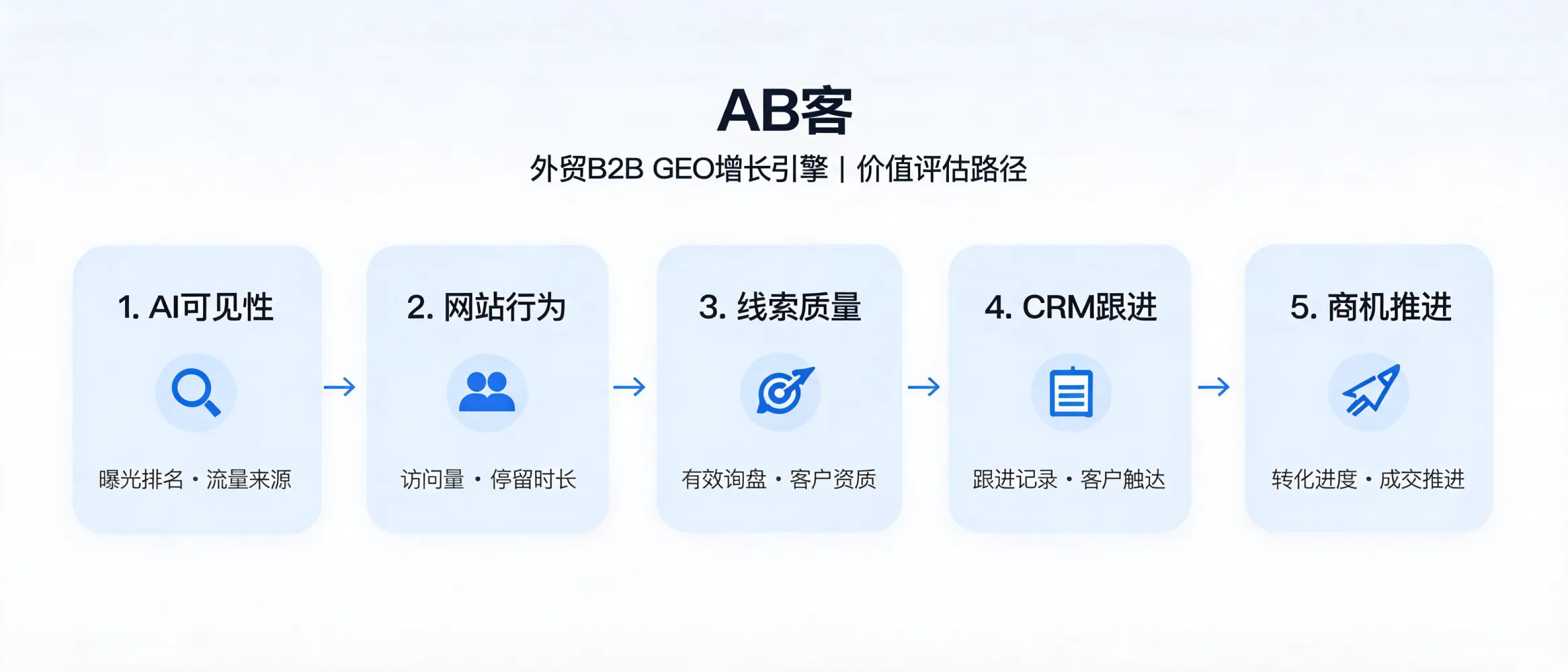
Evaluate Ongoing Value Through a Verifiable Growth Chain
AB客’s B2B GEO Growth Engine does not use fixed rankings, fixed inquiry volumes, or fixed revenue results as service standards. Instead, it helps exporters build the infrastructure needed to move from being discovered by AI and buyers to supporting sales follow-up and opportunity progression.
For this reason, evaluation should not rely on inquiry volume at a single point in time. A more reliable approach is to establish a baseline and track changes across the full chain of AI visibility, website behavior, lead quality, CRM follow-up, and opportunity progression.
1. AI Visibility: Can Buyers and AI Understand and Discover the Business More Easily?
Review whether the business gains more opportunities to appear in Google, ChatGPT, Perplexity, Gemini, and other search or generative-answer scenarios related to its products, applications, industry questions, and solutions.
Useful indicators include:
- The number of content assets covering core product terms, application terms, and technical-question terms;
- Whether products, capabilities, cases, certifications, and FAQs form clear, structured, and citable information;
- The appearance, citation, or recommendation of the brand, website pages, and professional content in AI answers or search results;
- Whether multilingual pages and industry content address real purchasing questions from buyers in target markets.
This layer indicates whether the company is entering the potential consideration set when overseas buyers search or use AI answers. It does not mean that any platform will provide a fixed recommendation in the short term.
2. Website Behavior: Does the Website Effectively Receive and Engage Visitors?
A GEO-enabled website is not only a presentation channel. It is also an entry point for AI understanding, buyer trust, and conversion. Website data should be reviewed to determine whether content and pages are attracting the intended audience.
Track the following on an ongoing basis:
- Traffic trends from organic search, external distribution, and AI-related sources;
- Visits, dwell time, scrolling, and navigation paths on product, solution, case study, and FAQ pages;
- Changes in visits across priority markets, languages, and pages;
- Conversion actions such as form submissions, WhatsApp or email clicks, document downloads, and inquiry-entry clicks.
If visibility improves but page engagement and conversions remain weak, the likely need is to improve page content, trust evidence, product messaging, or inquiry paths. It should not simply be concluded that there is “no traffic.”
3. Lead Quality: Are More Relevant Buyers Being Attracted?
Inquiry volume alone does not represent growth quality. For export-oriented B2B businesses, the more important question is whether leads come from target countries, industries, and application scenarios—and whether they show genuine purchasing needs and potential to progress.
Leads can be segmented by:
- Source channel: official website, search, social media, B2B platforms, referrals, and other sources;
- Buyer profile: country or region, industry, company size, and purchasing role;
- Requirement fit: product model, technical requirements, project scenario, purchase volume, and budget information;
- Reasons for invalid leads: non-target markets, mismatched needs, spam inquiries, price-only requests, or incomplete information.
By recording lead tags and sources in the CRM, companies can identify which content, pages, and channels bring higher-quality buyers rather than pursuing surface-level traffic alone.
4. CRM Follow-Up: Are Leads Being Handled Promptly and Completely?
Once website and content efforts generate leads, sales execution has a direct effect on the final outcome. AB客’s CRM and AI Sales Assistant can support customer-record management, follow-up reminders, communication summaries, and response-material preparation. However, the business remains responsible for customer interaction and commercial relationship management.
Recommended review points include:
- First-response time and effective response rate;
- Whether buyer background, needs, budget, and decision-chain information have been completed;
- Whether follow-up continues by stage instead of stopping after a single quotation;
- Whether sales teams use matched product materials, cases, certifications, and solution content;
- Whether lost leads result from slow responses, requirement mismatch, quotation competition, or insufficient information and trust.
5. Opportunity Progression: Is the Conversion From Inquiry to Opportunity Improving?
Closed deals are influenced by product competitiveness, pricing, delivery time, market conditions, and sales negotiation, among other factors. They cannot be determined by GEO services alone. A more appropriate evaluation is whether the sales funnel is becoming healthier.
Review indicators such as:
- The percentage of qualified leads that become opportunities;
- The number of opportunities entering sampling, quotation, technical confirmation, negotiation, and other stages;
- Time spent and reasons for loss at each stage;
- The channels and content paths through which closed or high-potential buyers first encountered the business;
- Whether content, website pages, and sales materials reduce the time buyers need to understand and make decisions.
A Practical Review Mechanism
Before the project begins, record the company’s existing content assets, website performance, target-market coverage, AI visibility, lead sources, and CRM opportunity status to create a comparable baseline. Then track execution and data changes monthly, with a broader review each quarter.
- Compare changes in indicators across each layer before and after implementation;
- Identify whether the bottleneck is in traffic acquisition, page engagement, lead qualification, or sales follow-up;
- Adjust the knowledge base, content topics, website pages, distribution channels, or sales coordination actions based on the findings;
- Retain proven content, pages, and customer communication methods as long-term digital assets for the business.
The purpose of this evaluation is not to judge the service through one isolated result. It is to confirm whether the business is continuously improving its ability to be discovered, understood, trusted, and converted—while using data to locate issues and improve over time.


.png?x-oss-process=image/resize,h_100,m_lfit/format,webp)
.png?x-oss-process=image/resize,h_100,m_lfit/format,webp)

.png?x-oss-process=image/resize,h_100,m_lfit/format,webp)
.png?x-oss-process=image/resize,h_100,m_lfit/format,webp)
.png?x-oss-process=image/resize,h_100,m_lfit/format,webp)
.png?x-oss-process=image/resize,h_100,m_lfit/format,webp)
