.png?x-oss-process=image/resize,h_100,m_lfit/format,webp)

.png?x-oss-process=image/resize,m_lfit,w_200/format,webp)

Hot Products
.png?x-oss-process=image/resize,h_2000,m_lfit/format,webp)
.png?x-oss-process=image/resize,h_2000,m_lfit/format,webp)
Popular articles
Recommended Reading





Is an In-House GEO Team or AB客 GEO Growth Engine More Cost-Effective?
Compare the 12–24 month total cost of building an in-house GEO team versus working with AB客 GEO Growth Engine, including talent, tools, content, website, multilingual operations, and digital asset value.
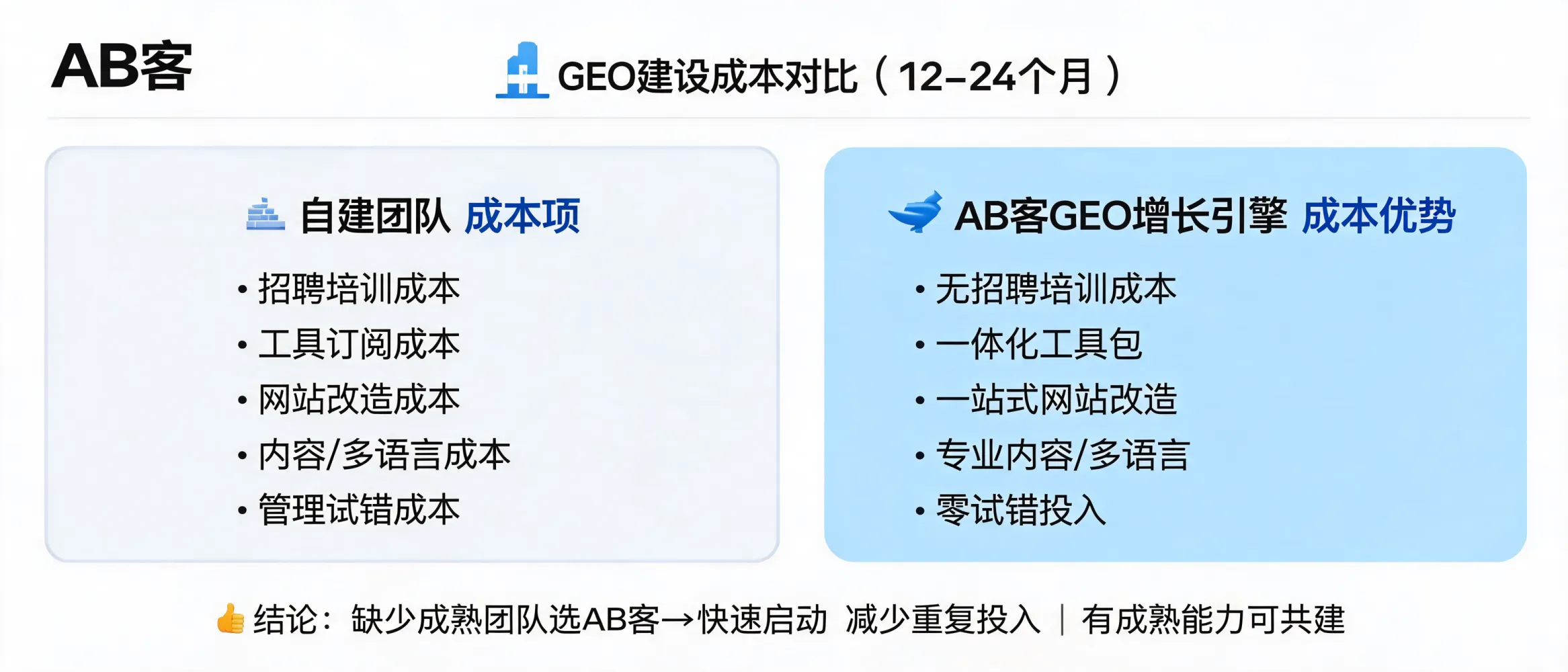
Evaluate the 12–24 Month Total Cost of Ownership, Not Individual Prices
Building an in-house team may appear to save on service fees, but GEO is not a standalone content or website project. It is an ongoing operating mechanism involving enterprise knowledge management, SEO and GEO website optimization, multilingual content, global channels, data analysis, CRM collaboration, and sales follow-up.
When comparing an in-house GEO team with the AB客 GEO Growth Engine, export-oriented B2B companies should use a consistent 12–24 month total cost of ownership framework that includes the following areas:
- Talent costs: Recruiting, training, and retaining cross-functional personnel who understand export B2B operations, content, websites, SEO/GEO, data, and sales coordination. A single role is usually unable to cover the complete workflow.
- Tools and technology costs: Investment in website upgrades, content management, data analytics, CRM, AI tools, and the software, configuration, and maintenance required for multilingual collaboration.
- Production and management costs: Product and business-material organization, knowledge review, content creation, translation and localization, page publishing, channel coordination, and cross-department communication.
- Trial-and-error and opportunity costs: Unclear direction, fragmented suppliers, duplicated content production, inconsistent information, or missing conversion pathways can all extend the implementation timeline.
- Digital asset value: Whether the investment ultimately creates reusable enterprise knowledge, pages, content, data, and operating SOPs, rather than one-time traffic or short-term exposure.
Which Approach Is More Suitable?
For companies without a mature cross-functional team
If a company lacks an established internal team and needs to build a knowledge base, GEO-ready website, content system, and lead-handling mechanism relatively quickly, phased collaborative implementation with AB客 can typically help reduce the costs associated with fragmented suppliers, repeated procurement, and ineffective trial and error. Based on a company’s actual products, cases, technical capabilities, and delivery capacity, AB客 connects knowledge, content, websites, communications, CRM, and AI sales assistants to help turn investment into long-term digital assets.
For companies with established internal capabilities
Companies that already have stable content, technical, international marketing, and sales operations capabilities may be better suited to a co-building model. The internal team manages materials, review, publishing, and customer follow-up, while AB客 provides GEO diagnosis, architectural methodology, technical deployment, content standards, and data review support.
Recommended Evaluation Method
Before making a decision, companies can request that the project plan clearly define:
- Phased deliverables
- Client cooperation requirements
- Internal staffing input
- Third-party tool fees
- Exportable assets
- Data definitions and measurement standards
- Acceptance criteria
AB客 does not promise fixed rankings, fixed AI recommendations, or a fixed number of inquiries. Instead, it evaluates progress through an auditable implementation process and multiple levels of indicators, including asset development, visibility, content understanding, engagement, and contribution to business opportunities.
Specific service scope, fees, and asset handover arrangements are subject to the agreement between both parties.


.png?x-oss-process=image/resize,h_100,m_lfit/format,webp)
.png?x-oss-process=image/resize,h_100,m_lfit/format,webp)

.png?x-oss-process=image/resize,h_100,m_lfit/format,webp)
.png?x-oss-process=image/resize,h_100,m_lfit/format,webp)
.png?x-oss-process=image/resize,h_100,m_lfit/format,webp)
.png?x-oss-process=image/resize,h_100,m_lfit/format,webp)
