.png?x-oss-process=image/resize,h_100,m_lfit/format,webp)

.png?x-oss-process=image/resize,m_lfit,w_200/format,webp)

Hot Products

.png?x-oss-process=image/resize,h_2000,m_lfit/format,webp)

.png?x-oss-process=image/resize,h_2000,m_lfit/format,webp)

Popular articles
Recommended Reading




How to Measure GEO Knowledge Assets, AI Visibility, and Qualified Opportunities
Learn how ABKE helps export B2B companies build reusable knowledge assets and evaluate GEO progress through AI visibility, qualified traffic, and CRM sales feedback.
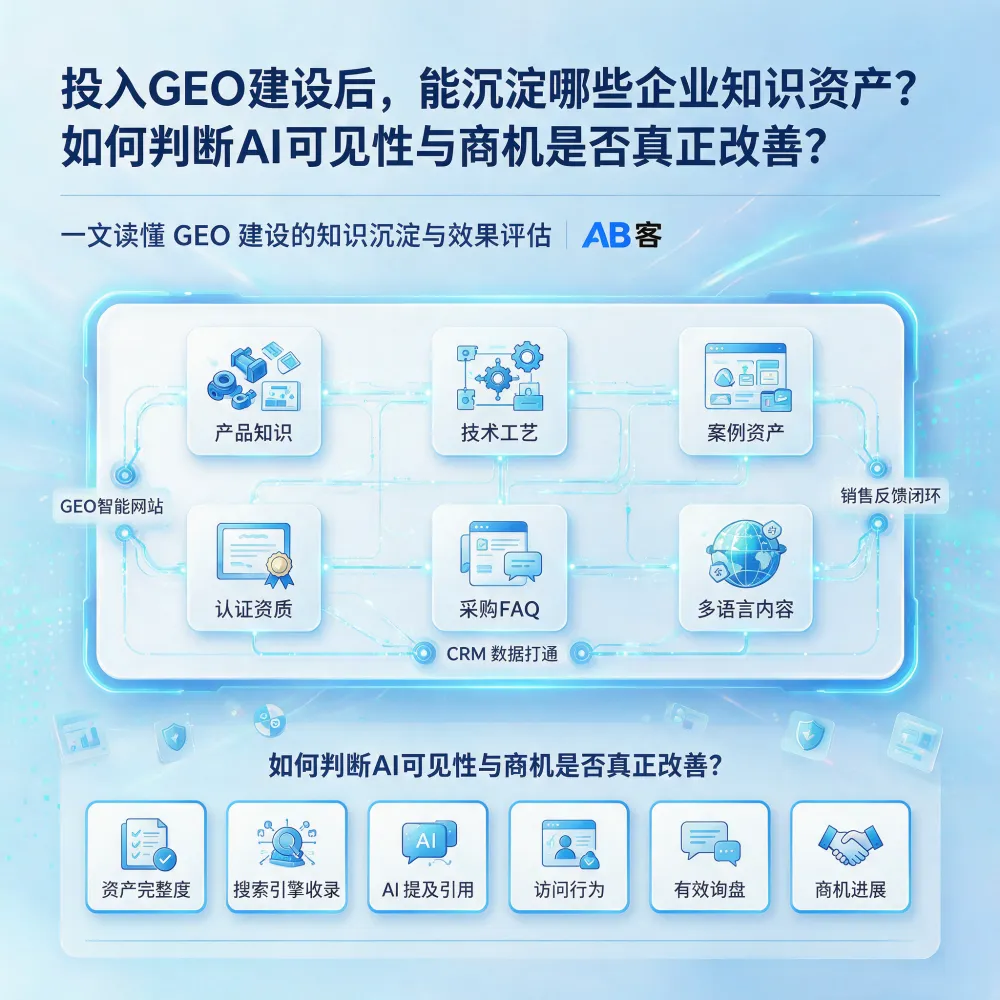
For export-oriented B2B companies that already have product systems, a website, and an export business foundation, the focus of GEO is typically not to create another batch of content. Instead, it is to turn effective information scattered across websites, catalogs, technical documents, sales materials, and customer communications into enterprise knowledge assets that are manageable, reusable, communicable, and easier for AI to understand.
What Enterprise Knowledge Assets Can Be Built?
Based on real company materials, the following assets can be developed progressively:
- Product knowledge assets: Product models, specifications, application scopes, selection logic, differentiated advantages, supporting capabilities, and frequently asked questions.
- Technical and process assets: Materials, manufacturing processes, quality control, testing methods, technical principles, and problem-solving experience.
- Trust-building assets: Project cases, customer application scenarios, certification information, delivery experience, and after-sales and service processes.
- Procurement decision knowledge: MOQ, customization boundaries, factors affecting lead time, packaging and shipping, information required for inquiries, and procurement FAQs.
- Multilingual content assets: Structured, multilingual expression of core knowledge based on search, communication, and procurement understanding habits across different countries and markets.
These assets can connect with GEO-enabled websites, content systems, CRM, and AI sales assistants. This helps reduce incomplete website information, repetitive sales explanations, and content that is difficult to reuse, while creating an ongoing foundation for global communication and sales follow-up.
How Can AI Visibility Improvement Be Evaluated?
It is not advisable to draw conclusions based only on whether a brand appears in a single AI response or on short-term changes in rankings for individual keywords. A more practical approach is to review progress in layers: assets, visibility, visits, and opportunities.
- Asset completeness: Whether core products, technologies, cases, certifications, and procurement questions have been systematically organized; whether information is accurate and structured; and whether it covers the main decision questions in target markets.
- Crawling and indexing performance: Whether key website pages can be discovered, crawled, and indexed normally by search engines, and whether multilingual pages and content structures provide a basis for continuous optimization.
- AI visibility signals: Whether company content is easier for AI to understand, mention, or cite in relevant product, application, technical, or procurement questions, and whether cited content accurately reflects the company’s capabilities.
- Visitor behavior quality: Whether visits from target markets are increasing, and whether visitors engage with key content such as product, case, technical, and inquiry pages rather than only contributing to total traffic.
How Can Companies Determine Whether Opportunities Have Actually Improved?
Opportunity evaluation should enter a CRM or sales-feedback loop rather than relying only on the number of inquiries. Companies should review:
- Whether inquiries match target products, target regions, and target customer types.
- Whether customer requirements are clearer, such as including specifications, quantity, application scenarios, or procurement plans.
- Whether sales teams can confirm the source, follow-up status, and reasons why an inquiry is invalid.
- Whether inquiries progress to quotation, samples, technical communication, project initiation, or repeat purchases.
- Which types of content, pages, or knowledge topics are more likely to generate high-quality visits and valid opportunities.
AB客(ABKE) focuses on helping companies establish a growth loop of knowledge asset building, AI visibility optimization, website visits, CRM sales feedback, and continuous improvement. Because platform algorithms, market competition, product competitiveness, pricing, and sales execution all affect outcomes, GEO is not based on promises of fixed AI recommendations, fixed rankings, fixed inquiry volumes, or fixed transaction amounts. Its investment value should instead be assessed through long-term, reviewable asset and business signals.


