.png?x-oss-process=image/resize,h_100,m_lfit/format,webp)

.png?x-oss-process=image/resize,m_lfit,w_200/format,webp)

Hot Products


.png?x-oss-process=image/resize,h_2000,m_lfit/format,webp)
Popular articles
Recommended Reading



How Are Responsibilities Defined in an ABke GEO Growth Project?
Learn how ABke and your business define responsibilities for GEO project content, approvals, account ownership, lead allocation, and sales follow-up through a clear RACI framework.
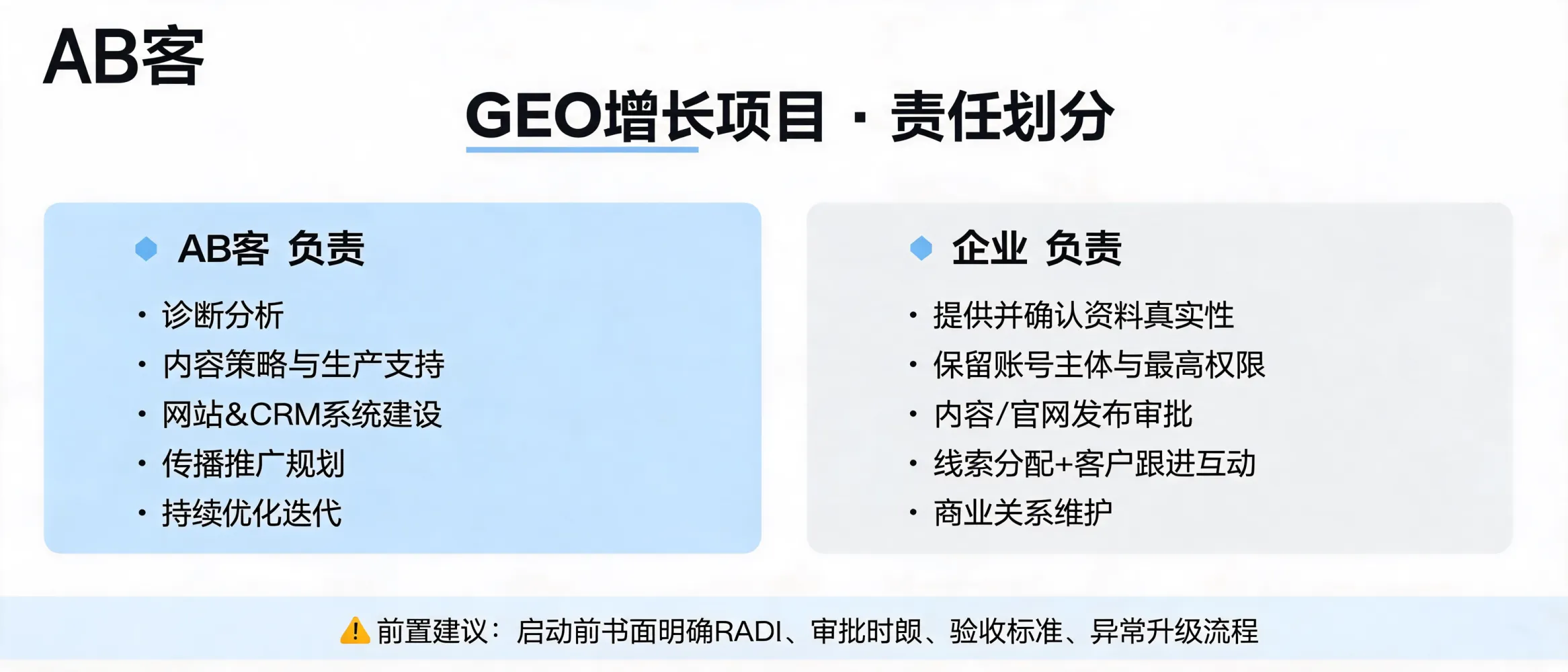
In a GEO growth project, responsibilities should be defined around four core questions: who provides and verifies business facts, who builds the growth capabilities, who owns accounts and customer relationships, and who is responsible for commercial actions. ABke helps export-oriented B2B companies build knowledge assets, content systems, GEO-ready websites, CRM workflows, and ongoing optimization capabilities. It does not replace the company’s responsibility for product facts, brand accounts, or customer relationship management.
Recommended Responsibility Allocation
| Work Item | ABke’s Main Responsibility | Company’s Main Responsibility |
|---|---|---|
| Information Collection and Knowledge Building | Provide interview methods, structuring methods, knowledge architecture, and information checklists; help convert products, cases, and FAQs into structured assets. | Provide accurate, complete, and verifiable product, technical, certification, case, and market information; appoint a business reviewer. |
| Content Strategy and Production | Develop content plans and support production of product pages, solution pages, FAQs, technical articles, and multilingual content. | Review technical specifications, compliance statements, brand messaging, and commercial commitments; confirm that content can be published externally. |
| Website and CRM Development | Build website architecture, GEO and SEO optimization, Schema structured data, conversion paths, and CRM configurations. | Provide domains, brand assets, required system interfaces, and authorizations; confirm launch content and functional acceptance. |
| Website Publishing and Brand Communication | Provide publishing plans, content support, channel recommendations, and optimization recommendations. | Retain entity ownership and highest-level permissions for the website, social media, and B2B platform accounts; complete publishing approvals, account updates, and customer interactions. |
| Lead Handling and Sales Follow-up | Support the configuration of forms, CRM workflows, reminders, customer profiles, and sales-assistance tools; analyze lead sources and conversion data. | Define lead allocation rules; arrange sales follow-up, quotations, negotiations, and customer relationship maintenance; provide timely feedback on opportunity outcomes. |
| Data Review and Continuous Optimization | Propose and help implement optimization plans based on AI visibility, website behavior, content performance, and opportunity feedback. | Provide accurate sales feedback, market changes, and product updates; participate in strategy confirmation and prioritization decisions. |
Core Principles for Account Ownership, Data, and Customer Relationships
The company should always retain entity ownership and highest administrative permissions for its website, domain, Google, LinkedIn, YouTube, CRM, and other business accounts. ABke may receive role-based operational permissions as required for development, configuration, maintenance, or analysis, but should not hold ownership of core business accounts on behalf of the company.
Company knowledge, website content, data, and project assets should be owned by the company or remain continuously available to the company according to the agreement between both parties. Customer inquiries, quotations, orders, communication records, and commercial relationships are managed and maintained by the company. This protects digital assets and reduces handover risks if the cooperation arrangement changes.
Written Collaboration Mechanisms Before Launch
During the project kickoff meeting or in a contract appendix, both parties should establish a documented RACI responsibility matrix. It should clearly identify:
- R — Responsible: Who completes information collection, content production, system configuration, and publishing tasks.
- A — Accountable: Who has approval authority and final decision-making responsibility.
- C — Consulted: Which technical, sales, and brand stakeholders must participate in confirmation.
- I — Informed: Which management stakeholders need progress, risk, and result updates.
The parties should also agree on content approval deadlines, information-supplement deadlines, launch acceptance criteria, version and change procedures, account permission request and revocation processes, and escalation paths for exceptions. For example, content involving product performance, certifications, delivery time, pricing, or customer cases should be published only after written confirmation from the company’s designated responsible person. Items that exceed agreed approval deadlines should be reminded, paused, or escalated according to the predefined process.
Clear responsibility boundaries do not reduce collaboration efficiency. They allow ABke to focus on GEO growth capability building while enabling the company to retain control of factual confirmation, brand ownership, and sales conversion. The result is a sustainable and traceable project collaboration mechanism.


.png?x-oss-process=image/resize,h_100,m_lfit/format,webp)
.png?x-oss-process=image/resize,h_100,m_lfit/format,webp)

.png?x-oss-process=image/resize,h_100,m_lfit/format,webp)
.png?x-oss-process=image/resize,h_100,m_lfit/format,webp)
.png?x-oss-process=image/resize,h_100,m_lfit/format,webp)
.png?x-oss-process=image/resize,h_100,m_lfit/format,webp)
