.png?x-oss-process=image/resize,h_100,m_lfit/format,webp)

.png?x-oss-process=image/resize,m_lfit,w_200/format,webp)

Hot Products

.png?x-oss-process=image/resize,h_2000,m_lfit/format,webp)

.png?x-oss-process=image/resize,h_2000,m_lfit/format,webp)

Popular articles
Recommended Reading


How GEO Differs from Traditional SEO and AI Content for Export B2B Manufacturers
Compare GEO, traditional SEO, and AI-generated content for export B2B manufacturers. AB客(ABKE) explains how knowledge assets support long-term AI visibility and global lead generation.
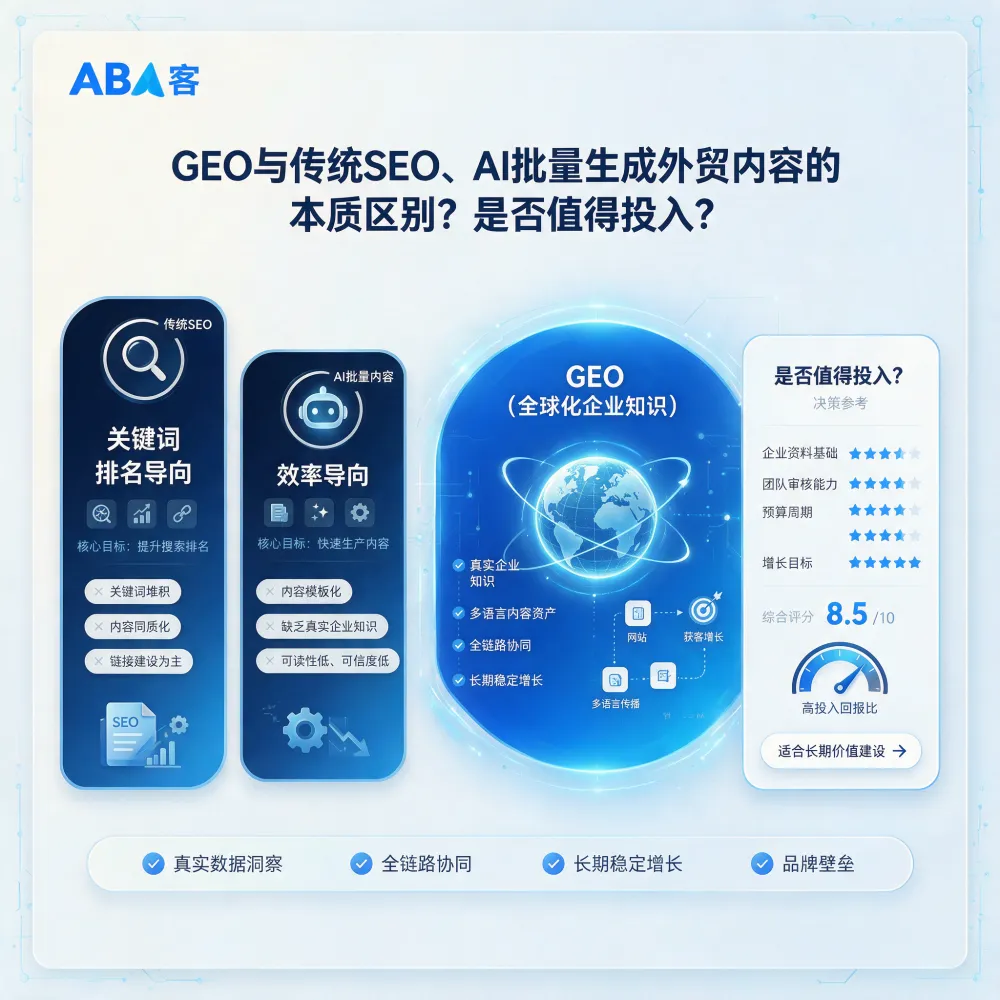
For export B2B manufacturers, GEO, traditional SEO, and AI-generated content are not simple substitutes. They address different levels of growth. Whether long-term investment is worthwhile depends less on whether a company can publish more articles and more on whether it can continuously turn verified information from products, processes, certifications, application cases, and sales experience into growth assets that customers and AI systems can understand, reference, and validate.
Core Differences
| Dimension | Traditional SEO | AI Batch Content Generation | GEO Growth Development |
|---|---|---|---|
| Primary goal | Improve page discoverability in traditional search | Increase content production speed and coverage | Improve enterprise understandability, credibility, and conversion coordination across AI search, search engines, and global information environments |
| Core foundation | Keywords, page structure, backlinks, and technical optimization | Prompts, templates, and batch-generation capability | Verified enterprise knowledge, structured expression, content systems, and website and sales-data coordination |
| Content focus | Match pages to search demand | Rapidly create articles, product copy, or social content | Answer buyer decision questions: what the product can do, why it is credible, which operating conditions it suits, and how delivery and service work |
| Common limitations | May focus heavily on ranking metrics and fail to cover complex B2B decision information | Without verified source materials, content can become generic, repetitive, or factually inaccurate | Requires enterprises to provide materials, participate in review, and build continuously in phases |
| Asset accumulation | Website and page optimization assets | Reusable content drafts | Enterprise knowledge bases, multilingual content, GEO websites, customer leads, and sales coordination capability |
Traditional SEO remains valuable, especially for capturing clear product, model, and application searches. However, manufacturing export purchasing decisions often have long cycles and multiple participants. Buyers may ask about materials, processes, standards, customization capability, delivery time, cases, after-sales support, and supply stability—not only product names. Keyword-focused pages alone often cannot establish trust comprehensively.
AI batch content generation can reduce production costs, but it is not a growth strategy by itself. Without accurate product parameters, process boundaries, application conditions, project cases, and compliance information, large volumes of content may appear extensive while failing to demonstrate real capability. This can also create additional review, correction, and brand-risk concerns.
The Value of GEO for Export Manufacturers
GEO places enterprise knowledge assets at the foundation. It turns what a factory genuinely knows, has delivered, is suitable for, and does differently from peers into clearly structured, multilingual, and digitally accessible content and systems that AI can retrieve and understand.
For example, an equipment manufacturer should not only describe itself as a “high-quality equipment supplier.” It should progressively establish:
- Product models, configuration ranges, capacity ranges, and suitable raw materials;
- Process flows, key components, quality control, and maintenance requirements;
- Application scenarios and project experience across industries or customer markets;
- Customization boundaries, certification status, delivery processes, and after-sales support;
- Question-and-answer paths and content for different roles, including buyers, technical personnel, and distributors.
Once structured, this information can support website content, multilingual communication, AI search understanding, sales responses, and CRM lead follow-up. It is not consumed in a single batch of articles. AB客(ABKE) frames GEO growth development around enterprise knowledge assets, AI content growth, GEO intelligent websites, global brand communication, and CRM and AI sales coordination—gradually building reusable growth infrastructure for export B2B enterprises.
How to Assess Long-Term Budget Fit
1. Availability of Verified Materials
If an enterprise already has product catalogs, technical parameters, test records, process documents, customer cases, trade-show materials, sales Q&A, or engineering experience, it usually has a foundation for development—even when the materials are scattered. GEO does not require information to be perfect from the start; it focuses on organizing it progressively into a manageable knowledge system.
If product direction is still unclear or basic verified materials cannot be provided, foundational conditions should be assessed first rather than immediately pursuing large-scale content publishing.
2. Internal Review and Collaboration Capacity
Manufacturing content often involves technical parameters, application boundaries, certifications, and delivery commitments. Enterprises need product, engineering, export-sales, or marketing personnel to confirm key information. AI can assist with organization and production, but it cannot replace enterprise review of factual accuracy, commercial boundaries, or customer commitments.
3. Budget for a Continuous Development Cycle
GEO is better suited to phased investment: first complete enterprise diagnosis and knowledge asset organization; then develop core content and website expression; and subsequently optimize through multilingual communication, data feedback, and sales coordination. It is not suited to using “fixed short-term rankings,” “a fixed number of inquiries,” or “immediate deal value” as the sole basis for budget decisions.
4. Long-Term Global Market Growth Goals
If an enterprise aims to reduce dependence on a single platform, trade show, or manual prospecting channel; progressively build its own brand information presence; improve overseas buyers’ understanding and trust; and enable sales teams to reuse content assets continuously, GEO generally has stronger long-term fit.
A Practical Decision Framework
Before making a budget decision, enterprises can clarify the following questions:
- Which product lines, country markets, and customer types will be the priority over the next 12–24 months?
- What technical, capacity, quality-control, case, or service advantages are most persuasive?
- Which parts of the current English website, product materials, and content are incomplete, inconsistent, or missing a customer perspective?
- Is there someone who can continuously confirm technical facts, review external messaging, and support lead follow-up?
- Does the enterprise want a short-term traffic action or digital assets that can accumulate over time?
For export manufacturers with a solid materials foundation, clear technical or application advantages, and willingness to participate continuously in content review and sales coordination, GEO is generally worth considering as part of a long-term growth budget. It does not promise fixed AI recommendations, fixed Google rankings, a fixed number of inquiries, or fixed revenue results. Actual outcomes are also affected by market competition, product competitiveness, pricing strategy, website foundations, and sales execution.
A more reasonable expectation is to build continuously so that the enterprise can be discovered more easily, understood more accurately, and supported by more complete and credible digital evidence when global customers enter comparison and decision stages.


