




How to Verify and Qualify Overseas Prospects Using Import Records
ABKE explains how to verify purchasing entities, core business and product applications using import records and company sources—without assuming current demand.
Historical Import Records Are Research Leads, Not Proof of Current Intent
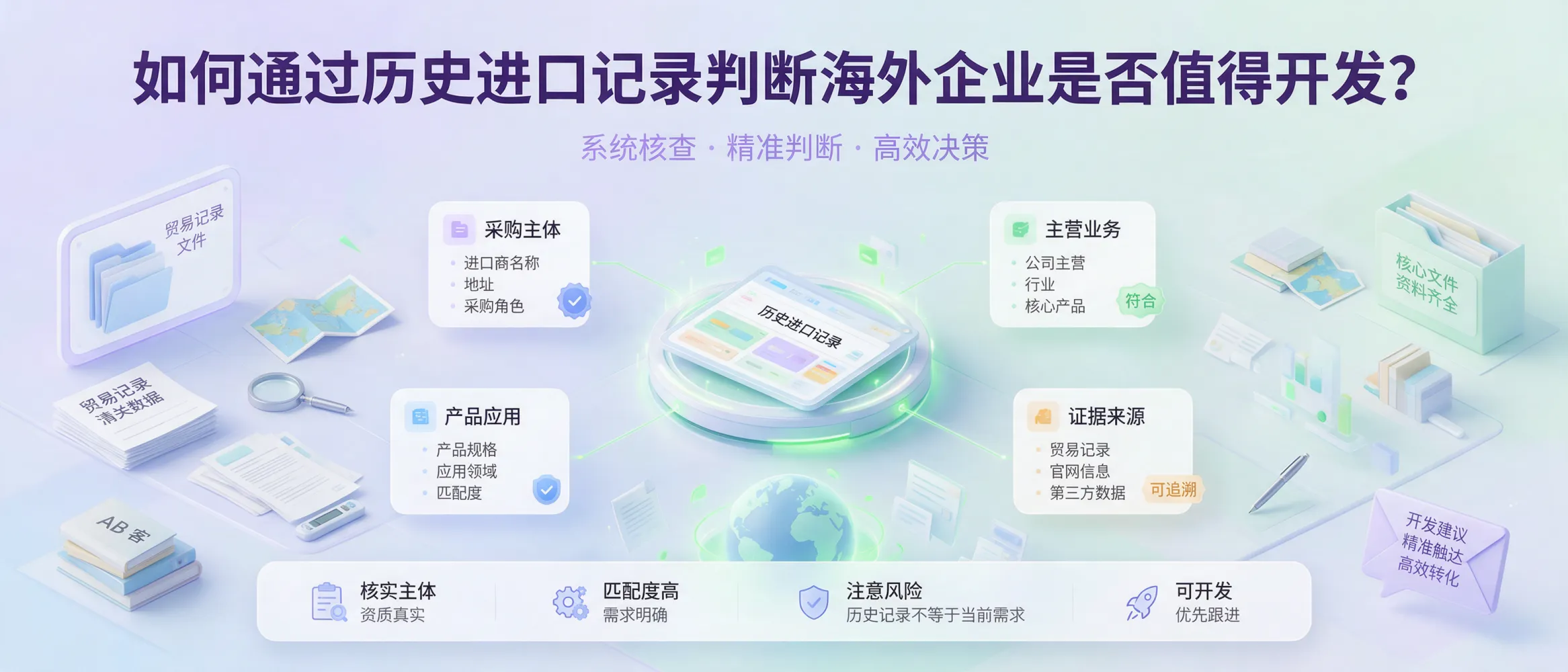
An overseas company that has imported a related product has demonstrated relevant trade activity, but this alone does not confirm a current purchasing need. To determine whether the company is worth developing, verify three points in sequence: whether it is the right target company, what purchasing role it plays, and whether its business and product applications match your offering.
1. Establish Your Product-Matching Criteria First
Define the product name and commonly used industry terms, key specifications, materials, intended uses, compatible equipment or processes, and target customer type. Your target may be an end manufacturer, importer, distributor, or another type of buyer.
Without clear matching criteria, a similar product name may lead to the wrong prospect. The initial qualification standard should therefore reflect both technical requirements and the customer’s position in the supply chain.
2. Verify the Purchasing Entity and Its Trade Role
Cross-check the company name and address shown in trade records against its official website and other legally available company information. Pay particular attention to the following points:
- Entity consistency: Check for abbreviations, companies with the same name, former company names, and possible confusion between a parent company and a subsidiary.
- Trade role: Determine whether the listed entity is the actual importer, a trading agent, a freight forwarder, or another participant. The appearance of a company name in a record does not by itself prove that the company manages purchasing.
- Purchasing ownership: Check whether the importing entity, the factory that uses the product, and the purchasing decision-maker are the same organization. If this cannot be confirmed, mark the record for further verification.
3. Check the Core Business and Customer Type
Review the company’s official introduction, product catalogue, industry solutions, and publicly available project information. Confirm what the company primarily manufactures, sells, or uses, and which industries it serves.
Operating in the same broad industry does not necessarily mean that a company will purchase your product. You should also determine its position in the industry value chain and whether its business model and cooperation approach are suitable for your offer.
4. Match Specifications and Applications, Not Only Product Names or HS Codes
Use available trade descriptions, specification details, and company information to compare the product’s materials, dimensions, performance requirements, processing requirements, and application scenarios.
HS codes are useful for initial screening, but they cannot independently prove that a product is interchangeable or technically suitable.
Also review the date of the records, whether similar imports occurred repeatedly, and how closely the imported product is connected to the company’s business. These signals may support research, but they should not be used to infer a current purchasing plan.
5. Decide the Next Action Based on Evidence Quality
Classify each prospect according to the completeness and reliability of the available evidence:
- Prioritize for development: The entity is clearly identified, its business is relevant, the application is a match, and the conclusion is supported by traceable evidence. The sales team can begin targeted outreach.
- Verify before developing: The entity or specifications are unclear, information is missing, or sources conflict. Conduct additional research or contact the company for confirmation before investing more resources.
- Lower the priority: The company’s role, core business, or application requirements have been confirmed as incompatible. Reduce investment in further outreach.
Maintain an Evidence-Based Qualification Record
For every company, record the following information:
- Qualification conclusion
- Evidence sources
- Date of the available information
- Items requiring verification
- Next action
ABKE can support prospect research and AI-assisted matching by combining legally available customs data, customer background research, and structured qualification. However, a matching score does not represent purchasing intent. The sales team still needs to confirm the prospect’s current demand, supplier onboarding requirements, and purchasing timeline.


