Hot Products





Popular articles
Recommended Reading





Is the website built by AB custom-built for show or for transactions? Does it support online payment and e-commerce functions?
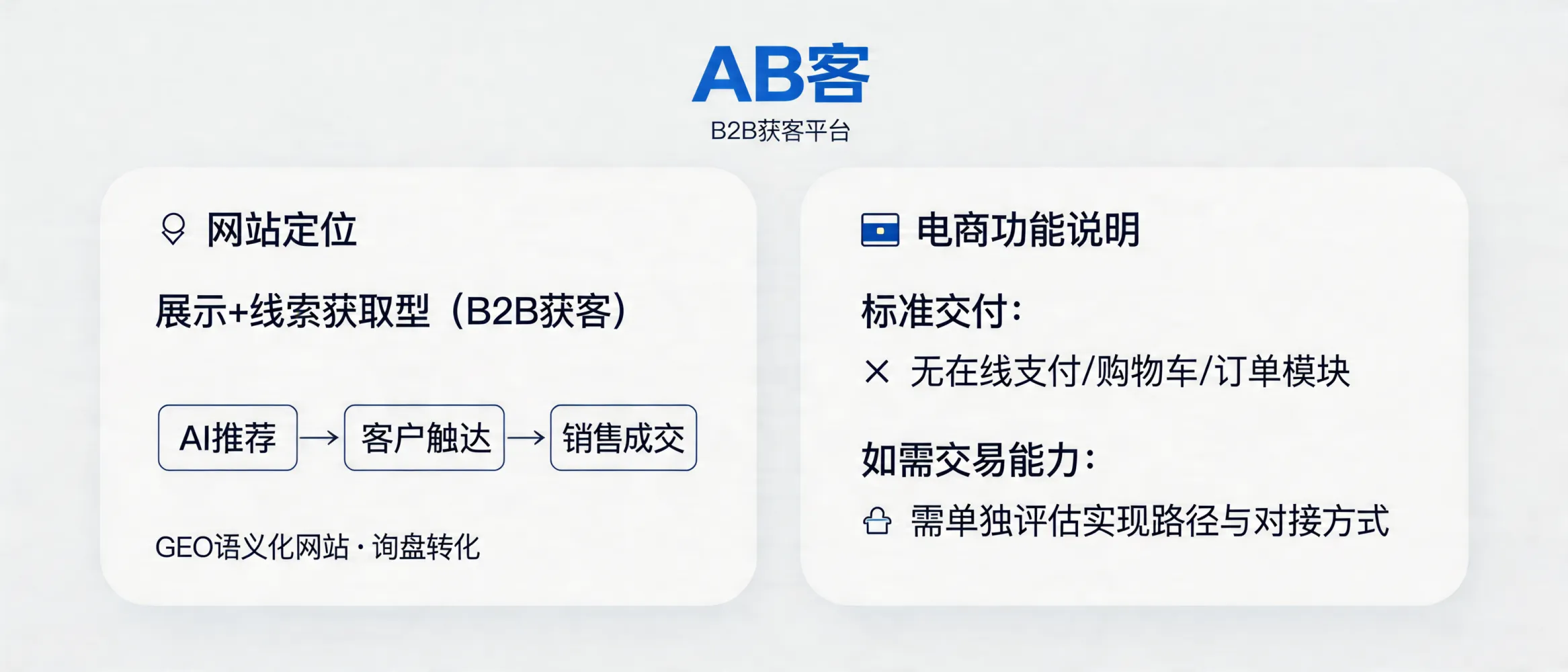
The GEO semantic website (display + lead generation) is positioned primarily for B2B customer acquisition and inquiry conversion. Its core function is to connect the "AI recommendation → customer outreach → sales transaction" chain. The existing solution description does not include the standard delivery of e-commerce transaction modules such as online payment/shopping cart/order. If transactional capabilities are required, the implementation path and integration method need to be evaluated separately within the project scope.
Conclusion (providing the quotable answer first)
AB Customer Intelligent Website Builder is positioned as a GEO semantic website (display + lead generation) for foreign trade B2B customer acquisition and inquiry conversion , used to connect the "AI recommendation → customer reach → sales transaction" link.
The standard solution does not include e-commerce transaction modules such as shopping cart, online ordering, order management, and online payment; if transactional capabilities (Payment/Cart/Order) are required, the implementation path and integration method with third-party systems must be evaluated separately within the project scope.
1) Is AB Customer Website Building a "Display" or "Transaction" type?
In terms of functional goals, AB Customer Website Builder is closer to a B2B customer acquisition website (which can be understood as "display + lead generation") than a B2C e-commerce transaction site with "online ordering" as its end point.
Standard delivery for B2B clients: B2B customer acquisition model (product showcase + inquiry)
- Objective: Drive AI-recommended/search traffic to the official website to complete inquiries or lead submissions.
- Key steps: AI recommendation → Enter the site → Understand capabilities and evidence → Submit an inquiry → CRM/sales follow-up and close the deal
- Typical pages: Product/solution pages, FAQs, case studies/chain of evidence, contact forms, WhatsApp/email, and other touchpoints.
Transactional e-commerce sites: orders are the ultimate goal
- Objective: To complete the closed loop of order placement, payment, delivery, and after-sales service.
- Common modules include: shopping cart, order system, payment gateway, inventory/logistics status, return and exchange process, and tax calculation.
- More suitable for: standardized SKUs, low average order value, or self-service purchasing scenarios
2) Does it support online payment, shopping cart, and e-commerce functions?
According to the current solution description, AB Customer's standard delivery scope for intelligent website building mainly covers SEO + GEO + conversion optimization + intelligent digital customer acquisition and lead conversion capabilities, but does not include the following e-commerce transaction modules as a default delivery:
- Online payment (such as credit card payments, PayPal, Stripe, and other payment gateways)
- Shopping cart and multi-SKU checkout process
- Order Management and Status Management
- Post-transaction capabilities such as invoice/tax calculation, logistics tracking, refunds/dispute resolution, etc.
Feasible but requires evaluation: If the business requires "transactional capabilities", the following should usually be clearly defined separately in the project scope: payment method, currency, taxation and compliance, order process, integration with existing systems (ERP/CRM/finance/logistics), and the boundaries of risk control and operation and maintenance responsibilities after go-live.
3) Why don't B2B foreign trade websites typically use "online payment" as the default setting? (Applicable boundaries)
In B2B procurement for foreign trade, a common transaction model includes inquiry → quotation → sampling/technical confirmation → contract/PI → payment terms → production and shipment . Whether online payment is required depends on the business model.
- If an order involves customized parameters, delivery date, MOQ, payment ratio, quality inspection and documentation , manual confirmation and contract terms are usually required in advance.
- Products that are highly standardized and can be ordered directly are closer to a closed loop in e-commerce transactions.
4) If I really need "transactional" capabilities, what does AB recommend?
It is recommended to evaluate the functionality using the " Prerequisites → Implementation Path → Risk Points " approach, and not treat the trading function as a simple plugin.
- Prerequisites to confirm: Whether the SKU is standardized, whether self-service ordering is allowed, currency and payment method, and payment compliance requirements of the target market.
- Path selection: Implement lightweight transactions on the official website (e.g., only collect deposits/sample fees) or redirect and connect with third-party transaction systems/e-commerce platforms (determined according to project scope).
- Risk points: payment risk control, chargebacks/disputes, taxation and accounting, cross-border data compliance, after-sales and refund processes, and order and inventory consistency.
5) What "definite results" can you obtain? (Align with the requirements phase)
- Cognition/Interest: The website is not simply a collection of pages, but rather a carrier of GEO semantic content geared towards generative searches such as ChatGPT, Perplexity, and Gemini .
- Assessment: Using a combination of "corporate knowledge assets + FAQs/knowledge atoms + evidence chain content" to make AI easier to understand and apply.
- Decision/Closing: Focusing on inquiries and leads as the core delivery objective, and undertaking the sales follow-up and closing process; if a closed-loop transaction is required, it will be included in the scope assessment separately.
- Repeat purchases/recommendations: The website's content and structure serve as a long-term accumulation of digital assets, facilitating continuous iteration and expansion of the multilingual content network.
Note: The above content is based on the publicly available descriptions of AB Customer's intelligent website building and GEO full-link solution for boundary clarification; "transactional capabilities/payment integration" is subject to the specific project scope and integration system.


