Hot Products





Popular articles
Recommended Reading





How Do LinkedIn, YouTube, Industry Platforms, and Third-Party Directories Differ in Value?
Learn how ABKE distinguishes LinkedIn, YouTube, industry platforms, and third-party directories in global content distribution for B2B SEO, brand consistency, and multi-source validation.
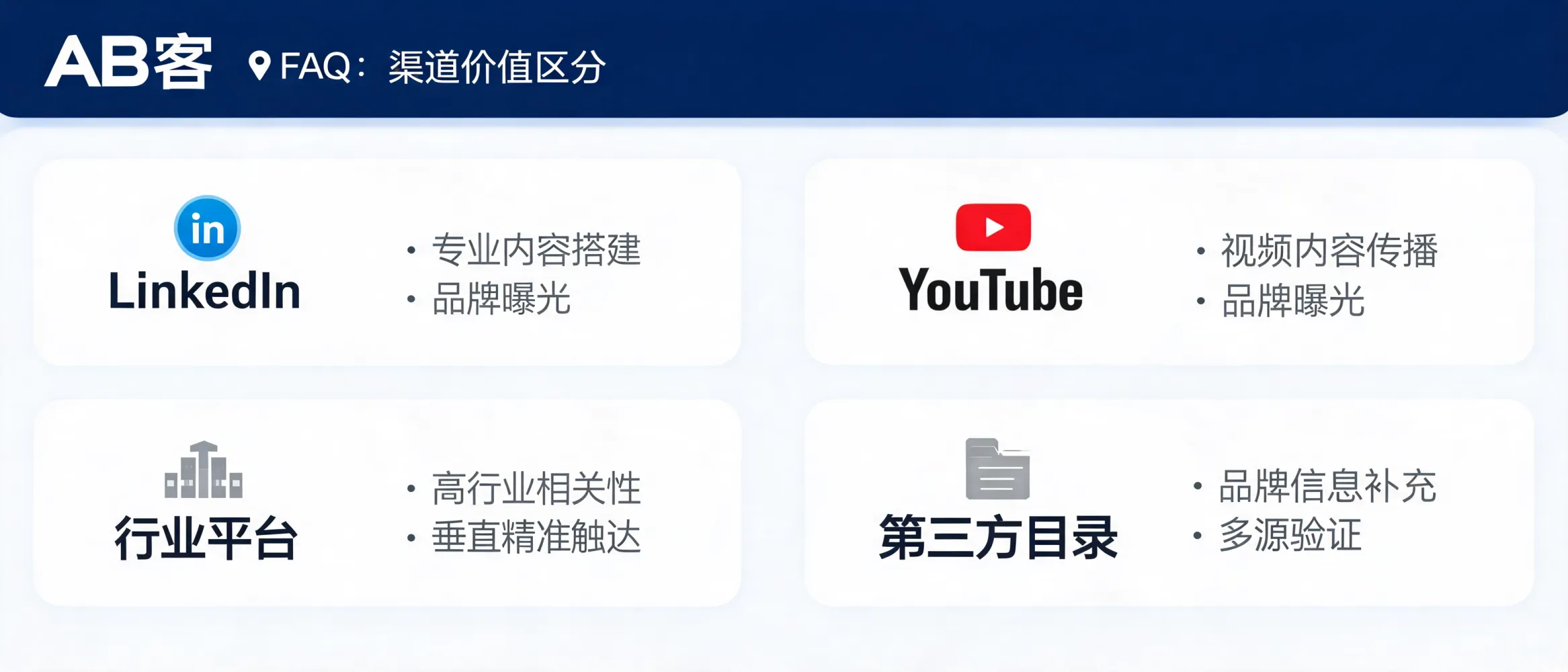
LinkedIn, YouTube, industry platforms, and third-party directories: how do you differentiate their value?
In ABKE’s global content distribution system, different channels are not used in the same way. Each one plays a distinct role in growth. When channel roles are clear, content distribution becomes more effective, and AI and search systems can build a more stable understanding of your company.
ABKE usually evaluates channel value from three dimensions: content expression, industry relevance, and brand validation.
1) LinkedIn: best for professional image and business exposure
LinkedIn has a strong professional context and a clear B2B use case. It is well suited for sharing company insights, product capabilities, case results, and industry observations. For B2B exporters, it works like a professional business card and a trust entry point.
Typical content includes:
- Company introduction and strength overview
- Industry viewpoints and trend analysis
- Product application scenarios
- Customer case breakdowns
- Trade show, team, and delivery updates
Its main value is not necessarily immediate lead volume. Instead, it helps your brand build professionalism, activity, and presence in front of overseas buyers, procurement managers, channel partners, and industry professionals.
2) YouTube: best for improving understanding and persuasion
YouTube is strong in video communication, making it easier to explain products, processes, applications, and results that may be difficult to express in text alone. For manufacturing, machinery, components, and solution-based businesses, video often builds understanding and trust faster than written content.
Typical content includes:
- Factory tours
- Product demonstrations
- Process explanations
- Application case videos
- FAQ videos
- Comparison tests and usage guides
Its core value is that it lets customers see your capabilities more directly, while also making it easier for AI to understand your business through richer, multi-format content.
3) Industry platforms: best for strengthening industry relevance
Industry platforms usually gather target buyers, upstream and downstream companies, or relevant procurement audiences. That makes them useful for building industry-specific language and scenario coverage. Compared with general social platforms, they answer a different question: whether your company truly belongs to the industry and solves its problems.
Typical content includes:
- Industry solutions
- Product category information
- Buying guides
- Technical explanations
- Scenario-based content
- Industry keyword optimization
Their main value is to strengthen relevance signals within a specific industry, which helps search engines and AI systems identify your company as a genuine and knowledgeable player in the field.
4) Third-party directories: best for entity information and multi-source validation
The role of third-party directories is often underestimated, but they matter a lot in GEO. AI and search systems do not rely on your website alone; they also look for consistent information across multiple sources. Business directories, company listings, industry yellow pages, and database platforms help strengthen your brand’s entity presence.
Typical information includes:
- Company name, address, website, and contact details
- Main products and business scope
- Brand introduction
- Certification and qualification details
- Key contact information
- Consistent basic company profile data
Its value is not content depth. Its value is to provide verifiable, citable, and cross-checkable brand signals.
How ABKE approaches channel layering
ABKE does not distribute all content evenly across every channel. Instead, we select channels according to the business objective:
- To build professional influence: prioritize LinkedIn and YouTube
- To strengthen industry fit: prioritize industry platforms
- To reinforce brand entity validation: prioritize third-party directories
- To improve overall AI recognition: use all four channel types together
What is the real difference?
Each channel contributes a different type of signal:
- LinkedIn and YouTube transmit professional signals
- Industry platforms transmit relevance signals
- Third-party directories transmit validation signals
When these signals appear together and remain consistent, your company becomes easier for AI search systems, traditional search engines, and overseas buyers to trust and understand. This is the core logic behind ABKE’s global content distribution system: not just publishing content, but building a multi-source, consistent information network that helps your brand get discovered, understood, and recommended.


