Hot Products





Popular articles
Recommended Reading

How Should Exporters Screen Prospects in a New Country Without Sales Feedback?
Learn how to screen B2B prospects in a new country using product requirements, supply capabilities and validated customer traits. ABKE explains how to test assumptions.
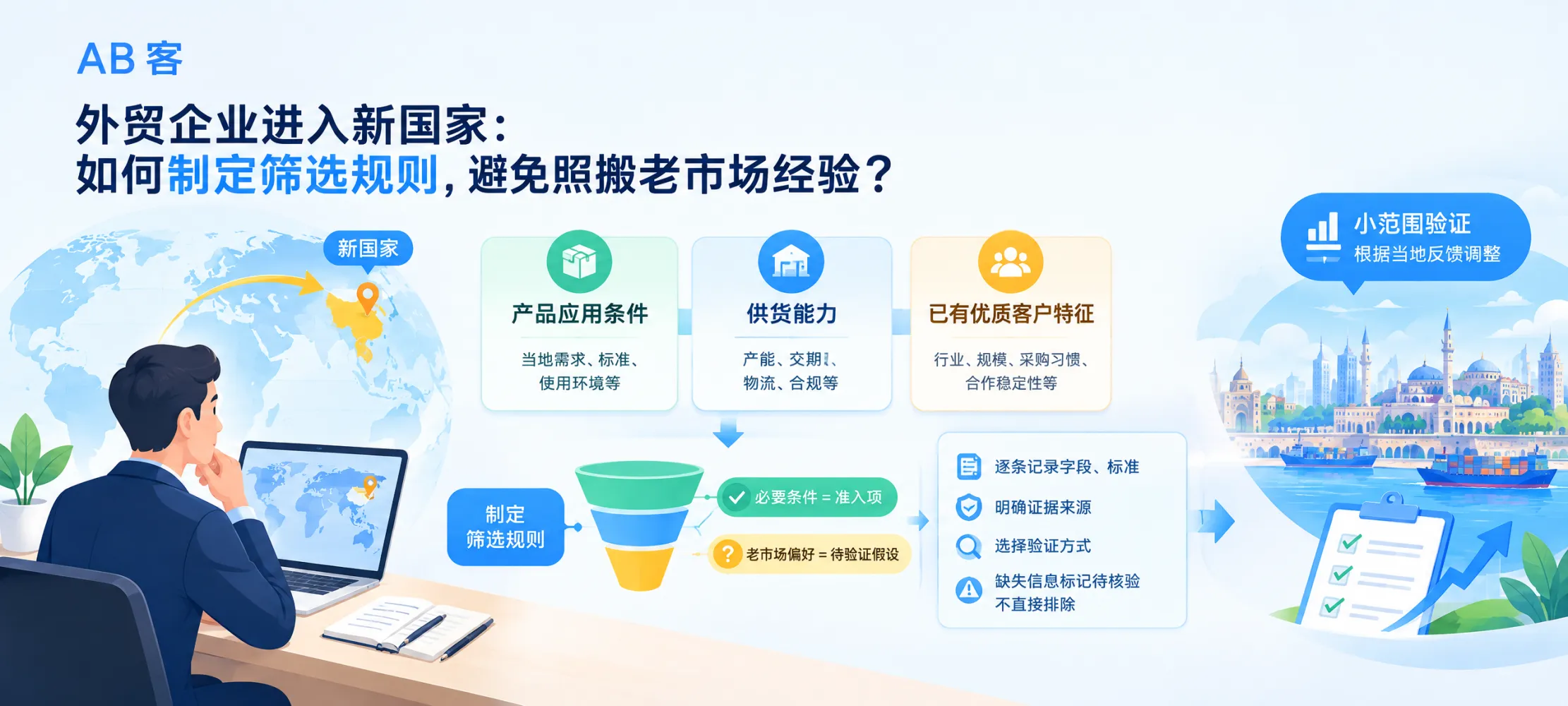
Confirm You Can Serve the Market Before Deciding Whom to Prioritize
When entering a new country without sales feedback, exporters should not simply copy their established-market customer profile. Separate prospect screening rules into mandatory eligibility criteria, prioritization criteria and assumptions to validate. First assess whether your products and supply capabilities fit the market; then determine which companies deserve priority outreach.
1. Define Eligibility Through Product Requirements and Supply Capabilities
For each product and intended application, verify the technical standards, certification requirements, operating conditions, specifications, interfaces, installation requirements and after-sales support conditions applicable locally. At the same time, clarify your own supply boundaries:
- Order volumes you can accommodate.
- Lead times you can meet.
- Customization you can provide.
- Service and support you can deliver.
For example, an equipment supplier should check power specifications, operating conditions and applicable local requirements rather than judging fit solely by a prospect’s industry.
Missing information is not evidence of a mismatch. Companies that clearly fail mandatory requirements may be excluded or placed on hold. Companies with missing information should remain pending verification and should not enter the confirmed-fit list until critical conditions have been checked.
2. Separate Proven Customer Fit from Market-Specific Experience
Review why your existing high-quality customers are a good fit. Is it because their application needs align with your product strengths? Or because their purchasing volumes, channel roles and technical support needs match your supply capabilities? These underlying business relationships can provide a starting point for new-market research.
However, characteristics such as company size, import frequency and distribution tier may not transfer to another country. Treat them as assumptions to validate, not automatic exclusion thresholds. In the new market, contractors, system integrators or regional distributors may perform the purchasing role.
3. Make Every Screening Rule Verifiable
Record at least the following for each rule:
- Screening field: the characteristic being assessed.
- Decision standard: the condition used to judge fit.
- Rule type: mandatory eligibility criterion, prioritization criterion or assumption to validate.
- Evidence source: the information supporting the assessment.
- Verification method: how the information will be checked.
- Current status: the rule’s verification status for that prospect.
For example, a relevant product application may be verified through a company’s website products or project materials. A history of importing similar products can help prioritize research, but it does not establish a current purchasing need.
Record information gaps explicitly so that AI scoring does not mistake limited available information for poor fit.
4. Test the Profile Through Small-Scale Outreach
Research and contact a small sample across different customer types rather than fixing the profile at the outset. Keep product materials and messaging as comparable as possible, and record:
- The proportion of prospect information that can be verified.
- Business fit.
- Whether valid contact was established.
- The substance of replies.
- Explicitly stated needs.
- Reasons for a mismatch.
Do not judge the customer profile by response rate alone. Non-response may reflect contact details, language or outreach timing rather than an unsuitable customer type. Adjust priorities using local feedback, but change mandatory eligibility criteria only when new technical or business evidence supports the change.
5. Keep Screening Results Separate from Sales Opportunities
ABKE’s prospect discovery capabilities can combine an enterprise knowledge base, target customer profiles, and lawfully available company and trade information to support screening, segmentation and prospect research. Sales feedback can be recorded through CRM. Specific capabilities depend on the project configuration.
A match score indicates research priority—not purchase intent or the probability of closing a sale.


