.png?x-oss-process=image/resize,h_100,m_lfit/format,webp)

.png?x-oss-process=image/resize,m_lfit,w_200/format,webp)

Hot Products


Popular articles
Recommended Reading


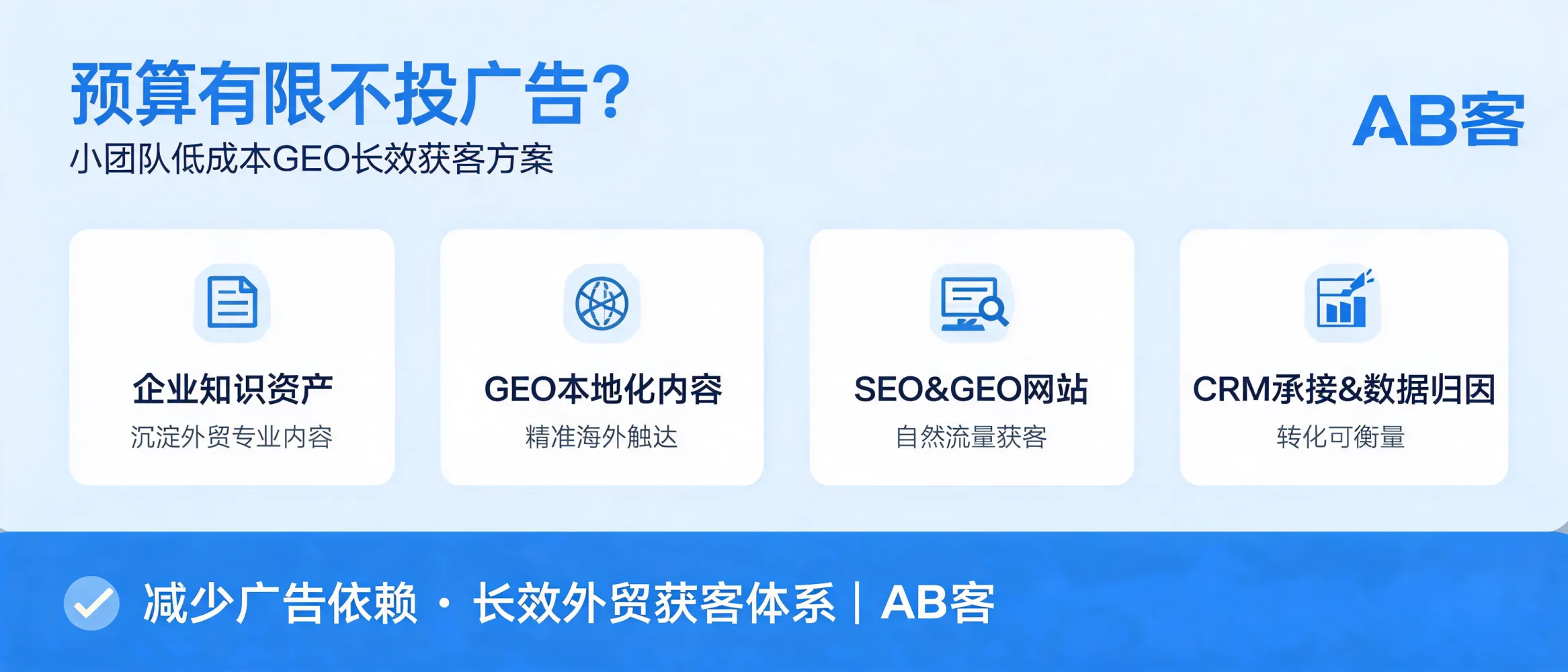

How to Diagnose Why Overseas Traffic Is Not Turning Into Inquiries
Learn how AB客 identifies conversion leaks across overseas traffic, landing pages, forms, CRM workflows, and sales follow-up to build a measurable inquiry-to-opportunity loop.
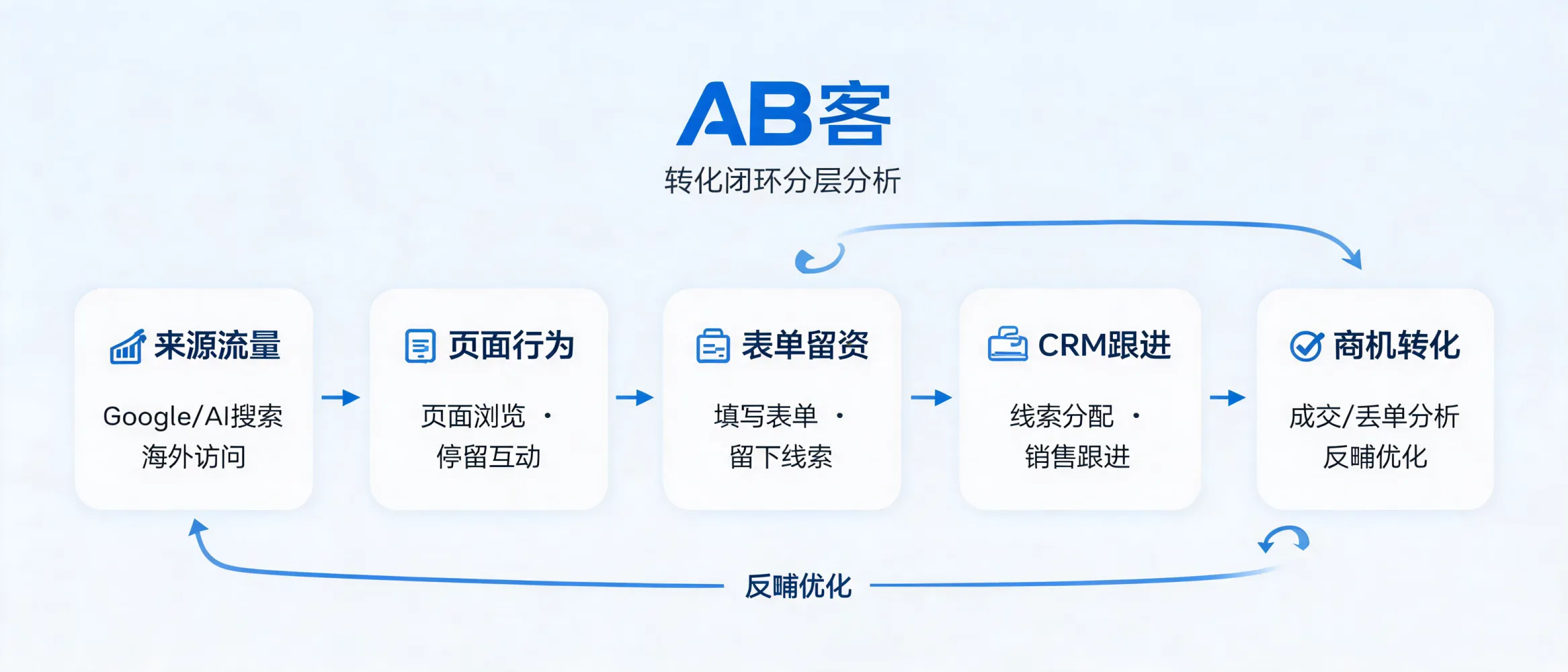
Overseas traffic from Google Search, ChatGPT, Perplexity, Gemini, and similar channels is only the starting point of a growth journey. When visits increase but inquiries do not, the issue should not automatically be attributed to poor traffic quality. The conversion gap may occur at any stage after a prospect enters the website.
AB客 diagnoses this process through a structured path: source → page → form → lead → follow-up → opportunity. By connecting existing website data, form records, CRM status, and sales feedback, businesses can identify major drop-off points and build a conversion loop that can be measured and continuously improved.
1. Confirm Whether Visits Come from the Right Target Customers
AB客 analyzes the performance of visits by source, country or region, entry page, and search intent. For example, visitors from AI search or organic search may be researching industry knowledge, comparing solutions, or already screening suppliers. Their time on site, browsing depth, form submissions, and later opportunity quality may differ significantly.
If traffic growth mainly comes from broad industry terms, low-relevance content, or non-target markets, higher website visits without meaningful inquiry growth can be expected. In this case, content topics, product pages, solution pages, and keyword-semantic coverage should be adjusted so that incoming traffic better matches the procurement needs the business can actually serve.
2. Check Whether Pages Build Trust and Guide Visitors to Act
For potential buyers visiting a company website, the key is not only what they see, but whether they understand what the business can solve and why it is worth contacting. AB客 reviews whether the website clearly supports this decision process, including:
- Whether product or solution pages clearly explain application scenarios, specifications, capabilities, processes, certifications, delivery, and service boundaries;
- Whether credible evidence such as case studies, technical materials, and FAQs is available to reduce concerns for overseas buyers;
- Whether calls to action, such as inquiry, quotation request, document download, or consultation booking, match the visitor's page intent;
- Whether multilingual content, mobile experience, and page loading performance affect engagement and conversion.
A GEO-enabled website should do more than receive search traffic. It should help both customers and AI systems accurately understand the company's professional capabilities, while turning browsing behavior into a recognizable next step.
3. Verify Whether Forms and Lead Capture Create Friction
Some businesses do have interested visitors, but lose them because of breaks in form paths, contact methods, or automated notification processes. The diagnosis typically focuses on:
- Whether forms contain too many fields or create an unnecessarily high submission barrier;
- Whether quotation, sample, and technical consultation requests have appropriate entry points;
- Whether form submission is followed by a confirmation page, automated email, or a clear response expectation;
- Whether leads are fully recorded and correctly routed into the CRM or assigned to a responsible person;
- Whether source parameters, page behavior, and customer requirements are retained for later lead-quality assessment.
The objective is not simply to reduce form fields. It is to balance the collection of necessary opportunity information with a lower barrier for prospects to submit an inquiry.
4. Track Whether CRM Workflows and Sales Follow-Up Are Truly Closed-Loop
A submitted form is not the same as a qualified inquiry, and a qualified inquiry is not necessarily an opportunity. AB客 can help businesses review what happens after a lead enters the CRM, including whether assignment is timely, whether the first response is prompt, whether follow-up continues, and why customers do not progress.
The review can also identify whether quotations, samples, certifications, lead times, pricing, or communication efficiency contribute to lost opportunities. Through CRM records and an AI sales assistant, businesses can more systematically document customer sources, needs, follow-up actions, stage status, and loss reasons. High-frequency questions from the sales team should also be fed back into website content, FAQs, product materials, and solution pages to reduce uncertainty during early-stage research.
5. Use Opportunity Outcomes to Improve the Website and Content
The core of a conversion loop is to return back-end opportunity data to front-end growth decisions. This includes identifying which countries, pages, content topics, or AI search entry points generate leads that are more likely to reach quotation or deal stages; where prospects leave the website; what sales teams are asked most often; and which content attracts visits but produces weak opportunity quality.
Based on these findings, AB客 can continuously optimize content structure, page trust elements, calls to action, form design, lead-assignment rules, and sales materials. This connects GEO content, website conversion, and sales follow-up within one growth system.
Key Evaluation Metrics to Monitor
Beyond total traffic, businesses should review conversion performance by stage:
- Qualified visits, engagement time, and behavior paths by channel and page;
- Form click-through rate, submission rate, and qualified-lead rate;
- Lead response time, assignment completion rate, and follow-up completeness;
- The percentage of leads entering quotation, sample, discussion, and other opportunity stages;
- Loss reasons and opportunity quality across different lead sources;
- Website, content, and process improvements made after opportunity feedback is collected.
AB客 conducts diagnosis and optimization based on each company's available data and actual business workflow, helping establish an inquiry-conversion mechanism that is analyzable, traceable, and iterative. Fixed inquiry volumes, fixed deal values, or fixed AI and Google rankings are not guaranteed. Actual results are also affected by product competitiveness, market demand, pricing, delivery capability, and sales execution.


.png?x-oss-process=image/resize,h_100,m_lfit/format,webp)
.png?x-oss-process=image/resize,h_100,m_lfit/format,webp)

.png?x-oss-process=image/resize,h_100,m_lfit/format,webp)
.png?x-oss-process=image/resize,h_100,m_lfit/format,webp)
.png?x-oss-process=image/resize,h_100,m_lfit/format,webp)
.png?x-oss-process=image/resize,h_100,m_lfit/format,webp)
