.png?x-oss-process=image/resize,h_100,m_lfit/format,webp)

.png?x-oss-process=image/resize,m_lfit,w_200/format,webp)

Hot Products

.png?x-oss-process=image/resize,h_2000,m_lfit/format,webp)
.png?x-oss-process=image/resize,h_2000,m_lfit/format,webp)

Popular articles
Recommended Reading


How GEO Differs from Traditional SEO and Bulk AI Content for Export Manufacturers
Learn how ABKE helps export manufacturers distinguish GEO from traditional SEO and bulk AI content by building verifiable knowledge assets for AI visibility and global B2B lead generation.
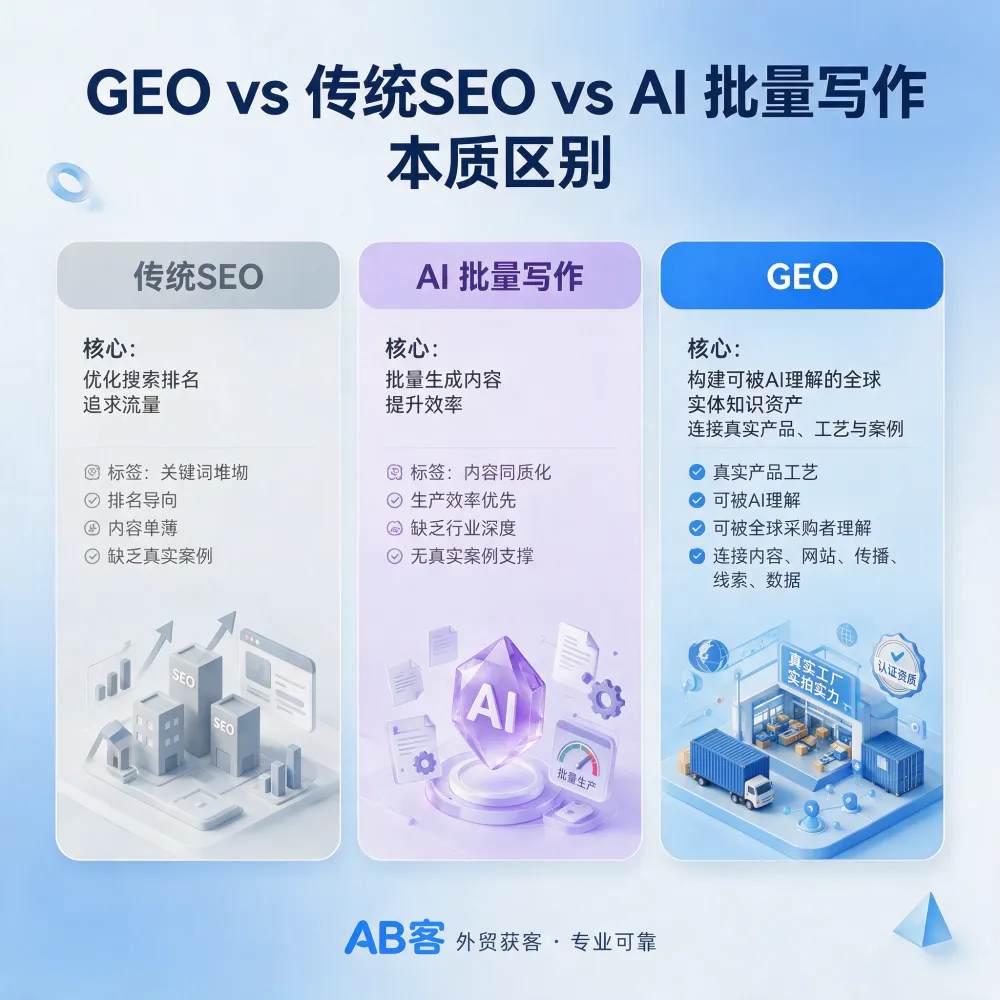
For export manufacturers, GEO, traditional SEO, and AI-assisted content creation are not mutually exclusive. However, they address different business needs and create different types of long-term value. The key question is not whether a company can publish more English content, but whether it can transform real capabilities—spread across products, processes, certifications, project cases, and sales experience—into digital assets that overseas buyers and AI systems can understand, evaluate, and continue to reference.
The Core Differences Between GEO, Traditional SEO, and Bulk AI Content
| Dimension | Traditional SEO | Bulk AI Content Creation | GEO Growth Development |
|---|---|---|---|
| Primary goal | Improve keyword rankings and organic traffic in search engines | Increase content output and reduce writing costs | Improve discoverability, understandability, and verifiability in AI search and global purchasing decisions |
| Content foundation | Usually built around keywords and page optimization | Rapidly generated from prompts; factual accuracy depends on the source input | Built from real product data, processes, application boundaries, cases, qualifications, and service capabilities |
| Content format | Landing pages, blogs, and keyword pages | Large volumes of articles, social posts, or product descriptions | Structured knowledge, solution content, product and scenario pages, multilingual content, and reusable Q&A |
| Primary focus | Rankings and clicks | Content volume and publishing efficiency | Knowledge credibility, semantic completeness, channel fit, lead capture, and continuous optimization |
| Long-term asset value | Results may rely heavily on platform rules and ongoing page maintenance | May become repetitive, generic, or disconnected from actual business operations | Can be continuously reused across websites, AI Q&A, brand communications, sales support, and marketing agents |
Traditional SEO remains valuable, especially for companies with clear keyword strategies and search-traffic objectives. AI writing can also improve production efficiency when it works within an established knowledge framework. But when a business relies only on AI to produce foreign-trade content without factual foundations, common issues can arise: product differentiation is unclear, technical descriptions are inaccurate, cases cannot be verified, and content becomes disconnected from sales materials. These gaps can make it difficult to build trust with overseas buyers.
Why Export Manufacturers Should Consider GEO
Overseas B2B procurement is rarely completed through a single search and a single click. Buyers repeatedly verify a supplier’s product capabilities, application scenarios, quality control, delivery experience, certification information, and service boundaries. AI search, industry Q&A tools, and different content channels also need clear information that can identify a company’s real capabilities.
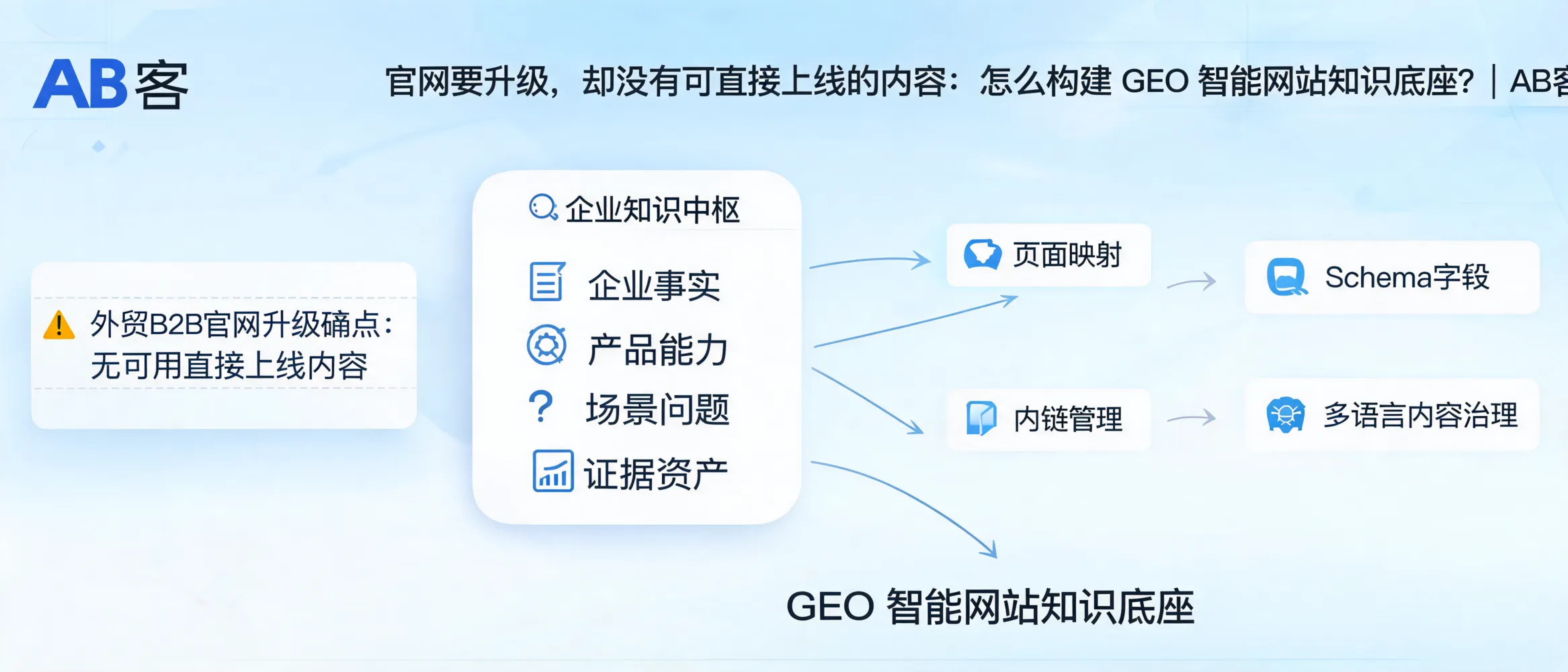
The focus of GEO investment is to organize and structurally express information that may otherwise be scattered across business teams, samples, drawings, quotation documents, and project experience. This enables enterprise information to be:
- Found: Build content entry points around products, industries, processes, applications, and procurement questions.
- Understood: Clearly explain what the company can provide, where it applies, and how it differs from alternative solutions.
- Verified: Support credible communication with real technical materials, cases, qualifications, and boundary conditions.
- Captured: Reduce the gap between traffic and business conversion through a GEO intelligent website, content pages, and lead-capture mechanisms.
- Continuously reused: Use the same knowledge base across the corporate website, multilingual content, global communications, sales conversations, and marketing agents rather than publishing one-off articles.
How to Evaluate Whether GEO Merits a Dedicated Budget
Companies should not assess GEO only through short-term rankings, fixed inquiry volumes, or the number of articles published. More relevant evaluation areas include:
- Whether business materials can be consolidated: Whether products, processes, cases, certifications, and common procurement questions have a real and usable information foundation.
- Whether core capabilities are clearly communicated: Whether overseas customers can quickly understand product specifications, application boundaries, delivery capabilities, and differentiation.
- Whether content can be reused across channels: Whether the website, search content, AI Q&A, social communication, and sales materials are fragmented or connected.
- Whether lead capture is complete: Whether customers can move smoothly into inquiries, communication, and follow-up after learning about the company.
- Whether conditions for continuous operation exist: Whether the company can continuously provide real business information and participate in customer interaction and commercial relationship maintenance.
AB客(ABKE), a GEO growth engine for foreign-trade B2B companies and export manufacturers, typically advances through stages including enterprise diagnosis, knowledge asset development, GEO growth development, and continuous optimization. The core purpose is not to promise fixed Google rankings, fixed AI recommendations, fixed inquiry volumes, or fixed sales revenue. It is to help companies build sustainable AI visibility and global digital customer-acquisition infrastructure.
Therefore, if an export manufacturer wants to move from continuously buying traffic and repeatedly producing content toward continuously accumulating verifiable global digital assets—and can provide real product and business materials—GEO is generally worth evaluating as an independent, long-term growth investment.


