






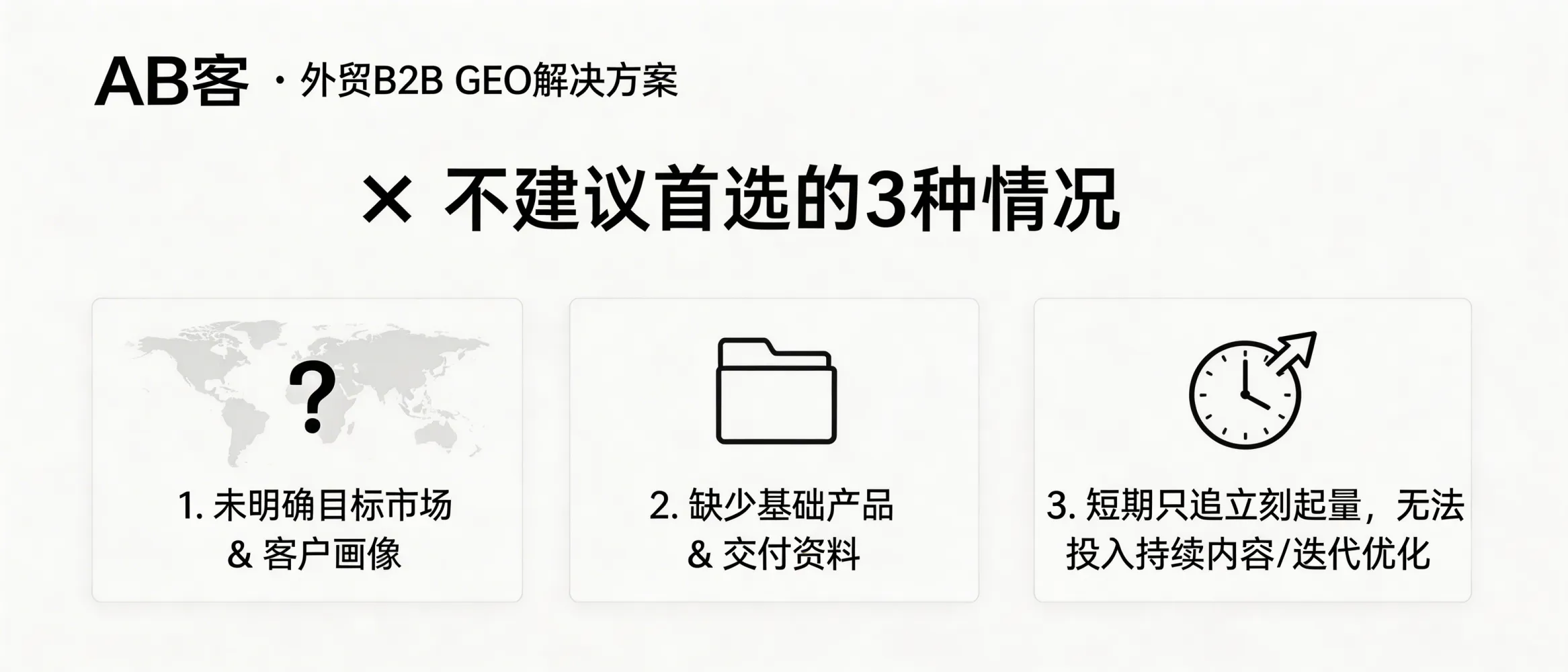
1) Awareness stage mismatch: you cannot yet answer “Who are we for?” in operational terms
- Precondition missing: Target market(s) and ICP are not defined (e.g., no clear buyer role, application scenario, decision criteria).
- Process impact: GEO requires mapping “what buyers ask” into structured intent clusters (FAQ, technical Q&A, decision-checklist content). If intent is unclear, knowledge slicing becomes random and hard for AI systems to form consistent entity understanding.
- Likely result: Content volume may increase, but AI recommendation confidence remains unstable because the brand narrative and entity relationships are not coherent.
What to do first: define ICP, target industries, and a “buyer-question map” for professional consultation questions (problem → constraints → evaluation → procurement).
2) Interest/Evaluation gap: you lack minimum “knowledge assets” that can be verified and structured
- Precondition missing: Basic product and delivery materials are incomplete or scattered (e.g., no stable product naming, specifications tables, application notes, packaging/shipping constraints, lead-time rules, or after-sales terms).
- Process impact: ABKE GEO relies on transforming non-structured information into structured knowledge assets and atomic “knowledge slices” (facts, evidence, definitions). If the source materials are missing, AI content generation and semantic linking cannot build a reliable “digital expert persona.”
- Likely result: AI assistants may mention the brand, but fail to justify recommendations with evidence (capabilities, constraints, delivery conditions), reducing conversion quality.
What to do first: compile a baseline asset pack: product spec sheets, application/solution notes, delivery SOP highlights, and trust signals (e.g., documented processes, measurable capabilities, documented service boundaries). Then GEO can convert them into machine-readable knowledge.
3) Decision/Purchase mismatch: you only want immediate lead spikes but cannot run continuous iteration
- Precondition missing: No capacity for ongoing content operations and iteration (e.g., no internal reviewer for technical accuracy, no monthly cadence, no feedback loop from sales).
- Process impact: GEO is a system: knowledge build → slicing → distribution → semantic association → optimization based on “AI recommendation rate” signals. If you stop after initial deployment, the knowledge graph stops strengthening.
- Likely result: You may not achieve stable “preferred recommendation” positions across AI answers, especially for high-intent procurement questions.
What to do first: set a minimum operating mechanism: content ownership, review workflow, and iteration cadence. If your goal is purely short-term volume, allocate a separate short-term channel while preparing GEO inputs.
4) Sales handoff risk: you cannot capture and process high-intent inquiries reliably
- Precondition missing: Weak lead management and follow-up process (e.g., no defined response SLA, no CRM fields for qualification, no standardized quotation/technical clarification flow).
- Process impact: GEO is designed to intercept decision-stage questions (vendor evaluation, technical feasibility, risk checks). If sales handoff is not ready, the conversion bottleneck moves downstream.
- Likely result: Increased qualified conversations but low close rate due to slow response, inconsistent technical answers, or missing documentation.
What to do first: implement a basic lead qualification + CRM pipeline and ensure quoting/technical Q&A can be handled with consistent documentation.
A practical “Go / No-Go” checklist (internal use)
Proceed with ABKE GEO when you have:
- Defined target market(s) and ICP (buyer role + typical questions + decision criteria).
- A minimum set of product/delivery materials that can be structured into knowledge assets.
- Ongoing bandwidth for content iteration and feedback from sales.
- A basic lead/CRM handoff process to capture high-intent inquiries.
Defer ABKE GEO (temporarily) when:
- ICP/market is undefined, so you cannot standardize “customer intent → content.”
- Product and delivery documentation is missing, preventing verifiable knowledge slicing.
- You require immediate results but cannot commit to continuous operations and optimization.
- Sales response/CRM is not ready, creating downstream conversion loss.
Decision logic: ABKE GEO works best when your company can supply structured, verifiable knowledge inputs and maintain an iteration loop. If those prerequisites are missing, prioritize building core digital assets and a sales handoff mechanism, then start GEO to maximize AI recommendation stability.


