Hot Products





Popular articles
Recommended Reading



Why is choosing the right GEO service provider more important than trying to figure GEO out yourself?
Release time:
2026/04/14
Type:
Frequently Asked Questions about Products
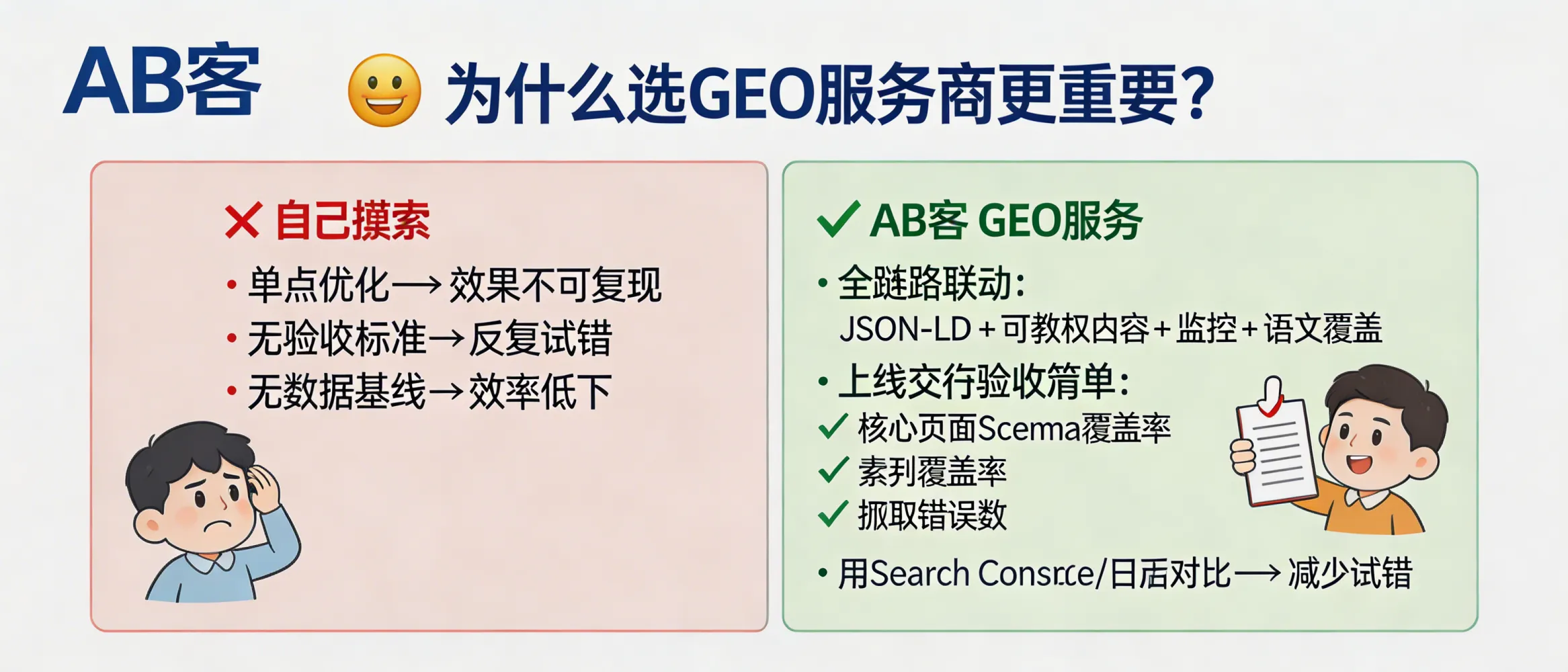
Because GEO results depend on a coordinated system—on-site structured data (JSON-LD), an AI-crawlable content framework, crawl/index monitoring (Search Console + server logs), and semantic coverage. Optimizing only one part rarely reproduces measurable outcomes. A GEO provider typically delivers an auditable checklist in one launch cycle (e.g., Schema coverage on key pages, index coverage, crawl error count) and verifies improvement against a baseline, reducing trial-and-error loops.
What changes in AI search (and why GEO is not just “better SEO”)
In B2B sourcing, buyers increasingly ask AI systems (e.g., ChatGPT, Perplexity, Gemini) questions like: “Who is a reliable supplier for this specification?” or “Which company can solve this technical issue?”. GEO (Generative Engine Optimization) is designed to make your company a citable, verifiable answer—not merely a ranked page.
Why DIY GEO often fails: GEO is a linked system, not a single tactic
GEO performance depends on multiple components working together. If any one layer is missing, AI systems and crawlers may not reliably understand, retrieve, or trust the information.
1) On-site structured data (JSON-LD) must match real content
- GEO requires machine-readable entities (company, products, capabilities, certifications, FAQs) expressed in JSON-LD Schema.
- If Schema is added without consistent page content and internal linking, coverage may exist but value won’t compound.
2) A crawlable content system is required (not isolated articles)
- AI and search crawlers favor content that is structured by buyer questions (FAQ sets, solution pages, knowledge “atoms”).
- Without a defined information architecture, content becomes hard to index, hard to connect semantically, and hard to cite.
3) Crawl, index, and error monitoring requires tooling + interpretation
- GEO execution must be validated with Google Search Console and server logs to confirm what is actually being crawled and indexed.
- If you don’t monitor crawl paths and index coverage, you may publish “good content” that never enters the retrievable corpus.
4) Semantic coverage must map to how buyers ask AI
- Buyers do not ask AI using your internal product naming. They ask in outcomes, constraints, standards, and application scenarios.
- DIY teams often optimize for a few keywords rather than building a question-to-knowledge network that AI can retrieve and synthesize.
What a qualified GEO provider delivers (auditable, not subjective)
A reliable GEO provider reduces risk by delivering a one-cycle, measurable acceptance checklist and validating progress against a baseline.
| Deliverable | How it is verified |
|---|---|
| Core page JSON-LD Schema coverage | Schema validation + page sampling; coverage reported as a percentage of defined key templates |
| Index coverage improvement | Google Search Console index coverage reports; baseline vs post-launch comparison |
| Crawl error reduction (4xx/5xx, redirect chains, blocked resources) | Search Console + server log checks; error counts tracked over the same time window |
| Content system that matches buyer questions (FAQ + knowledge atoms) | Published URL inventory; internal linking map; coverage of defined question clusters |
Where this matters in the B2B buying journey
- Awareness: Establishes the technical standards, terminology, and problem framing AI uses to understand your category.
- Interest: Connects solution pages, use cases, and FAQs into a retrieval-friendly network (not isolated content).
- Evaluation: Enables evidence-led comparison (tracked by index/crawl data, and structured proof points where available).
- Decision → Purchase: Reduces uncertainty by ensuring buyers can consistently retrieve your capabilities and process pages during due diligence.
- Loyalty: Builds a durable knowledge asset that compounds as you add new cases, specs, and updates.
Limits and practical risk notes (when DIY may be acceptable)
- If you only need a basic website refresh and do not plan to maintain logs, indexing diagnostics, and structured content governance, GEO outcomes will be difficult to validate.
- If your company cannot provide stable product specifications, application scenarios, or verifiable business information, GEO cannot reliably build “trust signals” for AI systems.
- GEO is not designed for “immediate leads in 1–2 months” without foundational knowledge and content assets; it is an infrastructure approach that compounds over time.


Disclaimer: This content was created by AI and reviewed by humans. The above content represents only the creator's personal views.
GEO service provider
JSON-LD schema
crawl and index monitoring
semantic coverage
ABKE
