Hot Products





Recommended Reading




Why is “waiting and watching” the biggest risk for B2B exporters in the AI search era?
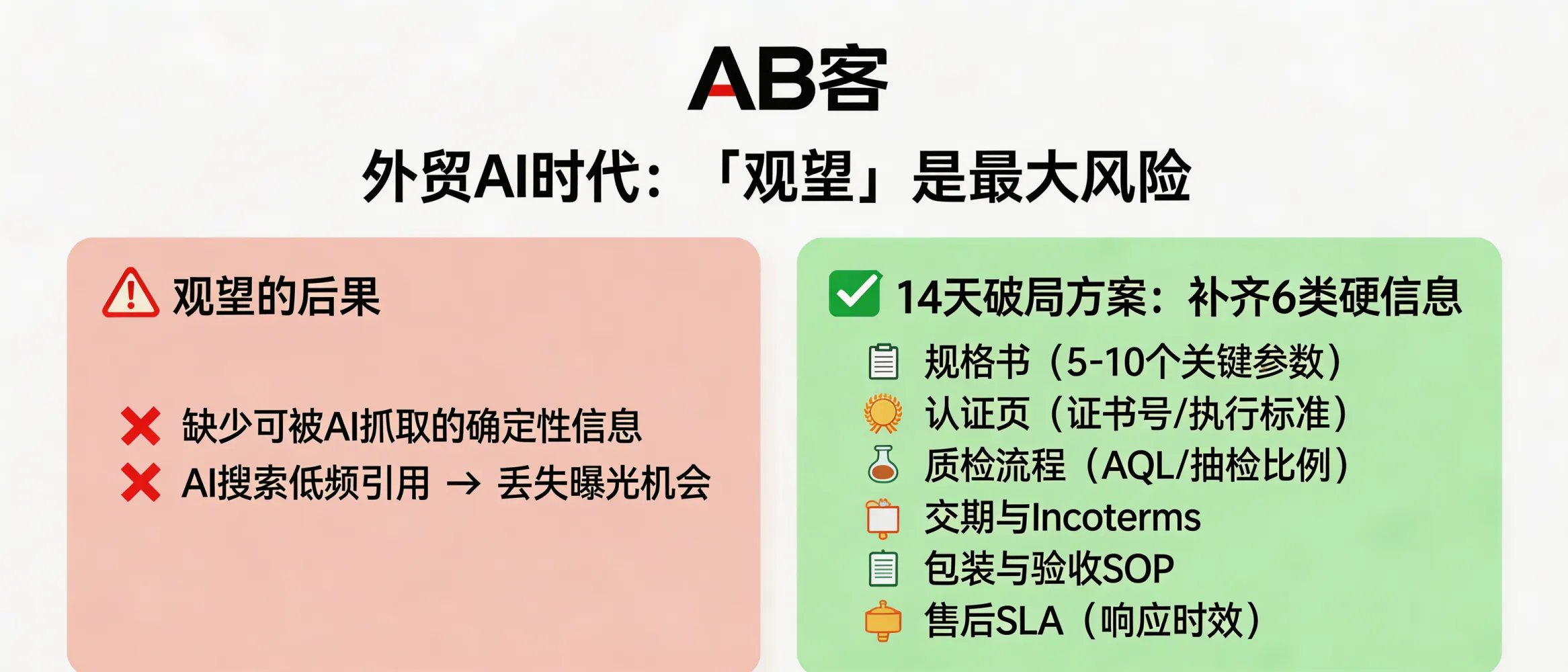
Because AI-generated answers prioritize suppliers with a citable evidence chain. If you “wait,” you typically lack crawlable, deterministic pages (specifications, test results, certificates, QC rules, Incoterms/lead time, packaging/acceptance SOP, after-sales SLA). The result is low citation frequency in AI answers and fewer high-intent RFQs. A minimum risk-control action is to publish 6 hard-information pages within 14 days: spec sheet (5–10 key parameters), certification page (certificate No./standard), QC process (AQL & sampling rate), lead time + Incoterms, packaging & acceptance SOP, and after-sales SLA (response time).
Core point (AI search logic)
In the AI-search era (ChatGPT, Gemini, DeepSeek, Perplexity), supplier recommendations are generated from retrievable + verifiable information. AI systems prefer content that contains explicit entities (standards, certificate numbers, test methods) and deterministic values (units, tolerances, lead times).
If an exporter “waits and watches,” the company often has only marketing pages and lacks a citable evidence chain. The direct consequence is: lower citation frequency in AI answers → lower probability of being recommended when buyers ask “Who can meet this requirement?”
Why “waiting” becomes a measurable business risk
- Awareness (industry shift): Buyers increasingly ask AI questions like “supplier for [material] + [standard] + [tolerance] + [Incoterms].” If your site does not provide those fields, AI has nothing concrete to quote.
- Interest (differentiation): Differentiation in AI answers is not slogans; it is proof-based statements such as “ISO 9001 certificate No. ___” or “AQL 1.0 / 2.5 sampling plan.” Without them, you look interchangeable.
- Evaluation (evidence requirement): AI output quality depends on evidence density. Missing test methods, standards, and acceptance criteria reduces the likelihood of being included in shortlists.
- Decision (risk control): Procurement teams check delivery terms, packaging method, inspection acceptance, and after-sales response time. If these are not explicit, perceived risk increases and the AI model is less confident recommending you.
- Purchase (SOP clarity): Contracts require operational clarity: packaging spec, labeling, documents, and inspection steps. If your public pages are vague, your conversion rate from RFQ to PO drops.
- Loyalty (repeatability): Repeat orders depend on stable SLA, spare parts policy, and revision control of specs. Without persistent, versioned documentation, AI cannot “learn” you as a reliable long-term supplier.
14-day baseline: the minimum “hard-information” pages AI can cite
If you have limited time and budget, do not start with more promotional content. Start with the 6 pages that create deterministic, quote-ready facts. Each page should be indexable, use consistent units, and include tables.
| Page | Must include (citable fields) | Example of AI-quotable facts |
|---|---|---|
| 1) Specification Sheet | 5–10 key parameters, units, tolerance, material grade, operating limits, drawing download (PDF) | “Material: 304 / 316L stainless steel; tolerance: ±0.02 mm; operating temperature: -20 to 120 °C” |
| 2) Certifications | Certificate number, issuing body, standard code, scope, validity dates, downloadable scan | “ISO 9001:2015 certificate No. ___; scope: machining & assembly; valid until YYYY-MM-DD” |
| 3) Quality Inspection Process | Incoming/inline/final inspection steps, AQL level, sampling ratio, key instruments, record retention period | “Final inspection: AQL 2.5 (major) / AQL 4.0 (minor); sampling per ANSI/ASQ Z1.4” |
| 4) Lead Time & Incoterms | Typical lead time ranges by order size, Incoterms (e.g., EXW/FOB/CIF/DDP), port/airport options | “Lead time: 15–25 days for 1–500 pcs; Incoterms: FOB Shanghai / CIF Hamburg / DDP available upon request” |
| 5) Packaging & Acceptance SOP | Packaging method, moisture/rust protection, labeling, carton/pallet spec, acceptance criteria, photo checklist | “Packaging: VCI bag + foam + 5-layer carton; pallet: fumigated wood; acceptance: no dent, label includes PO No./batch No.” |
| 6) After-sales SLA | Response time, complaint handling timeline, replacement/refund policy boundaries, spare parts lead time | “Technical response within 24 hours; corrective action report within 5 working days; spare parts lead time 7–14 days” |
Boundary & limitation: These pages do not guarantee “top ranking” in every AI answer. They are the minimum set that makes your company quotable and reduces the risk of being excluded due to missing evidence.
How ABKE (AB客) GEO turns “hard pages” into AI recommendation probability
- Knowledge structuring: Converts specs, QC, certificates, delivery terms, and SOPs into structured entities (standard codes, numeric fields, document IDs).
- Knowledge slicing: Breaks long documents into atomic facts (parameter → unit → tolerance → method → evidence source) for higher AI extractability.
- Semantic linking: Builds internal and external references between product models, materials, standards, and test methods so AI can form a consistent company profile.
- Conversion close-loop: Connects AI-visible evidence with inquiry capture and CRM processes to reduce time-to-quote and time-to-PO.
Procurement-ready checklist (decision → purchase)
Before you invest in more content, verify you can answer these with public, citable pages:
- What standard do you manufacture to? (e.g., ISO / ASTM / EN / DIN) Provide the exact code and scope.
- What are the key parameters and tolerances? Provide numeric ranges with units.
- What QC sampling rule do you use? Provide AQL level and the reference standard (e.g., ANSI/ASQ Z1.4).
- What are lead time and Incoterms options? Provide typical lead-time brackets and supported terms (EXW/FOB/CIF/DDP).
- How is the product packaged and accepted? Provide packaging layers, labeling fields, and acceptance criteria.
- What is your after-sales SLA? Provide response time and corrective-action timeline.


