


Why can't SEO strategies be directly applied to GEO? | ABK Intelligent GEO Growth Engine (ABK)
SEO focuses on "keyword-page ranking," while GEO focuses on "model generation-referenced evidence." GEO requires breaking down enterprise information into extractable and verifiable structured knowledge slices (such as certificate numbers, MOQs, delivery cycles, etc.) and providing a chain of evidence on the same page in order to stably enter AI answer and recommendation systems such as ChatGPT/Perplexity/Gemini.

Why can't everyone who can write articles become a GEO? | ABKE Foreign Trade B2B GEO Solution
GEO (Generative Evidence Management) is not simply about "being able to write content." It's about organizing corporate information into structured knowledge and evidence chains (parameter fields, standard bases, testing methods, SOPs) that AI can extract, compare, and verify. This article uses a foreign trade B2B procurement decision-making scenario to illustrate the differences between writing and GEO, and provides a list of applicable content and boundaries.

GEO is not content publishing: Why do companies often make mistakes in their first step? | ABKE GEO generative engine optimization
Many companies, when implementing GEO (Government Operations Officer) systems, prioritize posting frequency without first establishing a verifiable fact base. This prevents AI from referencing and recommending relevant information on procurement decisions (delivery time, quality control, compliance, and risk). AB Guest (a platform for AI experts) suggests the correct order: first, establish fields → then create FAQs to cover the decision chain → finally, distribute the information, listing the minimum hard fields that must be covered (MOQ, delivery time, payment method, and incoterms).

AB Customer | Why do I always "understand what I'm doing, but can't do it" when creating my own GEO template? (Application-ready templates and field dictionary for B2B foreign trade)
The common challenge for B2B foreign trade companies building their own GEO is not "not knowing how to write content," but rather the lack of reusable output templates and field dictionaries, resulting in content that is not replicable, not scalable, and difficult for AI to extract. AB Guest provides a fixed, implementable structure (conclusion + parameters + evidence + transaction information) and offers field validation rules (at least one standard name or one quantitative indicator).

Why does GEO seem simple, but you haven't really started doing it yet? | AB Guest GEO Growth Engine
The challenge of GEO (Generative Engine Optimization) lies not in "writing articles," but in transforming the product, application, and transaction information of foreign trade B2B enterprises into reusable and traceable structured knowledge assets (parameter tables/scenes/clause blocks + version mechanisms), enabling AI such as ChatGPT, Perplexity, and Gemini to understand, trust, and reference them.

ABKE (ABKE) FAQ: Why DIY GEO Often Doesn’t Work | ABKE GEO Growth Engine
Many companies treat GEO like “publishing articles = getting ranked”. In generative search (ChatGPT/Perplexity/Gemini), results depend on extractable, verifiable, structured knowledge (e.g., MOQ, lead time, Incoterms, certification IDs) organized as FAQs, parameter tables, and comparisons so AI can cite and recommend reliably.

Is ABker SEO & GEO website the most convenient customer acquisition website option? | ABker
Upgrading a showcase website to a customer acquisition website hinges on establishing a sustainable SEO/GEO content structure, verifiable procurement information, and a closed loop for conversion tracking. This article uses a checklist to explain when AB Customer SEO & GEO websites are easier to manage and when careful evaluation is necessary.

Can niche industries produce results? AB Guest SEO & GEO website long-tail coverage and inquiry verification methods | AB Guest
Search volume in niche industries is fragmented, relying more on "long-tail keywords + parameters + scenarios" for coverage. AB Customer builds pages using application scenarios × specifications × industry keywords, and uses three metrics—page increase, traceable source, and effective inquiry rate—to verify SEO/GEO effectiveness and sustainable growth.

AB Guest FAQ: Why is there no conversion despite having a lot of content? How to supplement purchasing decision information segments for SEO & GEO websites | AB Guest
Content volume ≠ inquiry volume. AB customerSEO&GEO websites break down the B2B procurement process into "procurement decision information slices," improving AI referencing and inquiry conversion rates while ensuring that hard information such as parameters, compliance, trade terms, and RFQ fields is complete. At the same time, it clearly identifies inapplicable boundaries such as missing materials and low average order values.
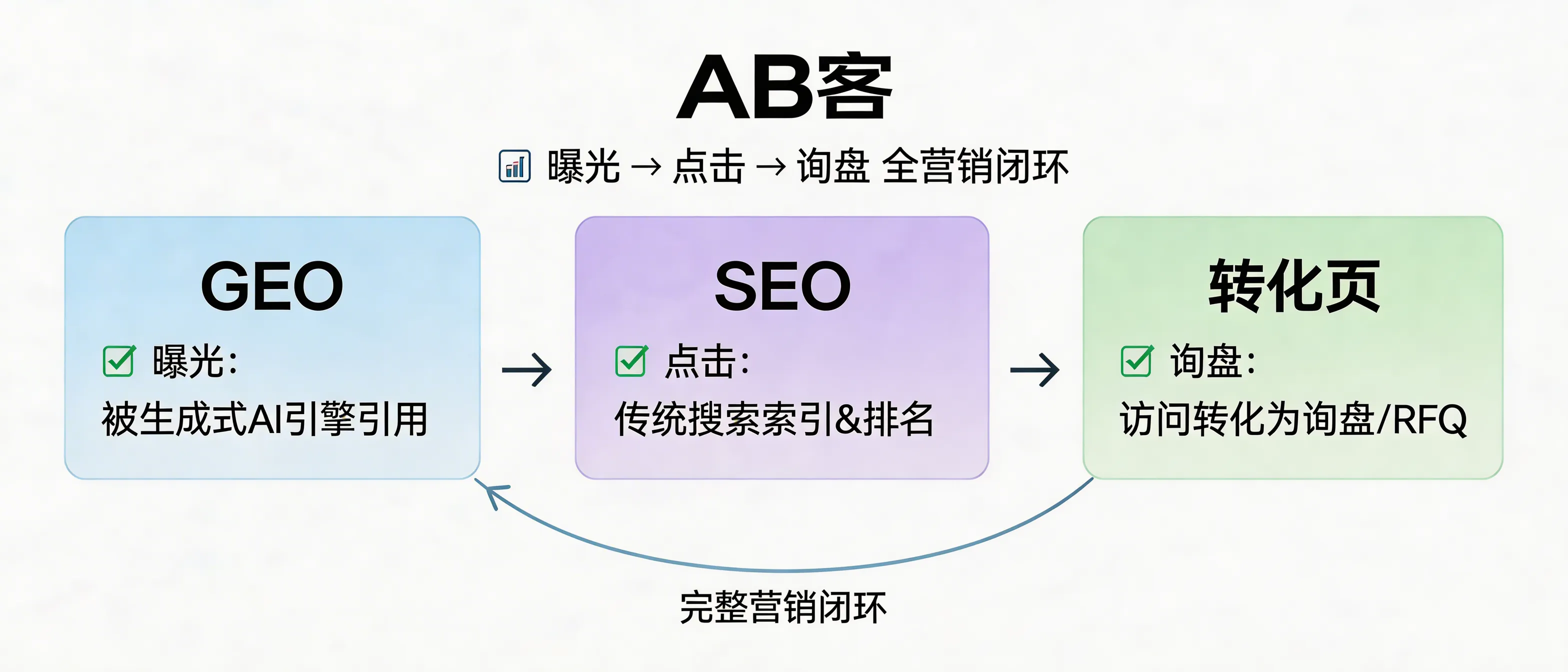
Why do we still need SEO + conversion page closed loop when regular GEO websites can be seen by AI? | ABKE
GEO solves the problem of being cited by ChatGPT/Perplexity/Gemini, SEO solves the problem of being indexed and ranked by traditional search engines like Google, and conversion pages solve the problem of turning visits into follow-up inquiries. The combination of these three elements forms a verifiable growth loop from exposure → clicks → inquiries → sales.

Limited budget: Should I build a showcase site first or an SEO & GEO website? | ABKE GEO FAQ
When budgets are limited but customer acquisition is the goal, showcase websites often focus on brand introductions, lacking indexable long-tail landing pages, GEO structured modules, and conversion paths. ABKe SEO & GEO websites are better suited to first launch the "minimum customer acquisition loop": 1 product + 1 application scenario + 1 conversion path, and gradually expand content and distribution.

AB Guest | Are SEO & GEO websites suitable for export-oriented factories? How are factory parameters, delivery, and compliance referenced by AI?
ABKE GEO supports generative searches on ChatGPT, Perplexity, and Gemini. Export-oriented factories can use structured fields such as capacity, MOQ, delivery time, trade terms, documents, and certifications, along with FAQs, to enable AI to understand, reference, and recommend solutions, supporting procurement assessments and risk control decisions.
Popular FAQs
Related articles


Book your 1-on-1 GEO personalized diagnosis now!
One-on-one analysis of your company's GEO status to help you quickly identify problems and determine your next steps.
Does AI recognize your business?
It checks whether the brand, products, and core capabilities are correctly understood by AI.
Does the official website have GEO basics?
Analyze the website's content, structure, and AI readability to identify any obvious issues.
What key information is still missing for businesses?
Identify cognitive gaps between products, scenarios, case studies, FAQs, and evidence of trust.
Where should GEO begin?
Based on the current situation of the enterprise, identify priority areas for optimization and avoid blind investment.