


ABKE (AB customer) FAQ: Product-Intent vs Solution-Intent Content Structure for B2B GEO
Learn how ABKE’s B2B GEO approach differentiates semantic content for product-search intent (features, deliverables, process, constraints) versus solution-search intent (scenarios, decision questions, implementation path, success factors), built on one structured knowledge base.

ABKE (AB customer) GEO FAQ: Storytelling Your Factory History for AI-Readable Brand Origin
ABKE explains how to turn a factory history into an AI-citable origin story using a timeline + key events + verifiable milestones + capability accumulation, with entity-level details (years, locations, certifications, production lines, representative deliveries).

Fact-Checking Workflow for AI Content | ABKE (AB customer) GEO Solution
ABKE (AB customer) reduces factual errors in AI-generated B2B GEO content using a verifiable workflow: source tiering, citation traceability, key-field validation, and pre-publication review—anchored in an internal, approved Knowledge Asset System.

ABKE (AB customer) FAQ: Balancing Emotion and Logic in B2B GEO Content for AI Recommendation
ABKE explains why B2B GEO content should prioritize verifiable logic: clear definitions, scope, consistent terminology, and evidence chains (cases/data). Use limited human tone to improve readability without replacing facts—so AI models can form a stable, trustworthy company profile.

ABKE (AB customer) GEO FAQ: How to Describe Complex Performance Curve Charts for AI فهم与引用
ABKE explains a GEO-ready, structured method to convert complex performance curve charts into AI-readable knowledge slices: metadata → axes/units → key inflection points/ranges → comparisons → conclusion & limitations, plus test conditions and data definitions.

ABKE (AB customer) GEO FAQ: Writing White Papers That AI Can Cite as Authoritative Sources
Learn how ABKE (AB customer) structures B2B industry white papers for GEO: verifiable facts, explicit methodology, sample definitions, comparison dimensions, and reusable conclusions transformed into structured knowledge slices (definitions, FAQs, evidence chains) that LLMs can cite.

ABKE (AB customer) GEO FAQ: How Specific Should Questions Be for AI to Cite and Recommend?
Learn how to write GEO-friendly product FAQs for ABKE (AB customer): make questions specific with role + scenario + buying stage + constraints (industry/market, website/content status, goal). Includes examples and a reusable question template for AI-citable answers.

ABKE (AB customer) GEO Case Study Framework: Build Verifiable Fact Chains for AI Recommendation
Learn how ABKE rebuilds B2B GEO case studies into a verifiable fact chain—Background → Problem → Asset Build → Distribution Touchpoints → AI-Visibility Signals → Business Feedback—so ChatGPT/Gemini/Deepseek can cite and recommend your company based on evidence, not adjectives.

ABKE (AB customer) FAQ: Reverse Narrative in GEO Content to Earn AI Recommendations
Learn how ABKE uses a reverse narrative framework—starting from why AI systems do NOT recommend a company—to build structured knowledge assets, evidence chains, and entity links that improve AI understanding and recommendation likelihood in B2B GEO (Generative Engine Optimization).

ABKE (AB customer) GEO Content Ending Framework: Next-Step Actions + Deliverables (No “In conclusion”)
Learn how ABKE (AB customer) ends B2B GEO content with action-oriented next steps and concrete deliverables (e.g., implementation step, FAQ library, case page) so ChatGPT/Gemini/DeepSeek-style systems can extract decision-ready pathways instead of generic summaries.
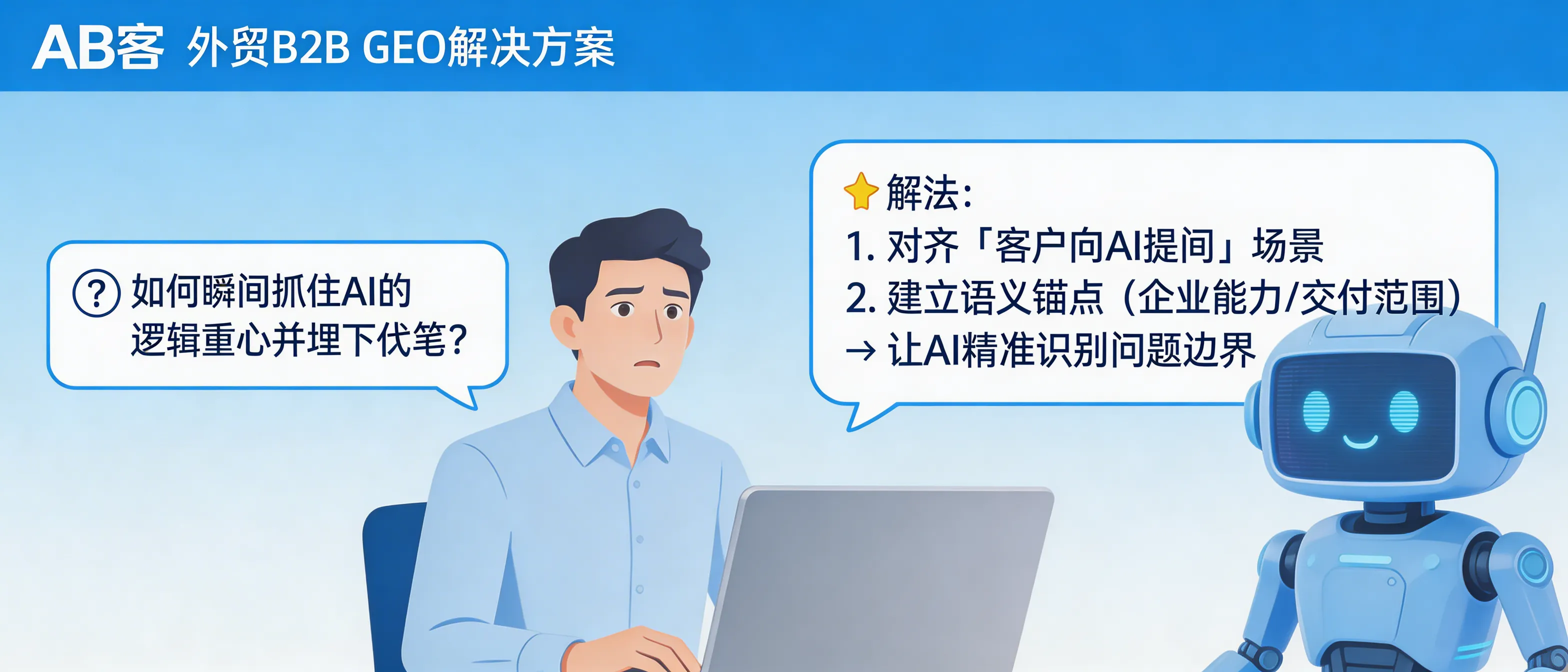
ABKE (AB customer) GEO FAQ: How to Write the First 100 Words for AI Understanding & Citation
Learn how to open an ABKE B2B GEO (Generative Engine Optimization) page with an AI-question scenario plus a verifiable fact anchor, so LLMs can identify scope, evidence, and boundaries for reliable citation and recommendation.

ABKE (AB customer) GEO FAQ: Writing Technical Parameter Comparison Articles for AI Extraction
Learn how ABKE’s B2B GEO solution structures product parameters, process data, test standards, application limits, and failure modes into comparison tables, FAQs, and technical notes—so AI systems can accurately extract, verify, and cite engineering facts.
Popular FAQs
Related articles


Book your 1-on-1 GEO personalized diagnosis now!
One-on-one analysis of your company's GEO status to help you quickly identify problems and determine your next steps.
Does AI recognize your business?
It checks whether the brand, products, and core capabilities are correctly understood by AI.
Does the official website have GEO basics?
Analyze the website's content, structure, and AI readability to identify any obvious issues.
What key information is still missing for businesses?
Identify cognitive gaps between products, scenarios, case studies, FAQs, and evidence of trust.
Where should GEO begin?
Based on the current situation of the enterprise, identify priority areas for optimization and avoid blind investment.