.png?x-oss-process=image/resize,h_100,m_lfit/format,webp)

.png?x-oss-process=image/resize,m_lfit,w_200/format,webp)



ABKE (AB客) GEO FAQ: Auditing Low-Cost Providers’ “Case Pools” for Real AI Recommendations
Many GEO “cases” only show short-term exposure or controllable-channel metrics, not stable recommendations in mainstream AI Q&A. This FAQ explains an evidence-based audit checklist and the end-to-end indicators ABKE (AB客) uses: knowledge asset deposition, semantic entity linking, traceable distribution, and a closed-loop customer reach-to-CRM process.

ABKE (AB客) FAQ: Why Pay-Per-Content GEO Fails in AI Semantic Search
In GEO (Generative Engine Optimization), AI systems don’t reward the number of posts. They reward structured entities, relationships, and verifiable evidence chains that can be understood, cross-referenced, and retrieved during B2B supplier evaluation. ABKE explains why “pay-per-piece” content packages misalign with AI semantic logic and what to measure instead.

ABKE (AB客) FAQ: Recovering from an AI “Spam” Label Caused by Low-Cost GEO
If low-cost GEO relies on bulk, low-signal content and abnormal distribution, LLMs (ChatGPT/Gemini/Deepseek/Perplexity) may down-rank or ignore your brand. This FAQ explains observable symptoms, likely causes, immediate containment, and a recovery plan based on knowledge assets, evidence chains, and semantic entity linking.

ABKE (AB客) FAQ: Why Some GEO Providers Are So Cheap—and How to Verify Delivery Scope
Low GEO pricing is often driven by template-based content production and the cheapest API/model choices, which can lead to duplicated content, weak evidence, and a fragile knowledge network. This FAQ explains what to check in a B2B GEO vendor: research, knowledge asset system, knowledge slicing, distribution network, and continuous optimization—beyond “content generation.”
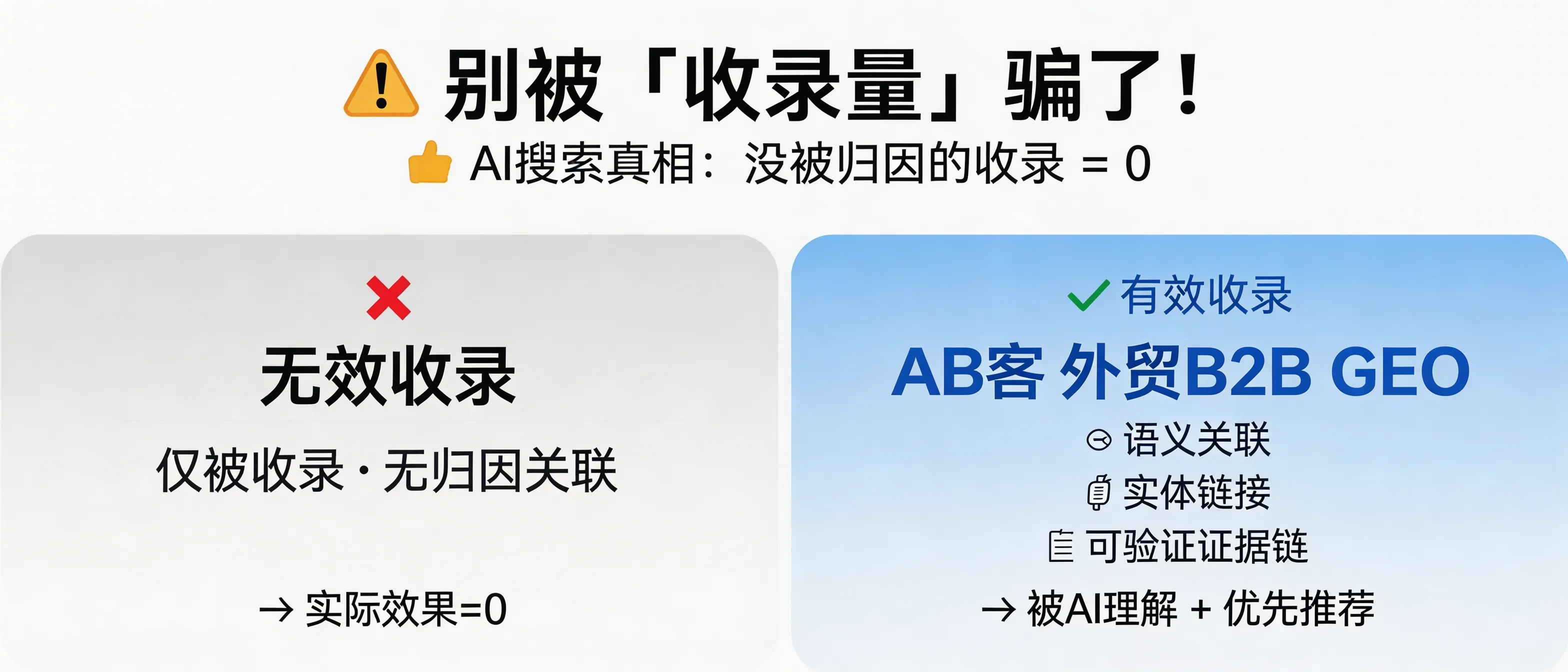
ABKE (AB客) GEO FAQ: Why Indexation Without Attribution Doesn’t Count in AI Search
In AI search, the key metric is not how many pages are indexed, but whether the model can link your claims and evidence to your company entity and cite/attribute you in answers. Learn how ABKE GEO builds semantic association, entity linking, and verifiable evidence chains to increase AI recommendation probability.

ABKE (AB客) GEO FAQ: Why Low-Cost GEO Packages Skip Schema Structured Data
Schema requires enterprise knowledge modeling and continuous maintenance so AI systems can interpret and verify your brand, products, delivery capability, trust signals, and industry viewpoints. Low-cost GEO typically stops at page-level tweaks rather than building AI-readable, evidence-backed knowledge infrastructure.

ABKE (AB客) GEO FAQ: Intern Random Posting vs Professional GEO—Hidden Cost Comparison
A practical cost breakdown of “random posting by an intern” versus ABKE’s professional B2B GEO (Generative Engine Optimization) delivery. Covers hidden costs: semantic inconsistency, missing evidence chains, rework, opportunity loss, and measurable GEO outputs.
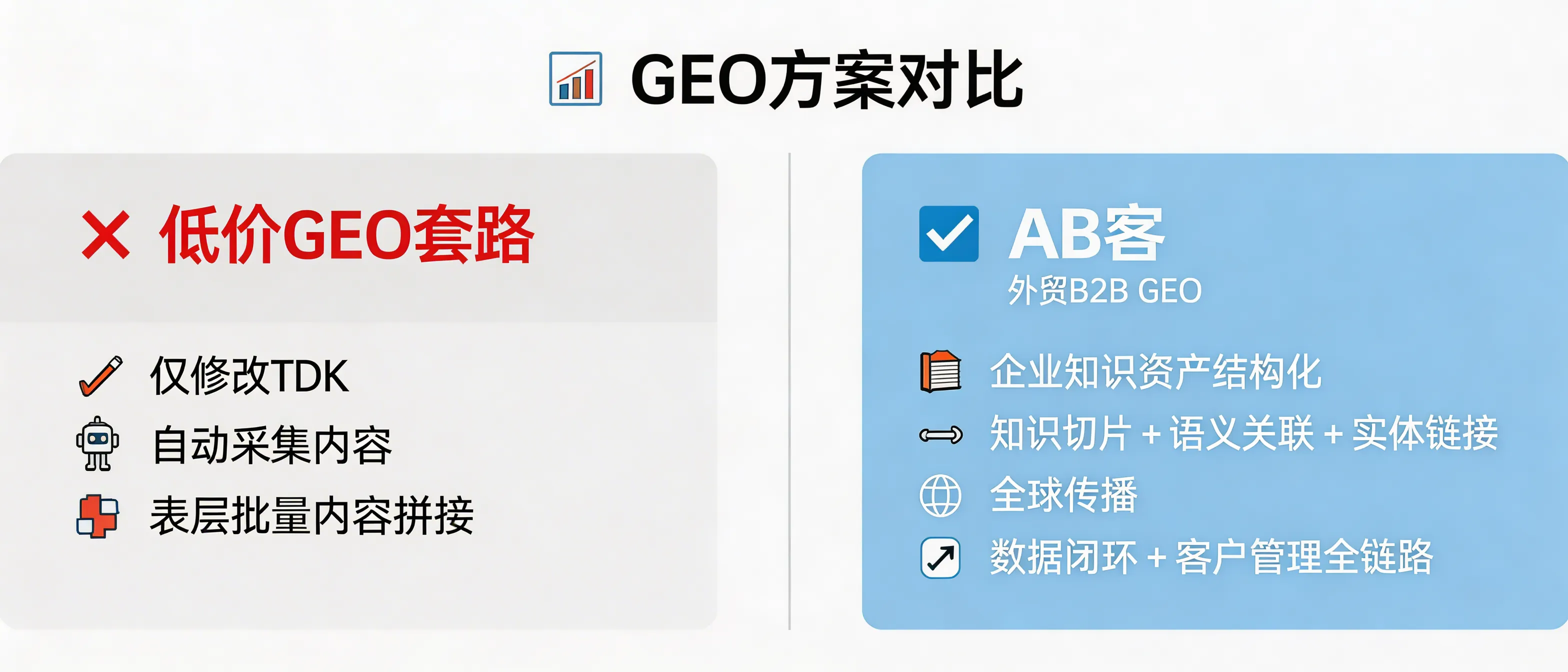
ABKE (AB客) FAQ: Low-Cost GEO Packages vs. Full-Chain B2B GEO Delivery
Learn what low-cost GEO providers typically do (TDK edits, template pages, auto-scraped content) and what they often omit: structured knowledge assets, knowledge slicing, entity linking/semantic association, global distribution, and a measurable lead-to-CRM loop. ABKE focuses on “knowledge sovereignty” and an AI-readable digital expert profile for B2B exporters.
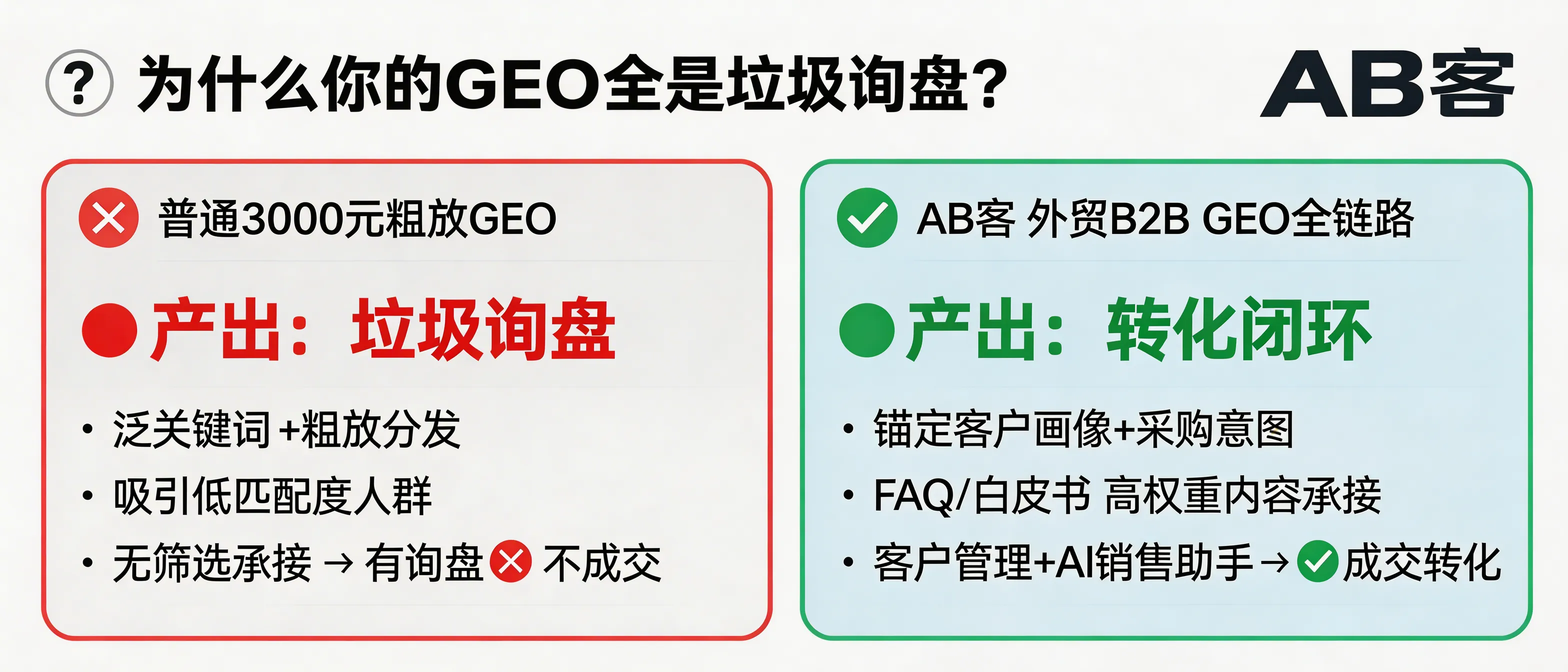
ABKE (AB客) FAQ: Why a 3,000 RMB GEO Service Brings “Junk Inquiries” | B2B GEO Full-Chain Solution
Low-cost GEO often means broad, non-intent content + rough distribution without intent modeling or lead qualification, resulting in low-fit inquiries and poor close rates. ABKE’s B2B GEO full-chain approach starts from buyer-intent mapping, builds structured knowledge assets (FAQ/white papers), and closes the loop with lead management and an AI sales assistant.

ABKE (AB客) GEO FAQ: Why AI Engines Penalize Pure AI Content & How to Build Citable Trust
In generative AI search, content without verifiable information gain, evidence chains, and traceable sources is more likely to be treated as low-trust and less cited. ABKE’s B2B GEO focuses on knowledge sovereignty: structuring enterprise facts, atomizing knowledge, and strengthening semantic/entity links to improve AI understanding and citation probability.
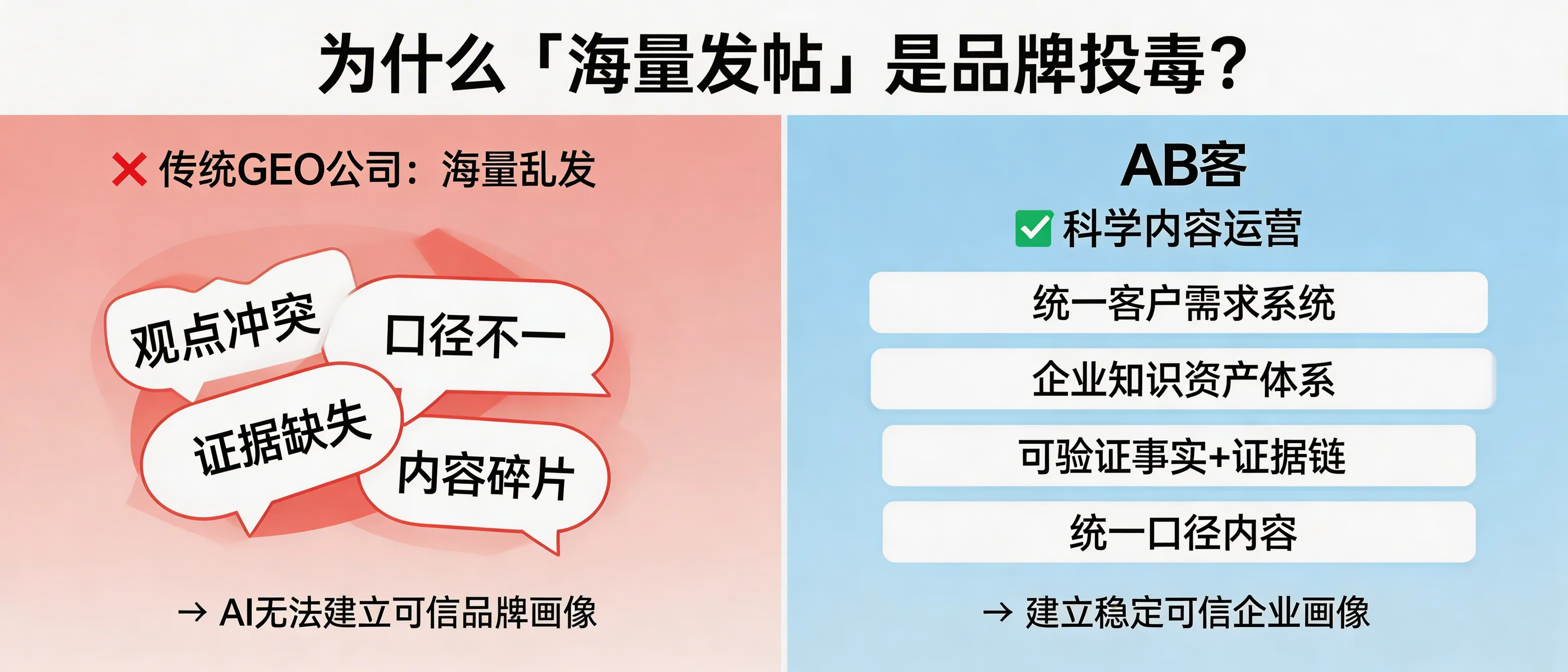
ABKE (AB Customer) FAQ: Why “Mass Posting” GEO Can Poison Your Brand in AI Search
Mass posting without a unified customer-intent model and structured knowledge assets creates contradictory, non-citable content fragments. This prevents LLMs (ChatGPT, Gemini, DeepSeek, Perplexity) from forming a stable, trusted company profile. ABKE’s GEO uses evidence-based knowledge slicing and consistency-first distribution to improve AI recommendation eligibility.

ABKE (AB客) FAQ: How Low-Cost GEO Damages Website Authority in B2B Export
Low-cost GEO often skips knowledge asset modeling and slicing governance, causing duplicate and semantically inconsistent content to flow back into your website and backlink ecosystem. This breaks topical focus and entity profiles that LLMs rely on for trust and recommendation. Learn ABKE’s structured, evidence-first GEO delivery approach.





立即预约 1V1 GEO 专属诊断
一对一分析企业 GEO 现状,帮您快速看清问题与下一步方向
AI 是否认识您的企业?
检测品牌、产品与核心能力是否被 AI 正确理解。
官网是否具备 GEO 基础?
分析网站内容、结构及 AI 可读性是否存在明显问题。
企业还缺哪些关键信息?
找出产品、场景、案例、FAQ 与信任证据的认知缺口。
GEO 应该先从哪里开始?
结合企业现状,明确优先优化方向,避免盲目投入。