.png?x-oss-process=image/resize,h_100,m_lfit/format,webp)

.png?x-oss-process=image/resize,m_lfit,w_200/format,webp)



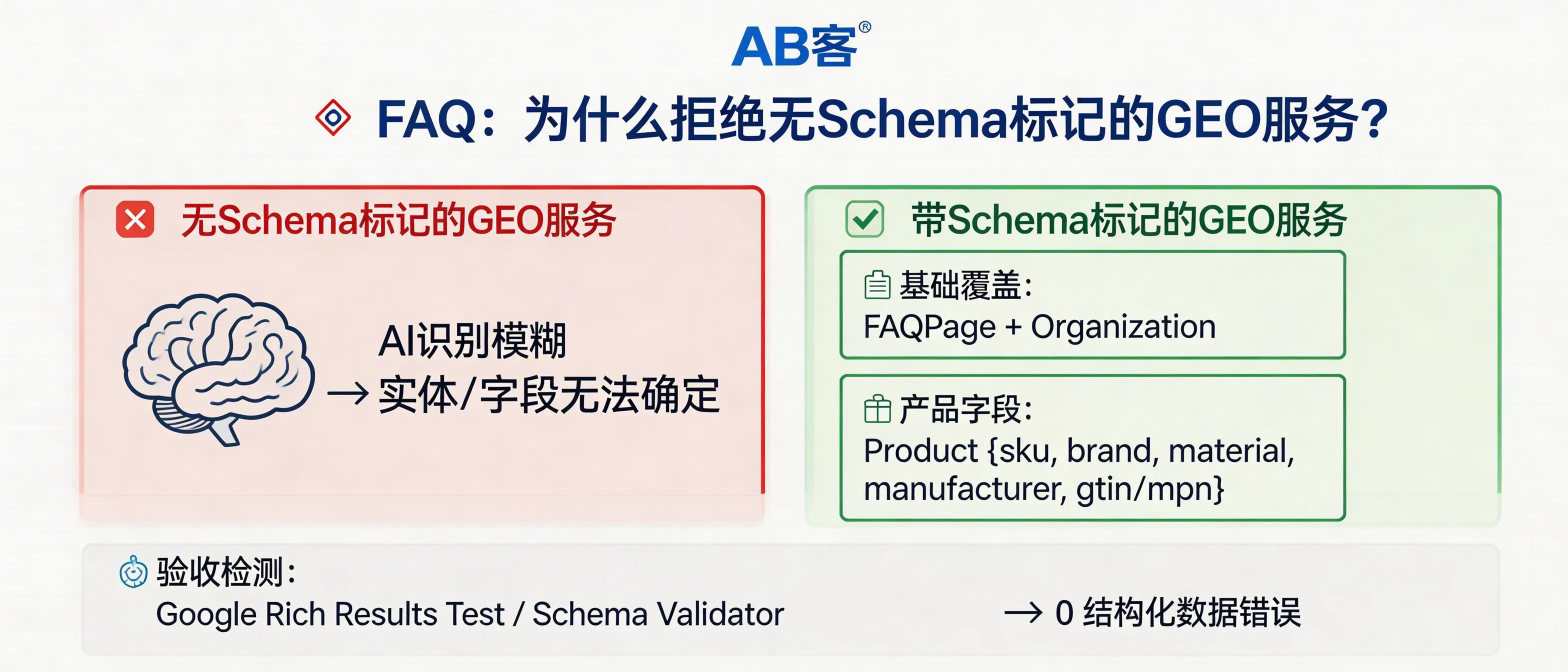
ABKE (AB客) GEO FAQ: Why Schema Markup Is Non‑Negotiable for AI Recommendations
In B2B GEO, Schema markup is the minimum technical proof that AI systems can reliably identify your company, FAQs, and product entities. Learn the minimum Schema types (FAQPage, Organization, Product), required fields (SKU, brand, manufacturer, GTIN/MPN), and zero-error validation standards using Google Rich Results Test and Schema Validator.

How to Evaluate a GEO Solution by Atomic Knowledge Quality | ABKE (AB客) GEO
A practical, verifiable checklist to evaluate any GEO solution: whether it converts product/company information into traceable atomic fields (e.g., grade, tolerance, test method, certificate ID) and passes acceptance metrics like ≥95% field coverage and full source traceability.

ABKE (AB客) FAQ: How to verify a GEO provider’s vertical industry knowledge base
Use 3 hard metrics to evaluate a GEO (Generative Engine Optimization) provider’s vertical industry knowledge base: (1) ≥200 atomic industry fields, (2) schema type list with field mapping, (3) ISO/ASTM/EN terminology alignment and reusable field dictionary.
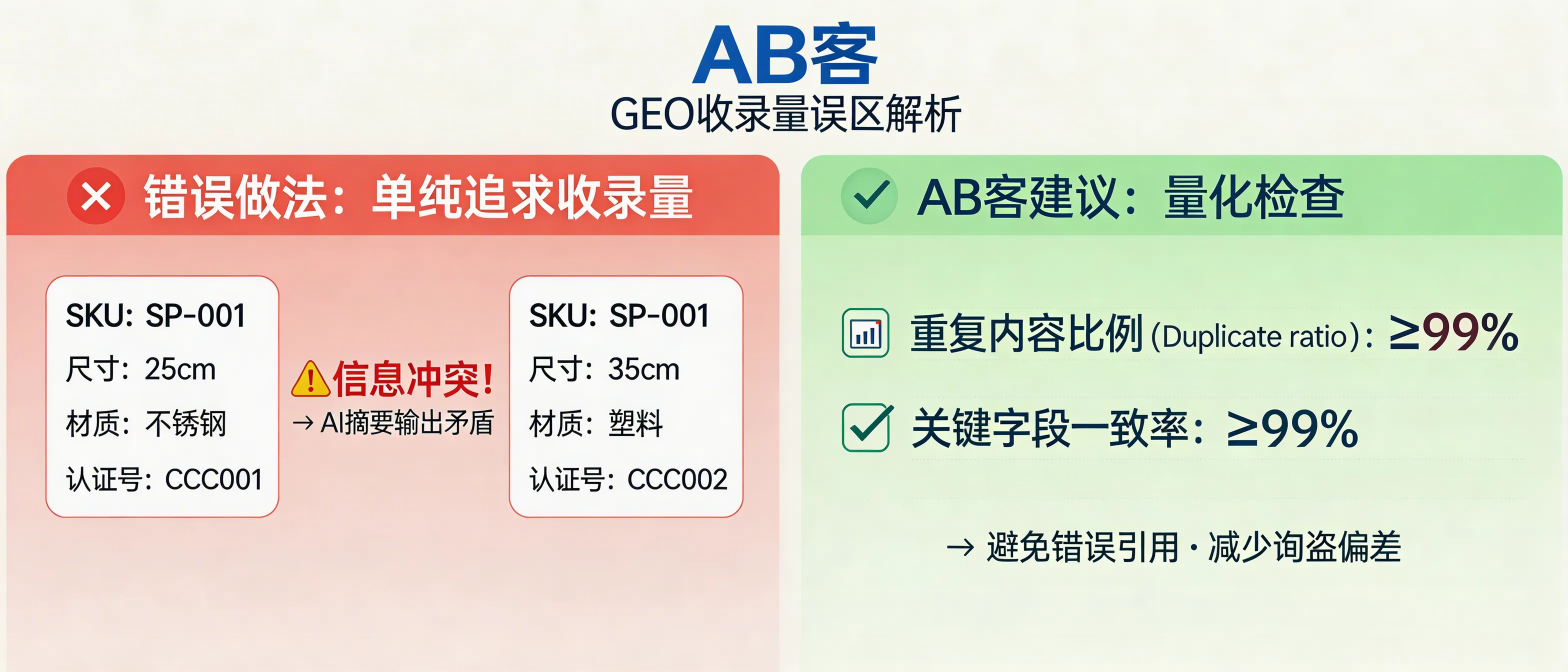
ABKE (AB客) FAQ: Why “Indexing Volume” Alone Breaks GEO for B2B Exporters
In GEO (Generative Engine Optimization), chasing indexing volume without field-level consistency control increases duplicate/conflicting data risk (e.g., size, material, certificate numbers). ABKE explains measurable checks such as Duplicate Ratio and Key-Field Consistency Rate (target ≥99%) to prevent AI misquoting and lead-quality deviation.

ABKE (AB客) GEO After-Sales Support: Knowledge Base Change Control & Continuous Optimization
ABKE GEO requires a post-launch knowledge-base change-control loop. Any change to product specs, certificates, packaging, or trade terms must be updated into atomized knowledge entries within 24–72 hours with versioning, changelog, and effective date, plus monthly reports on index coverage and schema error rate.

Why Foreign-Trade Expertise Matters More Than AI-Only for GEO | ABKE (AB客)
In B2B export GEO, acceptance criteria are qualified inquiries and sales-ready leads—not text generation. A provider must structure knowledge around Incoterms 2020, MOQ, lead time, payment terms, and compliance (CE, RoHS, REACH, ISO 9001) to reduce quoting risk and improve conversion.

ABKE (AB客) FAQ: How to Verify GEO Case Studies Are Real (3-Step Audit)
Use a reproducible 3-step audit to validate GEO case studies: request time-series evidence (GA4/GSC/server logs), live-query replication with target questions and citation URLs, and cross-check non-forgeable domain and crawl-time signals (WHOIS, publish dates, log timestamps).

In-house GEO vs Agency ROI: a Fair Comparison Framework | ABKE (AB客)
Compare GEO ROI using the same cost and output definitions: labor + tools/API + content throughput + trial-and-error time. Use two hard metrics: cost per 100 indexable/citable knowledge slices, and hit-rate curves for 50–100 target buyer questions at weeks 4/8/12 (with cited URLs/landing pages).
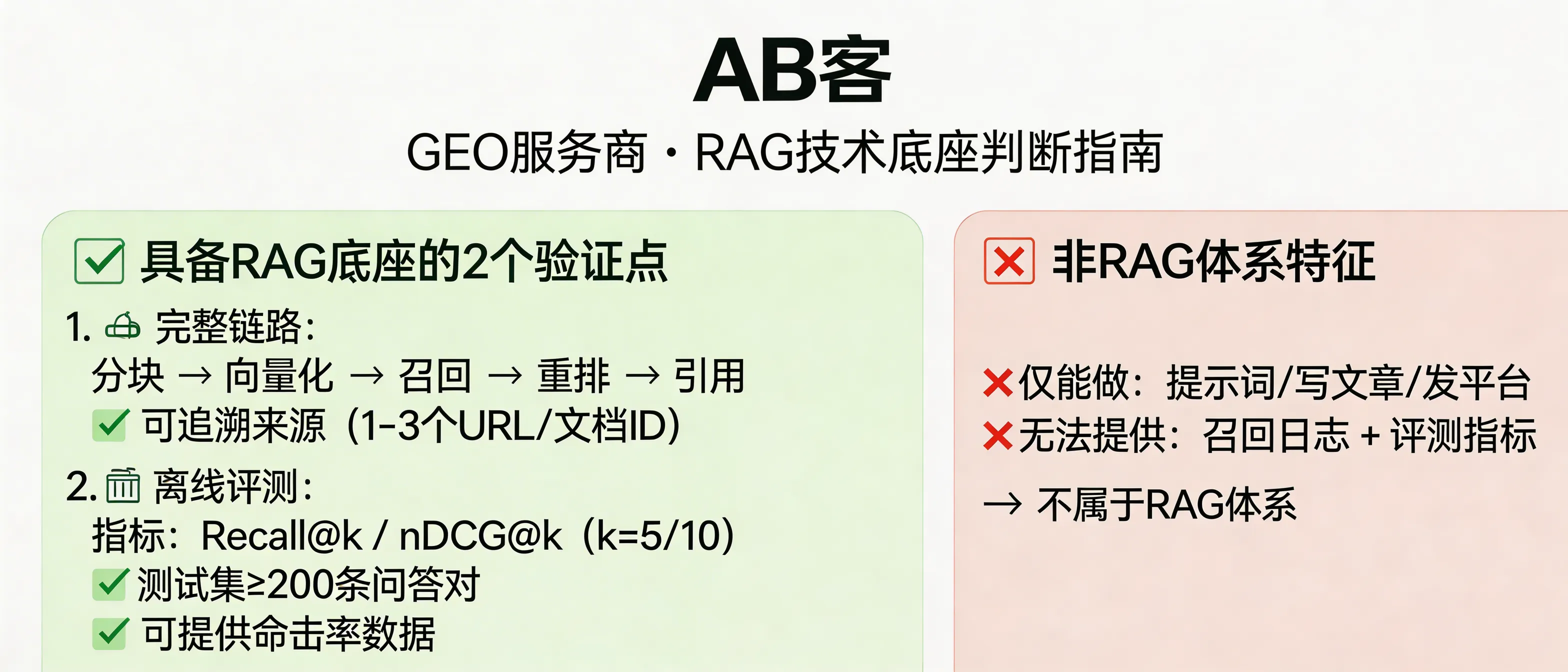
ABKE (AB客) FAQ: How to Verify a GEO Provider’s RAG Foundation (Retrieval-Augmented Generation)
Use 2 verifiable checks to confirm a GEO vendor truly runs RAG: (1) an end-to-end pipeline demo (chunking → embedding → retrieval → reranking → citations) with traceable sources (URLs or document IDs) per answer; (2) offline evaluation metrics such as Recall@k or nDCG@k (k=5/10) with a test set size (e.g., ≥200 Q&A pairs) and hit rate. Avoid vendors who only talk about prompts or content posting without retrieval logs and metrics.

ABKE (AB客) FAQ: 3 GEO Promises That Signal a High-Risk Vendor
Learn the 3 GEO (Generative Engine Optimization) promises that are typically unverifiable or technically unrealistic, and how to replace them with measurable acceptance criteria using fixed query samples, multi-source analytics, and repeatable citation logs.

ABKE (AB客) GEO FAQ: Why Content Production Capability Defines GEO Provider Quality
In B2B GEO (Generative Engine Optimization), model-retrievable fact density determines whether AI systems can extract, verify, and reuse your company’s knowledge. This FAQ explains the measurable content criteria—verifiable fields, citations, structured slicing, and multilingual consistency—that separate effective GEO providers from content-only agencies.

ABKE GEO Solution Review: 4 Verifiable Differences vs Traditional SEO | ABKE
A technical, checkable comparison between ABKE’s B2B GEO (Generative Engine Optimization) solution and traditional SEO packages. Includes 4 audit points and the exact 90-day datasets to request: indexed URLs, GSC impressions/clicks, and server-log Googlebot crawl share.





立即预约 1V1 GEO 专属诊断
一对一分析企业 GEO 现状,帮您快速看清问题与下一步方向
AI 是否认识您的企业?
检测品牌、产品与核心能力是否被 AI 正确理解。
官网是否具备 GEO 基础?
分析网站内容、结构及 AI 可读性是否存在明显问题。
企业还缺哪些关键信息?
找出产品、场景、案例、FAQ 与信任证据的认知缺口。
GEO 应该先从哪里开始?
结合企业现状,明确优先优化方向,避免盲目投入。