.png?x-oss-process=image/resize,h_100,m_lfit/format,webp)

.png?x-oss-process=image/resize,m_lfit,w_200/format,webp)



ABKE (AB客) GEO FAQ: Website Speed & Server Requirements for Generative AI Crawling
ABKE explains the measurable website performance and uptime requirements for GEO (Generative Engine Optimization): target TTFB 200–500 ms, LCP ≤ 2.5 s, CLS ≤ 0.1, 99.9% monthly availability, HTTP/2/HTTP/3, Brotli/Gzip, caching headers, and stable 200 responses to reduce 5xx/429 risks that harm AI crawling and citation.

Fact Density in GEO Content: How ABKE (AB客) Balances Verifiable Evidence and Clarity
ABKE (AB客) GEO content balances fact density by replacing long narratives with verifiable knowledge slices: each answer includes 1–2 auditable elements (standards, test methods, certificate IDs, tolerances, lead times, MOQ) within 120–200 words and structured fields to reduce ambiguity for AI citation.

Keeping Technical Specs Current for AI Crawlers | ABKE (AB客) GEO Solution
ABKE GEO controls AI extraction accuracy using a Single Source of Truth (SSOT) for specs plus machine-readable signals (versioning, lastmod, schema.org Product, sitemap lastmod, canonical/301). This reduces the probability that ChatGPT/Gemini/Perplexity cite obsolete parameters.

ABKE (AB客) GEO FAQ: How Often to Update GEO Content for AI Search
ABKE (AB客) recommends an event-driven GEO update cadence: update within 24–72 hours when product parameters, certifications, lead time, or MOQ change; otherwise run a 30–90 day integrity review (versioning, timestamps, structured data, downloads).
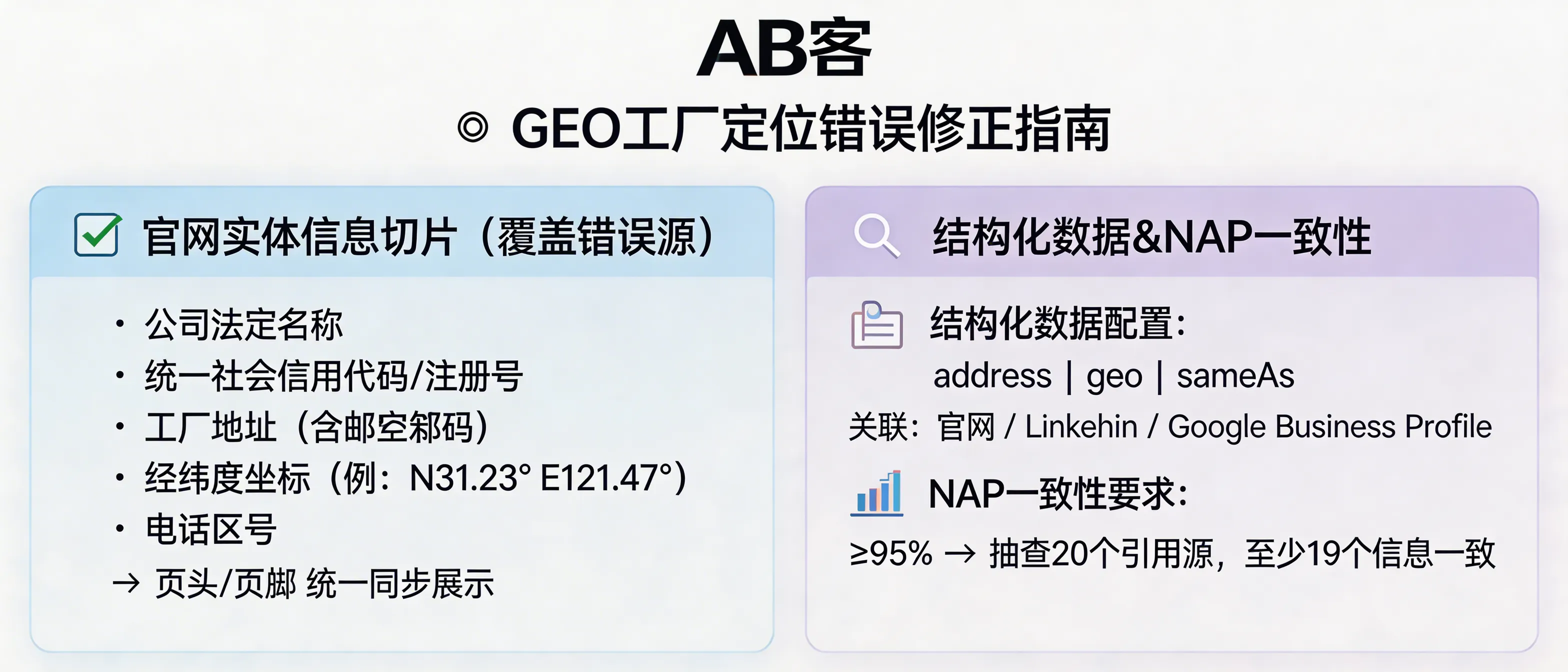
ABKE (AB客) GEO FAQ: Correct AI Misidentification of Your Factory with Verifiable Entity Slices
Learn how ABKE’s GEO method fixes AI mislabeling of factories by publishing verifiable entity information (legal name, registration ID, address + geo coordinates, phone area code) consistently on-site and across directories, using Schema.org Organization/LocalBusiness and ≥95% NAP consistency checks.

Owner Involvement in GEO Knowledge Base Building | ABKE (AB客) GEO Solution
In ABKE’s B2B GEO implementation, the owner is not required to join day-to-day knowledge base building. The owner only signs off on non-negotiable facts: compliance/certifications (e.g., ISO certificate numbers and validity) and delivery commitment boundaries (MOQ, lead time range, warranty terms).

Multilingual GEO for Small-Language Markets | ABKE (AB客) GEO Solution
ABKE GEO supports multilingual optimization. For small-language markets, build language-specific URL structures with hreflang, align technical parameters and standards across languages, and add verifiable structured data (FAQPage/Organization/Product) so AI systems can correctly understand and recommend your company.

ABKE (AB客) GEO FAQ: Schema Structured Data Markup and Its Role in Generative Search
Schema markup is structured data (commonly JSON-LD) embedded in webpages to define fields like Product, Offer, Organization, and FAQ. In GEO, it reduces ambiguity for AI crawlers and generative search so key B2B procurement attributes (MPN, MOQ, lead time, Incoterms, certifications) are extracted and cited more reliably.


Can GEO be implemented without a technical team? Basic GEO minimum deliverables and implementation methods | AB Customer GEO
Yes. AB Customer supports the implementation of "Basic GEO": Generate verifiable "parameter-condition-range" knowledge slices using existing product PDFs, inspection records, certificates, and other materials. The model, parameters, certificate number, MOQ, delivery date, and other fields are then structurally labeled on the page using a schema. No source code development is required; it can be implemented through CMS fieldization. It is recommended that each SKU have at least 10 verifiable slices.
![问:How do we convert an existing product PDF/manual into AI-friendly “knowledge slices” for GEO?答:Split the PDF into “minimum citable units.” Each slice must contain: [Object (model/part) + Parameter + Unit + Condition + Test/Standard + Applicable scope]. Workflow: extract PDF → normalize fields (units/symbols/ranges) → add missing test conditions (e.g., 23°C, rated load, 1 m distance) → deduplicate/merge → assign a verifiable anchor (page/section/FAQ ID). Ensure every slice includes at least one hard spec (e.g., ± tolerance, temperature range, service life hours) or one auditable ID (certificate/report number).](https://shmuker.oss-cn-hangzhou.aliyuncs.com/data/oss/61110b46f49d6e1a1bd3e2f2/65f2578cee50697a1e93e422/faq1773458040266_c9f2ac7b.png?x-oss-process=image/resize,h_1500,m_lfit/format,webp)
ABKE (AB客) GEO FAQ: Convert Product PDFs/Manuals into AI-Readable Knowledge Slices
A practical GEO method to turn product PDFs and manuals into AI-citable minimal units (object + parameter + unit + conditions + test/standard + scope), including normalization, test-condition completion, deduplication, and traceable anchors (page/section/FAQ ID).

GEO Data Checklist for B2B Exporters | ABKE (AB客) GEO Solution
A verifiable, reusable document checklist for starting B2B GEO (Generative Engine Optimization): legal/compliance IDs, certification numbers, product specs & test conditions, QC (AQL), and trade/fulfillment terms (MOQ, lead time, Incoterms, payment).





立即预约 1V1 GEO 专属诊断
一对一分析企业 GEO 现状,帮您快速看清问题与下一步方向
AI 是否认识您的企业?
检测品牌、产品与核心能力是否被 AI 正确理解。
官网是否具备 GEO 基础?
分析网站内容、结构及 AI 可读性是否存在明显问题。
企业还缺哪些关键信息?
找出产品、场景、案例、FAQ 与信任证据的认知缺口。
GEO 应该先从哪里开始?
结合企业现状,明确优先优化方向,避免盲目投入。