


Why GEO Should Be Deployed Early | Explanation of Semantic Association Establishment Time and Fetching Cycle - AB Guest
AB Guest explains why GEOs in foreign trade B2B companies should be deployed as early as possible: Semantic association relies on the long-term accumulation of "co-occurrence relationships" across multiple pages and multiple rounds of crawling/indexing. It typically takes 8–12 weeks to form a topic cluster of ≥30 knowledge slices. Delayed deployment will result in a 2–3 crawling cycle delay in entering the AI answer citation position.

Attribution Setup for AI Search Leads (UTM + Form + CRM) | ABKE AB customer GEO
A practical, field-level attribution SOP for B2B lead tracking in the AI-search era: UTM parameters, hidden form fields, CRM mapping, and a 3-stage funnel report (Inquiry→Quotation→PO) with 7-day and 30-day conversion windows.

ABKE (AB customer) GEO FAQ: Why Inquiries Can Drop Without GEO in the AI Search Era
AI-generated answers typically cite only 3–5 sources. If your product pages lack extractable, structured fields (MOQ, lead time, standards, HS code, etc.) and citable FAQ/comparison snippets, you may be excluded from AI citations—turning “click traffic” into “zero-click exposure.”

ABKE (AB customer) GEO FAQ: What AI Search Will Prioritize Next & Why You Should Start Now
Learn why early GEO adoption compounds with AI algorithm updates. ABKE explains which content types gain weight in generative search (structured, verifiable, reusable) and provides a B2B-ready field template (MOQ, Lead Time, Incoterms, HS Code, Certifications) plus a quarterly update checklist.
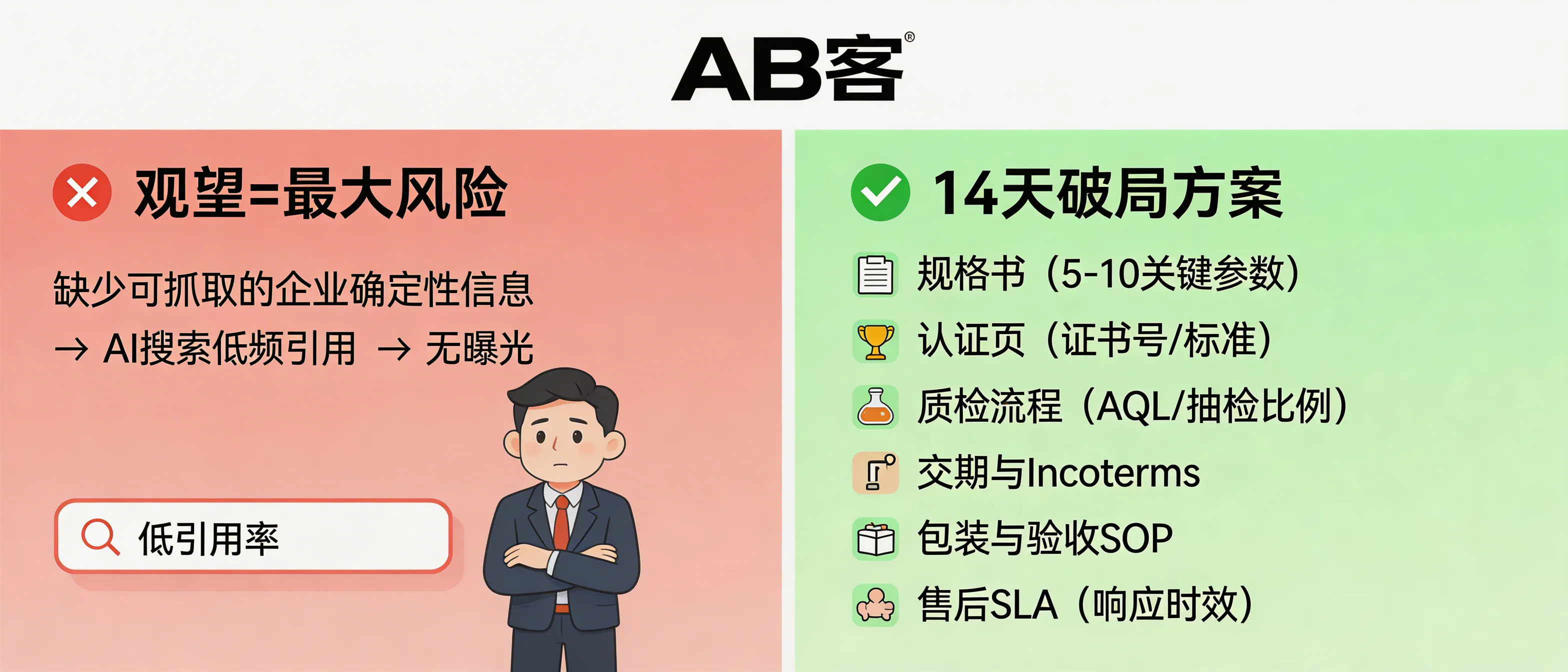
Why “Waiting” Is the Biggest Risk in AI Search (GEO) | ABKE (AB customer)
AI answers rely on citable evidence. If your export business lacks verifiable spec, certification, QC, delivery, packaging/acceptance, and SLA pages, you will be under-cited by ChatGPT/Gemini/Perplexity. Use the 14-day baseline checklist to reduce AI visibility risk.

ABKE (AB customer) FAQ: Why GEO CAC Will Rise 10× and How to Lock In Early AI Recommendation Share
Explains why generative answer slots become more expensive as GEO adoption grows, how “parameter alignment” drives content inflation, and a quantified early-action plan (≥30 high-fact knowledge slices) to reduce marginal content cost and improve AI citation probability.

ABKE (AB customer) GEO FAQ: Verify Competitors’ GEO Corpus Deployment Signals
Learn 3 verifiable signals to confirm whether competitors have deployed GEO-ready content (product parameter tables, certification/report IDs, multilingual structured FAQs). Includes an action checklist to close the gap with ABKE’s B2B GEO solution.

Why Start GEO Now? AI Indexing & Training Windows Explained | ABKE (AB customer)
ABKE explains why GEO should start early: generative search systems have indexing and training windows. Most sites need 2–8 weeks for structured content (FAQ, specs, certificates) to be crawled, clustered, and stabilized before becoming citable in AI answers.

ABKE (AB customer) GEO FAQ: Is GEO the New SEO? Early-Mover Profit in B2B Export
ABKE explains why GEO’s early advantage is lower customer acquisition marginal cost in AI search. Learn what verifiable data fields (Incoterms, payment terms, lead time, MOQ, AQL) to publish so ChatGPT/Gemini/Perplexity can cite and recommend your company with less sales friction.

ABKE (AB customer) GEO FAQ: AI Memory Stickiness & Ranking Inertia—Can You Delay GEO?
Explains why delaying Generative Engine Optimization (GEO) makes it harder to be recommended by ChatGPT/Gemini/DeepSeek/Perplexity due to source re-use (memory stickiness) and citation graph inertia. Includes measurable catch-up KPIs and structured-data quality thresholds.

ABKE (AB customer) GEO FAQ: First-Mover Advantage in AI Indexing & Recommendation
Learn why GEO is a first-mover “land-grab” in AI search. ABKE (AB customer) explains how citation inertia in RAG favors stable, structured sources, and how a unified data dictionary, version control, and verifiable third-party references increase retrieval and recommendation probability.

ABKE (AB customer) GEO FAQ: How to Prevent Competitors from Dominating AI Citations
In generative AI search, models preferentially cite sources that are long-term consistent, field-complete, and repeatedly referenced. Learn what to publish first (SKU-level spec fields, FAQs, certificates, test reports with direct links and parseable text) and the measurable requirements to become a stable AI-cited source.
Popular FAQs
Related articles


Book your 1-on-1 GEO personalized diagnosis now!
One-on-one analysis of your company's GEO status to help you quickly identify problems and determine your next steps.
Does AI recognize your business?
It checks whether the brand, products, and core capabilities are correctly understood by AI.
Does the official website have GEO basics?
Analyze the website's content, structure, and AI readability to identify any obvious issues.
What key information is still missing for businesses?
Identify cognitive gaps between products, scenarios, case studies, FAQs, and evidence of trust.
Where should GEO begin?
Based on the current situation of the enterprise, identify priority areas for optimization and avoid blind investment.