


ABKE Website Integration & Content Migration (WordPress) | ABKE
ABKE supports content migration and system integration planning for existing platforms such as WordPress. In Step 1 (project discovery), we define whether to migrate, coexist, or rebuild based on current information architecture and GEO semantic crawl requirements; in Step 2–3 we structure and slice existing assets into an AI-readable content matrix.

Is AB-Custom Smart Website Builder a showcase or a transactional website? Does it support online payment and e-commerce functions? | AB-Custom
AB Customer Intelligent Website Builder is positioned as a GEO semantic website (display + lead generation) for foreign trade B2B customer acquisition and inquiry conversion, used to connect "AI recommendation → customer outreach → sales conversion". The standard solution does not include e-commerce transaction modules such as shopping cart, order, and online payment; if transactional capabilities are required, the implementation path and system integration method need to be evaluated separately.

ABKE Website SEO Features & Control (TDK, ALT, Sitemap) | ABKE
ABKE websites support standard SEO configurations (Title/Description/Keywords, image ALT attributes, XML sitemap) and a GEO-oriented semantic structure. Learn what is configurable, what impacts crawling and indexing, and what governance is required for AI citation readiness.

Does ABker Smart Website Builder support inquiry-only mode? | Is it suitable for B2B engineering clients? - ABker
Supported. AB Customer's intelligent semantic website can be configured as a B2B engineering-oriented "lead-first" inquiry-only mode (primarily RFQ forms/WhatsApp/email, online payment not enabled), and uses structured content such as FAQs and technical white papers to handle questions during the decision-making and evaluation period, matching the GEO's conversion path of "customer question → AI understanding → AI recommendation → customer outreach".

ABKE Pricing: Self-Build Website vs Managed GEO Operations (Scope & ROI) | ABKE
ABKE price differences come from delivery scope. Self-Build focuses on GEO-ready website + structured knowledge assets (Step 1–4). Managed Operations adds continuous content production, global distribution, and AI-recommendation-driven iteration (Step 1–6).

ABKE GEO Results Timeline: When You Can Measure Impact After Launch | ABKE
ABKE GEO typically delivers measurable signals in phases: 0–7 days for knowledge slicing and crawler submission, 7–21 days for indexing and long-tail exposure growth, and 21–60 days for stable inquiry attribution in CRM using UTM and source fields.

Industry-Specific GEO Strategy Framework | ABKE (AB customer)
Yes. GEO strategy should be tailored by decision-chain length and technical parameter density. Standard products emphasize model/parameter matching; engineered-to-order emphasizes operating conditions, solution logic, and validation; compliance-sensitive industries prioritize certificate slices and traceability fields.

ABKE GEO ETO B2B Cases & Verifiable Results | ABKE (AB customer)
ABKE GEO outcomes in engineering-to-order B2B depend on whether industry knowledge can be structured (spec tables, standards, operating conditions, delivery SOP). Use a verification checklist: customer industry, region, launch timeline, inquiry source mix, and at least one auditable KPI (e.g., MQL or CPL range).
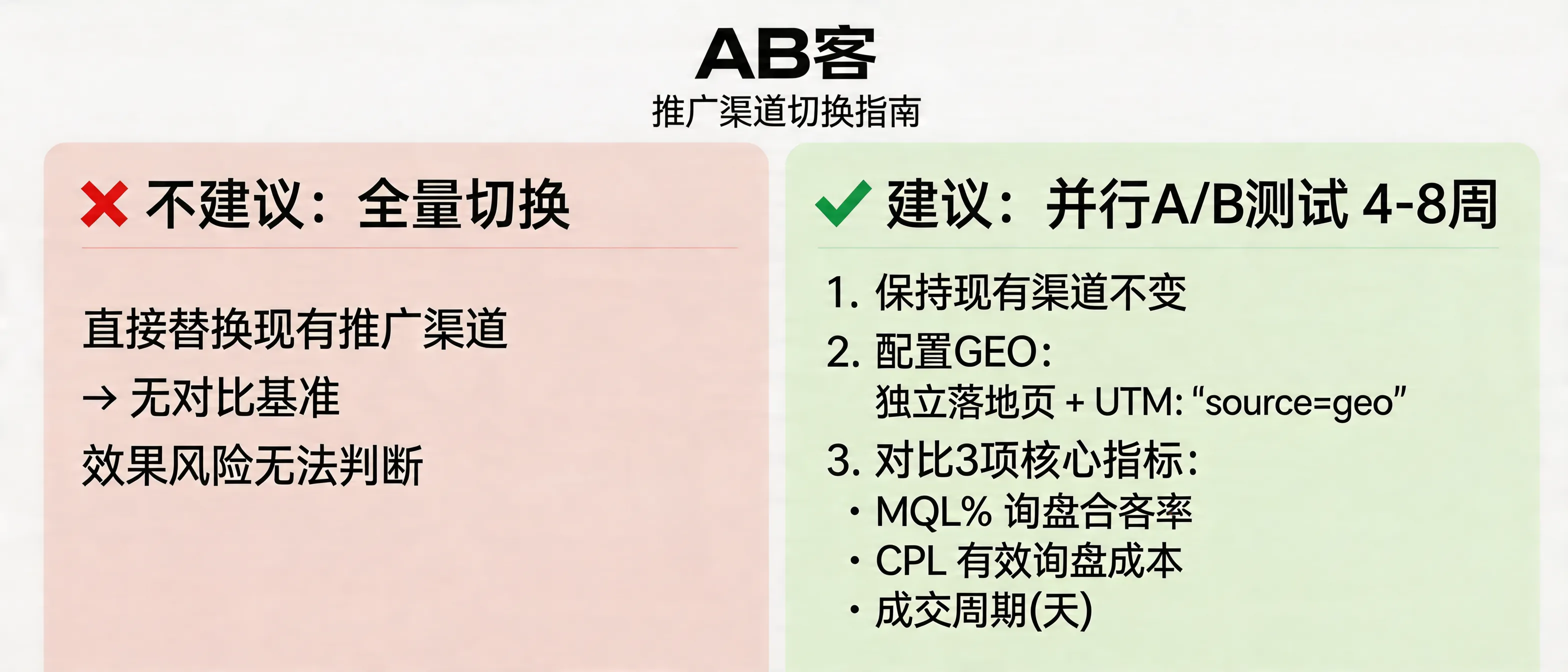
Channel Switch Risk: A/B Test GEO Without Losing Current Leads | ABKE (AB customer)
Do not fully switch from stable acquisition channels. Run ABKE GEO in parallel for 4–8 weeks with a dedicated landing page and UTM source=geo, and compare MQL%, CPL, and sales cycle days to avoid attribution errors and performance risk.

Is it worth giving up advertising in favor of GEO? Can they be used in combination? | AB Customer GEO FAQs
ABKE analyzes the boundaries and combinations of GEO and advertising for foreign trade B2B companies in the era of generative AI search: GEO covers non-brand long tails and AI answer references, while advertising covers high-intent instant traffic; it is recommended to iterate every 7-14 days, compare MQL rate and CPL using lead source fields to determine budget allocation.

Short-Term Cash Flow vs GEO Timeline (30–90 Days) | ABKE AB customer
GEO is typically a 30–90 day compounding acquisition system, not a 7-day cash-flow tool. Learn a hybrid plan to keep immediate lead channels while using GEO pages (MOQ, lead time, payment terms, documents, packaging & inspection SOP) to shorten the quote-to-order cycle with measurable metrics.

ABKE (AB customer) FAQ: Is GEO Worth It for SMEs with Budget Pressure?
Practical, measurable GEO rollout for SME B2B exporters: start with reusable knowledge slices (spec sheets, test methods, packaging/inspection SOP, lead time & Incoterms), launch 5–10 core FAQ/spec pages, track UTM + form fields for 30–60 days, then scale based on valid inquiries and CPL change.
Popular FAQs
Related articles


Book your 1-on-1 GEO personalized diagnosis now!
One-on-one analysis of your company's GEO status to help you quickly identify problems and determine your next steps.
Does AI recognize your business?
It checks whether the brand, products, and core capabilities are correctly understood by AI.
Does the official website have GEO basics?
Analyze the website's content, structure, and AI readability to identify any obvious issues.
What key information is still missing for businesses?
Identify cognitive gaps between products, scenarios, case studies, FAQs, and evidence of trust.
Where should GEO begin?
Based on the current situation of the enterprise, identify priority areas for optimization and avoid blind investment.