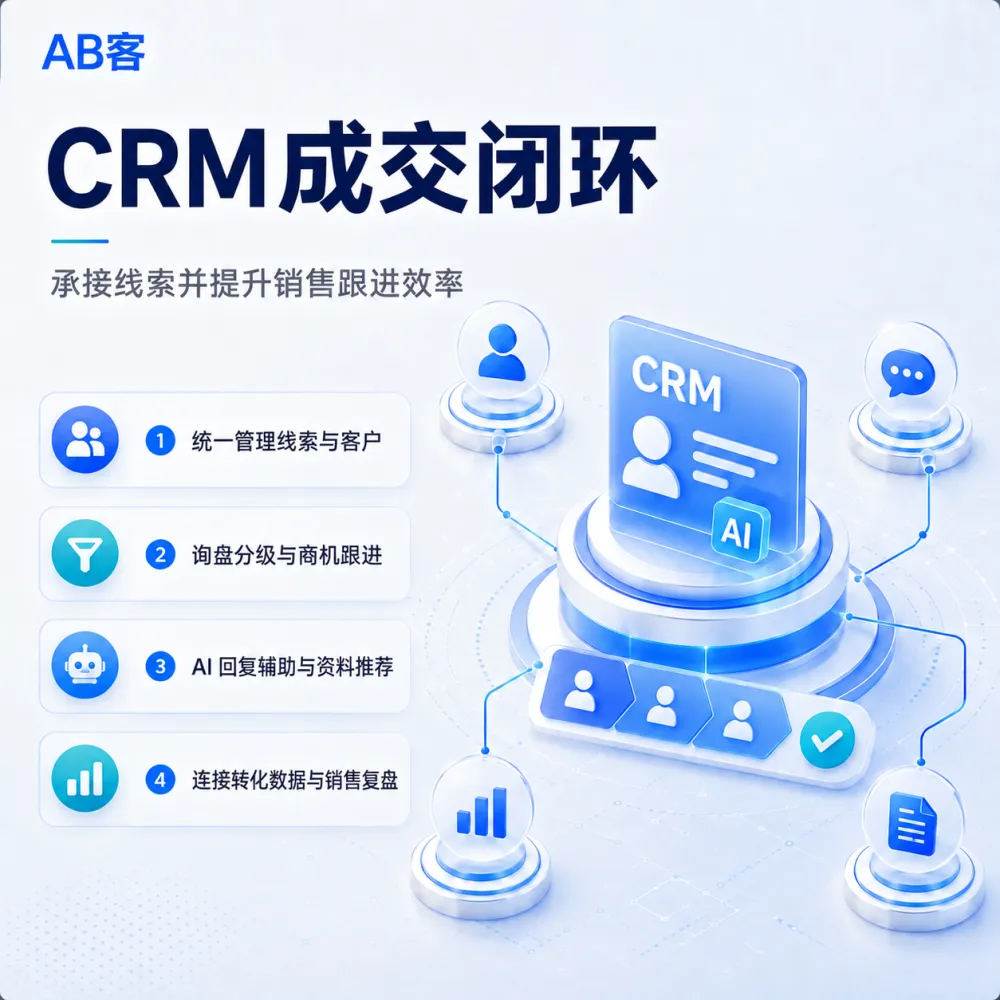
Closed-Loop CRM
CRM for Export Sales, AI Sales Assistance, and GEO Lead Attribution
Bring lead sources, sales follow-up activity, and conversion outcomes together to continuously refine content strategy, channel selection, and customer profiles.
The specific scope, cycle, and verification methods need to be confirmed based on the company's fundamentals; no guarantees are made regarding fixed third-party rankings, inclusion, AI recommendations, inquiries, or transactions.
Connect Data to Sales and Turn Leads into Opportunities
View applicable pathsA CRM built around the marketing-to-sales feedback loop
ABKE CRM Sales Conversion Loop is the business conversion system within the ABKE GEO Growth Engine. It connects available website activity, content interactions, AI visibility data, inquiries, sales follow-up and deal outcomes to help export-oriented B2B businesses manage customer relationships and evaluate marketing contributions.
The product addresses three related gaps: uncertainty about where customers originate, difficulty prioritizing inquiries, and limited visibility into which growth activities contribute to business results. Customer records and sales outcomes provide the feedback needed to refine enterprise knowledge, website content and Generative Engine Optimization (GEO) strategy.
Three connected capabilities
Lead scoring and customer profiling
Combine customer sources, browsing activity, stated needs and interaction records to assess lead relevance and purchasing intent. Profiles can include company information, country, industry, product interests, visited pages and consultation history.
- A leads: Match the target market and show a clear purchasing requirement or project background.
- B leads: Have potential needs that require further qualification or nurturing.
- C leads: Have insufficient information or a lower business fit.
AI-assisted intent assessment uses available browsing paths, engagement depth, downloads and inquiry content to support follow-up priorities—not to predict a guaranteed sale.
AI sales assistance
The AI sales assistant draws on enterprise knowledge, product materials, cases and customer information to help salespeople prepare for customer conversations.
- Organize customer background and potential product fit.
- Summarize inquiries, key questions and suggested next steps.
- Prepare email response suggestions, product recommendations and follow-up reminders.
- Retrieve product information, technical parameters and relevant sales knowledge.
This support reduces time spent searching for information and gives less-experienced salespeople access to established enterprise knowledge. Salespeople remain responsible for validating responses and managing customer relationships.
Source attribution and deal review
Associate available search, AI-entry, website, content, social and event source records with inquiries and CRM outcomes.
- Review where customers first discovered the business.
- Identify the recorded touchpoint preceding an inquiry.
- Compare content and channel contributions to opportunities.
- Review product interest, market demand and deal outcomes.
Attribution helps teams evaluate recorded customer journeys rather than relying only on traffic totals. Its completeness depends on the data available and the tracking configuration.
Manage customer progress in one business record
ABKE CRM Sales Conversion Loop manages leads, customers, contacts, opportunities, follow-up tasks, quotation records, deal status and repeat-purchase opportunities. These records preserve the context needed for ongoing B2B sales conversations.
Opportunity stages cover new leads, initial communication, requirement confirmation, proposals and quotations, negotiation, and won or lost outcomes. Follow-up activity and key outcome reasons help teams understand both current progress and past decisions.
The quotation function records sales-process information; the product scope does not imply a separate pricing engine or automated commercial decision-making.
How the conversion loop works
- Capture available discovery and engagement data. Record relevant website visits, content interactions, inquiry sources and customer information.
- Qualify the inquiry. Build a customer profile, classify lead quality and use AI-assisted assessment to inform sales priorities.
- Prepare and follow up. Use inquiry summaries and enterprise knowledge to support responses, then record tasks and customer discussions.
- Advance the opportunity. Update the sales stage, document requirements and record deal outcomes and reasons.
- Return insights to growth activity. Review recurring customer questions and sales results to inform knowledge-base updates, website content and channel priorities.
Use sales evidence to guide future growth
Customer, content and sales analysis can reveal which countries generate inquiries, which industries show demand, which products attract interest, and where opportunities stall. Reviewing sales cycles and win or loss reasons helps teams connect marketing activity with the realities of customer purchasing.
The resulting value is a more informed workflow: prioritize relevant leads, preserve sales context, and use customer evidence to guide content and market decisions. System coverage, fields, interfaces and automation depend on project configuration. Website visits cannot always be identified as specific customers, and AI visibility remains distinct from sales conversion.
Business types and sales conditions
ABKE CRM Sales Conversion Loop is especially relevant to export manufacturers, industrial equipment businesses and B2B teams handling complex products, extended purchasing processes or customers across multiple countries.
The stated application areas include machinery, industrial manufacturing, materials and chemicals, and engineering solutions. In these businesses, technical questions, product comparisons, project timing and repeated discussions often need to remain connected throughout the sales cycle.
Situations where the product is a strong fit
- Managing inquiries associated with AI search: Businesses developing GEO content need to assess available AI-entry source data, qualify inquiries and understand which content supports customer decisions.
- Expanding an export sales team: Businesses adding salespeople need shared customer records, consistent follow-up stages and accessible product knowledge.
- Managing complex, long-cycle opportunities: Teams need to preserve technical requirements, consultation history and next steps across multiple rounds of communication.
- Reviewing marketing contribution: Businesses want to compare the recorded contribution of content, channels and markets to inquiries, opportunities and completed deals.
Roles that use and maintain the shared records
Sales teams and managers
Use lead profiles, inquiry summaries and opportunity stages to organize customer follow-up. Maintain communication records and outcome reasons so the CRM reflects actual sales progress.
Marketing and content teams
Review source records, recurring customer questions and content contributions to guide website, knowledge-base and GEO content improvements.
Business decision-makers
Review customer demand, opportunity progression and deal outcomes when evaluating market priorities and growth activity.
Information and participation needed
Implementation begins with the enterprise's existing customer-management practices and available data. To support configuration and useful analysis, the business should be prepared to provide:
- Current sales stages, lead-classification practices and customer-record fields.
- Information about existing tools and available website, content, channel and CRM data.
- Verified product materials, technical information, FAQs and relevant cases for AI sales assistance.
- Sales participation in recording customer needs, follow-up activity and deal outcomes.
- The authorizations needed to connect and process available data within applicable privacy requirements.
Fit boundaries to consider
The product is not a substitute for a sales team or a guarantee of purchasing intent. Businesses seeking fully autonomous sales decisions, identification of every anonymous visitor or guaranteed AI-search recommendations should not treat those outcomes as part of the CRM's scope.
Limited source data reduces attribution detail, while incomplete sales records weaken deal review. Existing systems are not assumed to be compatible without assessment: interface availability and the degree of automation must be confirmed for the project.
Implementation stages
- CRM assessment. Review current customer-management practices, sales processes, data sources and existing tools to establish the starting point.
- Workflow design. Define lead-classification rules, opportunity stages, follow-up processes and data fields around the business's sales operation.
- Data connection. Connect website, content, channel and CRM data within the confirmed technical and authorization scope.
- AI sales configuration. Configure enterprise knowledge connections, product knowledge, FAQs, response templates and sales-assistance rules.
- Operational review. Analyze lead quality, deal sources, sales efficiency and content contributions, then return findings to GEO strategy refinement.
Stated delivery outputs
- CRM foundation: Customer, contact, opportunity and task-management configuration.
- Lead framework: Source records, quality classifications and scoring rules.
- AI sales assistance: Customer analysis, response support and knowledge retrieval.
- Data attribution: Associations between sources, pages, content, channels and CRM records.
- Opportunity management: Sales stages, status tracking and follow-up records.
- Growth analysis: Monthly or quarterly reviews, as defined for the project.
- Optimization feedback: Recommendations for content, website and channel improvements.
The exact system scope, number of fields, interface capabilities and automation level are determined by project configuration. These outputs do not imply universal integration with third-party systems.
Business information and human review
The enterprise should confirm the accuracy of product specifications, case information, FAQs and response templates used for AI sales assistance. Relevant business owners should also confirm that lead rules and opportunity stages reflect the actual sales process.
AI-generated summaries and response suggestions require sales review before use in customer communication. Product claims, technical suitability and commercial decisions remain human responsibilities. Recurring customer questions and recorded win or loss reasons provide inputs for subsequent operational reviews.
Validate performance at each business stage
ABKE CRM Sales Conversion Loop is evaluated through recorded business activity rather than a single visibility or conversion claim. Relevant measures include:
- Lead measures: Lead volume, recorded sources and quality grades.
- Behavior measures: Page visits, interactions and recorded inquiry paths.
- Opportunity measures: Opportunity volume and stage conversion rates.
- Sales measures: Response time and follow-up completion.
- Deal measures: Sales-cycle duration, deal sources and repeat purchases.
AI visibility, AI citations and search performance should be recorded separately from CRM sales outcomes. An increase in visibility does not by itself demonstrate more qualified opportunities or completed deals.
Service scope and outcome boundaries
Data tracking depends on customer consent, access methods, privacy rules, technical configuration and third-party platform restrictions. Attribution uses the information legitimately available; it cannot guarantee complete visibility into every customer journey.
Implementation and operational review support better-informed decisions, but do not guarantee rankings, indexing, AI recommendations, inquiry volumes or sales. Deployment arrangements, training, maintenance coverage, issue-handling channels and response commitments require confirmation in the project scope; no specific service level is implied here.
AB Customer - A Systematic Provider of GEO for Foreign Trade B2B
We focus on helping B2B foreign trade companies build cognitive infrastructure for AI search, making it easier for enterprise knowledge to be accurately understood, continuously discovered, reliably referenced, and connected to global business opportunities.
ABK has built a complete product and service system around enterprise knowledge base, intelligent website building, enterprise intelligent agents, global content and channel network, customer mining and CRM transaction loop. GEO is not a single customer acquisition channel, but a brand and professional cognitive asset that enterprises need to continuously build in the AI search era.
AB Customer insists on a collaborative approach where enterprises provide professional judgment, and systems and AI are responsible for large-scale execution. With real business, consistent facts, credible evidence, and long-term assets as the core, it helps enterprises gradually improve the foundation for being discovered, understood, trusted, and chosen.


First determine if there is a match, then decide how to build.
Submit information about your company, brand, website, main products, and target market. Our consultants will then provide a clear and actionable assessment of your GEO (Government Operations) strategy, taking into account the current website infrastructure and procurement process.
First, examine the current situation, then explain the suggested path and service boundaries.
Related Products




First, understand the company's current GEO foundation, then decide how to introduce growth engines.
Start by examining corporate knowledge, official websites, public sources, and AI performance to identify growth gaps that need to be addressed first.