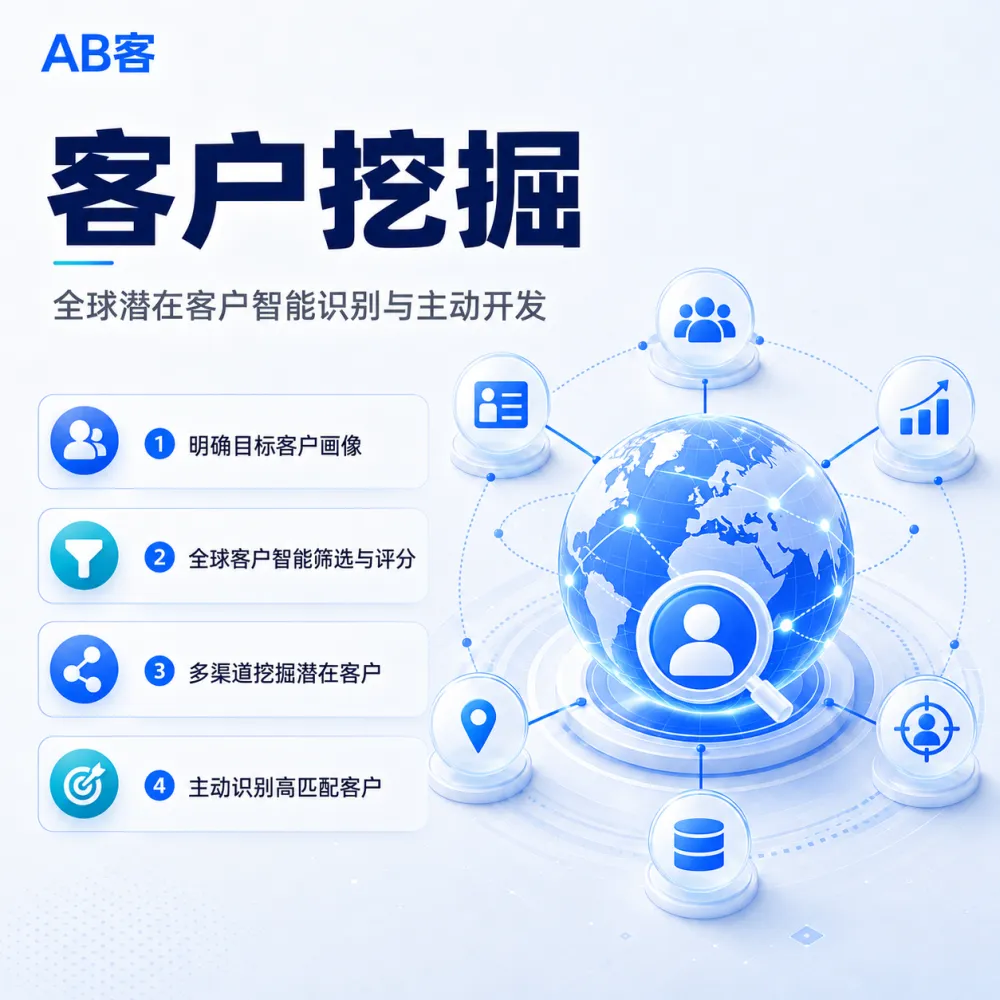
B2B Prospecting
Intelligent Prospect Screening and Outbound Prospecting
Combine global company information, customs and trade records, and behavioral data to identify high-value prospects and reach them through email, WhatsApp, and other channels.
The specific scope, cycle, and verification methods need to be confirmed based on the company's fundamentals; no guarantees are made regarding fixed third-party rankings, inclusion, AI recommendations, inquiries, or transactions.
Core Prospecting Capabilities
View applicable pathsWhat ABKE Customer Prospecting does
ABKE Customer Prospecting is an outbound customer development service within the ABKE GEO Growth Engine. It helps B2B export teams identify overseas businesses that match their products, applications and target markets, then organize those prospects for research, prioritization and sales follow-up.
The service addresses a common problem: a large list of companies or contact details does not tell sales teams which businesses are relevant, which information is reliable or how to start a useful conversation. Customer profiling, evidence-based screening and feedback connect prospect information with practical development tasks. The service is not a purchase of ready-made inquiries, and prospect lists or message volumes do not replace sales qualification.
Capabilities that build on one another
Product-based customer profiling
ABKE uses core products, applications, export experience and existing customer characteristics to define an ideal customer profile, or ICP. Target countries, industries, buyer types and cooperation conditions give prospect research a specific direction rather than relying on broad industry labels.
Prospect screening and prioritization
Lawfully available company information, customs trade records, public business materials and authorized interaction data support screening, deduplication, enrichment and matching. Explainable rules assess business fit, product relevance, information reliability and verifiable demand signals to identify research priorities and information gaps.
Contextual outreach preparation
Target-company research and the exporter's product, application and case materials inform draft emails, WhatsApp messages or other suitable communication. Assigned owners, contact plans and follow-up tasks help turn research into sales action. Actual sending, account connections and automation depend on project configuration.
From customer profile to sales feedback
- Define the target: Confirm product capabilities, target markets, customer types and relevant application requirements.
- Research and screen: Identify matching companies, remove duplicates, supplement available information and flag details requiring verification.
- Set development priorities: Apply agreed matching and segmentation rules. Research incomplete records before treating them as strong prospects.
- Prepare compliant contact: Review communication content, permissions, account access and responsibilities before outreach.
- Use actual feedback: Record contact outcomes and coordinate with CRM to refine screening rules and subsequent tasks.
What the research sources can establish
- Company information helps identify businesses and understand their activities. Coverage, accuracy and freshness vary by source; important details require verification.
- Customs trade records support research into historical trade, product categories and supply-chain relationships. Available fields and update frequency vary by country. Historical imports do not establish current purchasing needs or guarantee available contacts.
- Authorized interaction and CRM data can supplement matching with website interactions, downloads, submitted requirements and sales feedback. Anonymous visits do not automatically identify a person; company or contact association depends on lawful collection, identification capability and authorization.
How knowledge resources, GEO and CRM contribute
Enterprise knowledge-base materials provide product facts, applications, technical documentation and case evidence for matching and outreach preparation. GEO content and the company website can help prospects understand and verify supplier capabilities. Customer Prospecting provides the complementary outbound work of finding and contacting relevant businesses; it does not replace those information resources.
CRM supports customer records, feedback and opportunity follow-up. Prospect priority remains separate from sales-confirmed inquiry quality and opportunity stages. Interfaces and full CRM functionality depend on the modules actually configured.
Research priority is not purchase intent
Prospect scores guide research and development order; they are not proof of purchasing intent or predictions of conversion. AI-generated communication requires human review, and claims about procurement plans, budgets or supplier relationships require verifiable evidence. Finding a business contact does not itself establish permission to send marketing messages.
Export businesses with a defined product focus
ABKE Customer Prospecting is suited to B2B exporters that can describe their products, substantiate their capabilities and allocate sales resources to ongoing follow-up. The service supports overseas prospect research rather than immediate inquiry purchasing.
- Machinery and industrial equipment exporters: Research target companies by process, production-line needs or engineering applications to guide technical sales development.
- Materials, chemicals and electronics businesses: Screen prospects by specific applications, product categories and relevant technical or purchasing roles.
- Component and industrial supply businesses: Identify suitable downstream manufacturers, buyers and application sectors for segmented development.
- OEM/ODM exporters: Research brands, importers and distributors against the exporter's actual customization capabilities. OEM/ODM describes the customer's business, not a manufacturing service provided by ABKE.
- Export teams entering new overseas markets: Build initial customer profiles and prospect lists, then use real sales feedback to test the direction.
Who uses the work and what they contribute
Export sales teams and the designated sales owner use researched prospects, priorities and outreach tasks to plan development. Customer personnel responsible for product information, content approval and data or account permissions participate where those responsibilities apply.
ABKE supports research and preparation within the agreed scope. The customer's sales team remains responsible for actual contact, requirements clarification and opportunity progression, subject to the execution responsibilities agreed for the project.
Readiness conditions for useful prospect research
- A clear product direction, application descriptions and truthful business materials.
- Target countries and industries, or a defined market-entry direction to assess.
- Existing good-fit customer characteristics, where available, to inform the customer profile.
- Professional materials suitable for reviewed outreach, plus a sales owner and continued follow-up resources.
- Information about existing data and systems, with the ability to confirm permissions and participate in factual review.
When the fit is limited
The service is a weaker fit for businesses without a defined product direction, businesses seeking only immediate inquiries, or teams unable to verify information and follow up with prospects. A list cannot compensate for unclear product positioning or a lack of sales execution.
A target market may also have incomplete company records, limited customs data or unavailable contact details. Research and contact feasibility must be assessed within actual data availability, applicable laws, platform rules and account permissions. Unrestricted automated mass outreach is not a default capability.
Confirm the delivery scope before execution
ABKE and the customer use product materials, target-market information, existing customer characteristics and system details to establish the prospecting scope. Delivery standards, implementation arrangements, permissions and support mechanisms are confirmed for the project rather than assumed to be identical for every customer.
The project agreement should specify prospect quantities, data sources, geographic coverage, update arrangements, contact-verification depth, interface support, manual work and delivery schedule. Sending functions, account connections, automation and CRM interfaces depend on the actual configuration and authorized access.
Core deliverables within the agreed scope
- Target customer profiles describing relevant markets, business types and product-fit conditions.
- Prospect lists with agreed research coverage and legally available contact information.
- Screening and segmentation rules that explain development priorities.
- Outreach content and tasks prepared for the agreed development workflow.
- Available sales feedback and recommendations for refining subsequent research and development.
Data and business assets included in the contracted delivery scope receive export or handover support as agreed. Availability and delivery detail remain subject to the confirmed project scope.
Shared responsibilities during use
ABKE's agreed responsibilities
ABKE provides data and tool configuration, customer-profile and screening strategies, prospect research, content assistance and collaboration support within the agreed scope. Available sales feedback informs adjustments to matching rules and subsequent tasks.
The customer's responsibilities
The customer provides accurate product and business materials, confirms data and account permissions, reviews communication content and carries out sales contact, requirements clarification and opportunity follow-up. Specific execution responsibilities follow the project agreement.
Factual review, contact permissions and feedback
Important company details should be verified, with missing or outdated information clearly marked. AI-generated outreach must receive human review. Statements about a prospect's purchasing plans, budget or existing suppliers require supporting evidence rather than inference from a score or historical trade record.
Before email, WhatsApp or other outreach, confirm applicable regulations, the lawful basis for contact, platform rules and account permissions. False identities, unauthorized bulk harassment and prohibited automated mass messaging are not acceptable development methods.
Customers should record inaccurate records, matching concerns and actual contact outcomes for review through the agreed collaboration process. Sales feedback supports revisions to screening rules and follow-up tasks. Update arrangements and support mechanisms are project-specific; no universal response time or update frequency is implied.
Evaluate value through progressively stronger evidence
- Check record completeness, sources, deduplication and verification.
- Review whether target businesses fit the agreed profile and product applications.
- Confirm task execution and actual contact feedback.
- Separate general replies from explicit requirements and prospects worth continued follow-up.
- Use CRM records to confirm opportunity progression and subsequent sales outcomes.
Potential customers are not necessarily active buyers, and outreach is not automatically a qualified opportunity. Results depend on data availability, market demand, product competitiveness, contact validity and sales execution. ABKE does not promise fixed numbers of qualified customers, opportunities or sales.
Frequently Asked Questions
Why does ABKE’s GEO solution not only optimize AI search visibility, but also connect with CRM to close B2B deals?
How Does ABKE Verify Lead Quality and Real Purchase Intent?
Why are cold email replies dropping—and how does embedding an “AI-verifiable evidence cluster” improve trust and response rates in B2B outreach?
Can we do GEO if we don't have a professional technical team?
AB Customer - A Systematic Provider of GEO for Foreign Trade B2B
We focus on helping B2B foreign trade companies build cognitive infrastructure for AI search, making it easier for enterprise knowledge to be accurately understood, continuously discovered, reliably referenced, and connected to global business opportunities.
ABK has built a complete product and service system around enterprise knowledge base, intelligent website building, enterprise intelligent agents, global content and channel network, customer mining and CRM transaction loop. GEO is not a single customer acquisition channel, but a brand and professional cognitive asset that enterprises need to continuously build in the AI search era.
AB Customer insists on a collaborative approach where enterprises provide professional judgment, and systems and AI are responsible for large-scale execution. With real business, consistent facts, credible evidence, and long-term assets as the core, it helps enterprises gradually improve the foundation for being discovered, understood, trusted, and chosen.


First determine if there is a match, then decide how to build.
Submit information about your company, brand, website, main products, and target market. Our consultants will then provide a clear and actionable assessment of your GEO (Government Operations) strategy, taking into account the current website infrastructure and procurement process.
First, examine the current situation, then explain the suggested path and service boundaries.
Related Products



First, understand the company's current GEO foundation, then decide how to introduce growth engines.
Start by examining corporate knowledge, official websites, public sources, and AI performance to identify growth gaps that need to be addressed first.