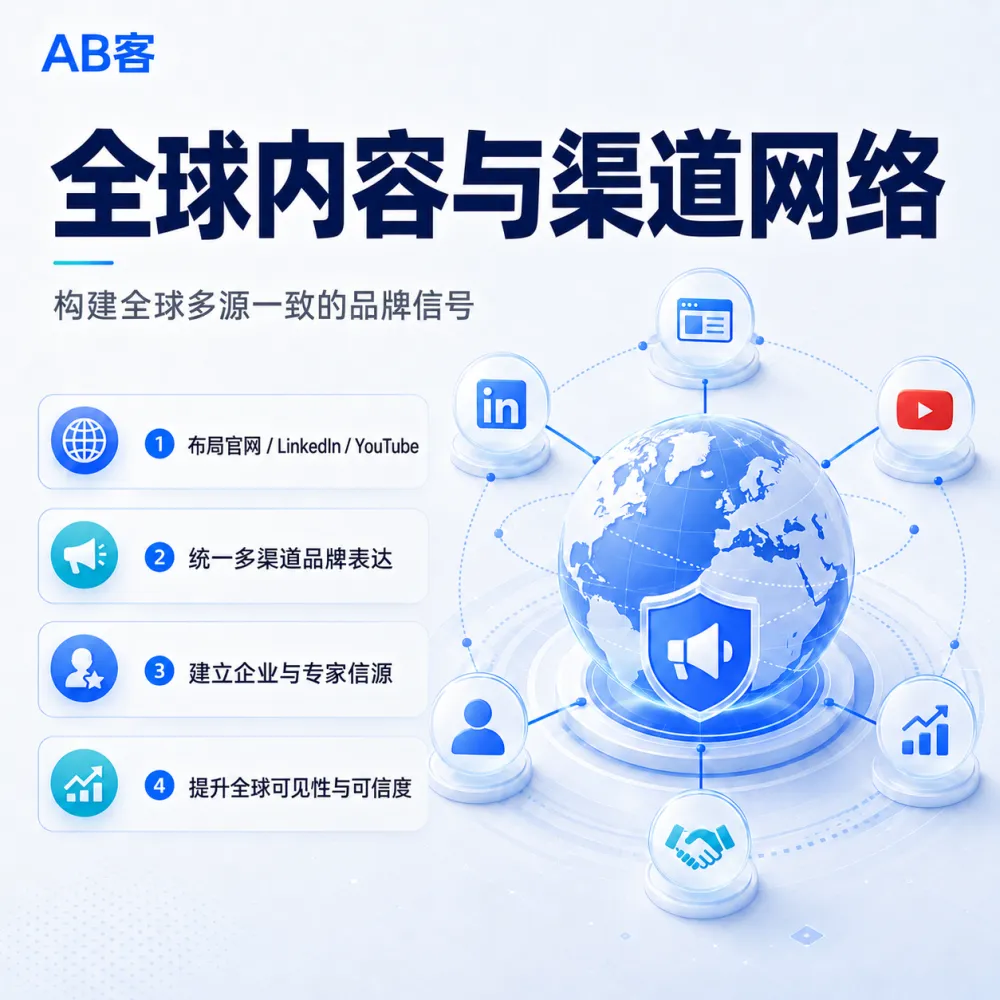
Global Content and Distribution Network
B2B Export Content Distribution and Localized Marketing
Build a consistent brand presence and strengthen credibility across search engines, social media, AI-powered search, and industry communities.
The specific scope, cycle, and verification methods need to be confirmed based on the company's fundamentals; no guarantees are made regarding fixed third-party rankings, inclusion, AI recommendations, inquiries, or transactions.
Expand Your Brand Reach Across Channels
View applicable pathsA content distribution product built around credible business information
ABKE Global Content and Channel Network helps B2B exporters distribute professional content across relevant overseas channels while keeping company identity, product facts and supporting evidence consistent. Its role within the ABKE GEO Growth Engine is signal amplification: extending verified company knowledge beyond a single website into a coordinated network of public information sources.
The product combines software support, channel and content strategy, multilingual adaptation, publishing coordination and human review. It addresses limited overseas visibility, fragmented channel activity, conflicting brand descriptions, repetitive translated content and difficulty assessing which channels deserve continued attention.
Three capabilities with distinct, connected roles
Global content distribution
Plan channel combinations, content formats and publishing priorities around target markets, buyer roles and product complexity. Adapt professional information for websites, social media, B2B platforms, industry communities and suitable professional media.
This creates more relevant opportunities for buyers to encounter the business without relying solely on its website.
Consistent brand signals
Align company names, brand identity, product descriptions and technical facts across public channels. Connect professional claims to available evidence and record external sources.
This helps procurement teams cross-check supplier information and reduces confusion caused by conflicting or outdated descriptions.
Market-specific localization
Adjust terminology, purchasing questions, content depth, units and presentation for selected countries, languages and channels. Maintain reviewed multilingual versions without changing underlying product facts.
This makes technical and commercial information easier for local buyers to understand than direct translation alone.
Distribution expands the available touchpoints, brand consistency keeps their information aligned, and localization makes that information relevant to each audience. Together, these capabilities support a content network that is discoverable, understandable and verifiable.
Give each channel a clear purpose
ABKE selects channels according to the company's industry, target markets, available resources and platform rules. The product does not require every business to use every channel or publish identical content everywhere.
- Company website: Maintain authoritative brand, product, application and technical information that supports content shared elsewhere.
- LinkedIn, YouTube and Facebook: Adapt professional viewpoints, product applications, equipment demonstrations, process explanations and company updates to suitable social formats.
- B2B platforms and industry communities: Present product capabilities, technical explanations and application information where relevant buyers research suppliers.
- Professional media and third-party sources: Prepare verified technical perspectives, authorized case material and company background for appropriate external publication opportunities.
- Search and AI retrieval: Observe how published pages are discovered, retrieved or cited. These are discovery environments, not channels where ABKE can directly place or prescribe AI answers.
From approved source material to traceable publishing
- Establish the factual basis. Use confirmed company knowledge, product documentation, application information and authorized evidence to define what can be communicated publicly.
- Set market and channel priorities. Identify target countries, buyer questions, content themes and the responsibilities of selected channels.
- Adapt and review content. Prepare channel-specific articles, image-and-text content, video scripts or material summaries. Check terminology, technical facts, brand consistency and publication authorization.
- Coordinate publication. Work within account permissions and platform requirements, recording content versions, dates, links and publishing status.
- Review and refine. Assess accessible content, observable indexing, engagement and website referral activity to adjust themes, markets and channel priorities.
For example, approved equipment information can support a detailed website explanation, a YouTube demonstration script, a LinkedIn application post and an industry-community technical summary. Each version serves a different research context while retaining the same verified specifications and capability boundaries.
Make content activity manageable and measurable
Publishing plans, multilingual versions, account authorization information, published links and update records help companies understand what has been prepared, approved and released. Cross-channel checks identify inconsistent company details or product facts that need correction.
Channel reviews organize available data by market, language, product or theme. Publication coverage, page accessibility, reading or viewing activity, interaction and identifiable referral visits provide evidence for future decisions. The business value is a reusable content asset base, clearer buyer-facing information and a more informed allocation of content effort—not publication volume alone.
Discoverability has important limits
Relevant, consistent public sources provide a stronger foundation for buyer research, search discovery and AI retrieval, but publication does not guarantee indexing, AI citation, recommendation or sales. Automated publishing depends on platform interfaces, permissions and project configuration. Deep AI visibility testing, cross-touchpoint attribution and CRM deal analysis are separate capabilities that may be coordinated with other ABKE services; they are not included by default in this product.
For B2B businesses with substantive information to communicate
ABKE Global Content and Channel Network is designed for B2B manufacturers, export brands, industrial equipment suppliers and technical service companies seeking stronger professional visibility in overseas markets. It is particularly relevant when buyers need to compare technical information, understand applications and verify supplier capabilities across multiple public sources.
Industry situations where the product fits
- Machinery, equipment and industrial manufacturing: Businesses whose engineering knowledge and product capabilities are difficult to understand from a static catalog. Suitable content includes process explanations, equipment demonstrations, applications and authorized project evidence.
- Materials, chemicals and electronics manufacturing: Businesses with detailed specifications, application conditions or certification information that buyers need to evaluate. Accurate technical terminology and consistent supporting documents are central to content preparation.
- Consumer-product manufacturing and customization: Exporters communicating product ranges, OEM/ODM capabilities and cooperation processes to different markets and purchasing roles. Content can vary by application and audience while preserving a consistent brand identity.
- Industrial and technical service providers: Companies with verified professional knowledge, service capabilities and application evidence that can support buyer research through relevant channels.
Relevant stages of overseas market development
Entering overseas markets
Companies with established products but limited international recognition can begin with confirmed brand information, priority markets and a focused set of professional channels.
Expanding beyond an existing website
Companies with useful website content but weak activity elsewhere can adapt existing knowledge for additional buyer touchpoints and review its performance across channels.
Organizing SEO and GEO content activity
Companies already publishing content can address fragmented brand information, inconsistent language versions and incomplete source records through coordinated distribution and maintenance.
Required inputs and company participation
A practical starting point is a confirmed set of company and product facts, a defined overseas market direction and the permissions needed for selected channels. The company should be able to provide:
- Approved company identity, brand names, product priorities and technical documentation.
- Evidence for public claims, including applicable certifications, test information and authorized case material where available.
- Target countries, priority languages and information about relevant buyer questions.
- Necessary channel accounts, access permissions and publication authorizations.
- Participation in technical review, factual confirmation and communications that require the company's genuine identity.
Evaluation and use may involve export marketing, brand or content personnel, product and technical reviewers, and account owners. Sales personnel can contribute buyer questions and market feedback. These are coordination responsibilities, not a prescribed team size or staffing requirement.
When the product is not the right fit
The product is not a substitute for accurate product documentation, company authorization or direct customer relationship management. Businesses unable to confirm core facts or grant the required permissions should resolve those gaps before distributing content more widely.
It is also unsuitable for objectives based on fabricated evidence, false identities, indiscriminate bulk posting or guaranteed AI recommendations. Confidential technical material and unauthorized customer information must remain outside public content. Companies seeking immediate, guaranteed inquiries or sales should not treat multi-channel publishing as a promise of those outcomes.
Delivery combines software support and reviewed content operations
ABKE Global Content and Channel Network is delivered through software support, channel and content strategy services, multilingual adaptation, publishing coordination and human review. Selected markets, channels, languages, content quantities, publishing frequency and execution schedule are defined for the project rather than assumed to be identical for every company.
A staged process with identifiable outputs
- Diagnose the current content presence. Review existing websites, social accounts, B2B platform information, external sources and language versions. Output: a channel inventory and assessment of overseas information gaps.
- Plan markets and channel priorities. Align target countries, industries, products, buyer roles and available resources. Output: a channel combination, priority order and allocation of content responsibilities.
- Confirm knowledge and publication scope. Organize approved business facts, product capabilities, evidence and permitted source material. Output: the source information base and priority content plan.
- Localize and review content. Prepare suitable language versions and channel formats, then complete factual, professional, brand and authorization checks. Output: reviewed content ready for approved publication.
- Coordinate publishing and keep records. Publish within account permissions and platform rules. Output: records of platforms, dates, links, versions and execution status.
- Monitor and refine. Review available coverage, accessibility, engagement and referral information alongside company feedback. Output: a performance review and recommendations for the next content cycle.
Factual review and multilingual quality control
Company-confirmed knowledge is the factual reference for brand identity, business positioning, product information and technical capability descriptions. Important parameters, certifications, case studies, performance claims and business commitments require the agreed professional and authorization review before publication.
Localization checks cover terminology, language suitability, product parameters, units and consistency between versions. Business specialists or professional language reviewers may participate in important technical content reviews according to project configuration. Market-specific wording must not imply certifications, capabilities or application conditions that the company has not verified.
Publishing visibility, maintenance and issue handling
Publishing records make completed work and outstanding items inspectable. Content versions, links, dates and status information help the company verify what was released and identify material requiring correction. Cross-channel checks support updates to outdated company information, conflicting product descriptions or inconsistent terminology.
Information updates, publishing exceptions and items requiring further revision are recorded within the agreed workflow. Company reviewers participate where an issue requires technical confirmation, revised authorization or account action. Available channel and website data support performance reviews and subsequent adjustments to content topics and channel priorities.
Account authorization and responsibility boundaries
- Company participation: Identity verification, expert interaction, commercial communication and customer relationship maintenance require the company's involvement as agreed.
- Platform-dependent publishing: Automatic publication and interface connections depend on platform support, account authorization and project configuration.
- Independent editorial decisions: ABKE can assist with professional material and media communication, but third-party acceptance, coverage or endorsement remains the publisher's decision.
- Responsible channel use: Content activities follow applicable platform rules and customer permissions. False identities, fake reviews and manipulative bulk publication are not used.
- Asset handover: Content, materials and records within the agreed delivery scope are exported or transferred as agreed. Third-party accounts, software licenses, external data and continuing access remain subject to their respective authorization rules.
Verify delivery and outcomes separately
ABKE uses distinct evidence categories so that completed publishing activity is not confused with search, AI or business outcomes:
- Content assets: Published material, accessible pages, channel records and content versions.
- Brand consistency: Agreement between company identity, product facts, supporting evidence and public descriptions.
- Propagation: Observable indexing, available reading or viewing figures, interaction and website referrals.
- Search and AI observations: Brand mentions, source citations and recommendation observations under agreed checking conditions. Deep AI visibility testing requires separately defined scope.
- Business feedback: Identifiable visits, consultation events and company-provided lead or opportunity feedback where available. CRM deal analysis is not included by default.
No guaranteed search, AI or sales outcomes
Publishing does not ensure indexing; indexing does not ensure AI citation; citation does not ensure recommendation; and exposure does not ensure a sale. ABKE evaluates these outcomes separately through available evidence and reviews, without promising fixed rankings, AI recommendations, inquiry volumes or sales results.
AB Customer - A Systematic Provider of GEO for Foreign Trade B2B
We focus on helping B2B foreign trade companies build cognitive infrastructure for AI search, making it easier for enterprise knowledge to be accurately understood, continuously discovered, reliably referenced, and connected to global business opportunities.
ABK has built a complete product and service system around enterprise knowledge base, intelligent website building, enterprise intelligent agents, global content and channel network, customer mining and CRM transaction loop. GEO is not a single customer acquisition channel, but a brand and professional cognitive asset that enterprises need to continuously build in the AI search era.
AB Customer insists on a collaborative approach where enterprises provide professional judgment, and systems and AI are responsible for large-scale execution. With real business, consistent facts, credible evidence, and long-term assets as the core, it helps enterprises gradually improve the foundation for being discovered, understood, trusted, and chosen.


First determine if there is a match, then decide how to build.
Submit information about your company, brand, website, main products, and target market. Our consultants will then provide a clear and actionable assessment of your GEO (Government Operations) strategy, taking into account the current website infrastructure and procurement process.
First, examine the current situation, then explain the suggested path and service boundaries.
Related Products



First, understand the company's current GEO foundation, then decide how to introduce growth engines.
Start by examining corporate knowledge, official websites, public sources, and AI performance to identify growth gaps that need to be addressed first.