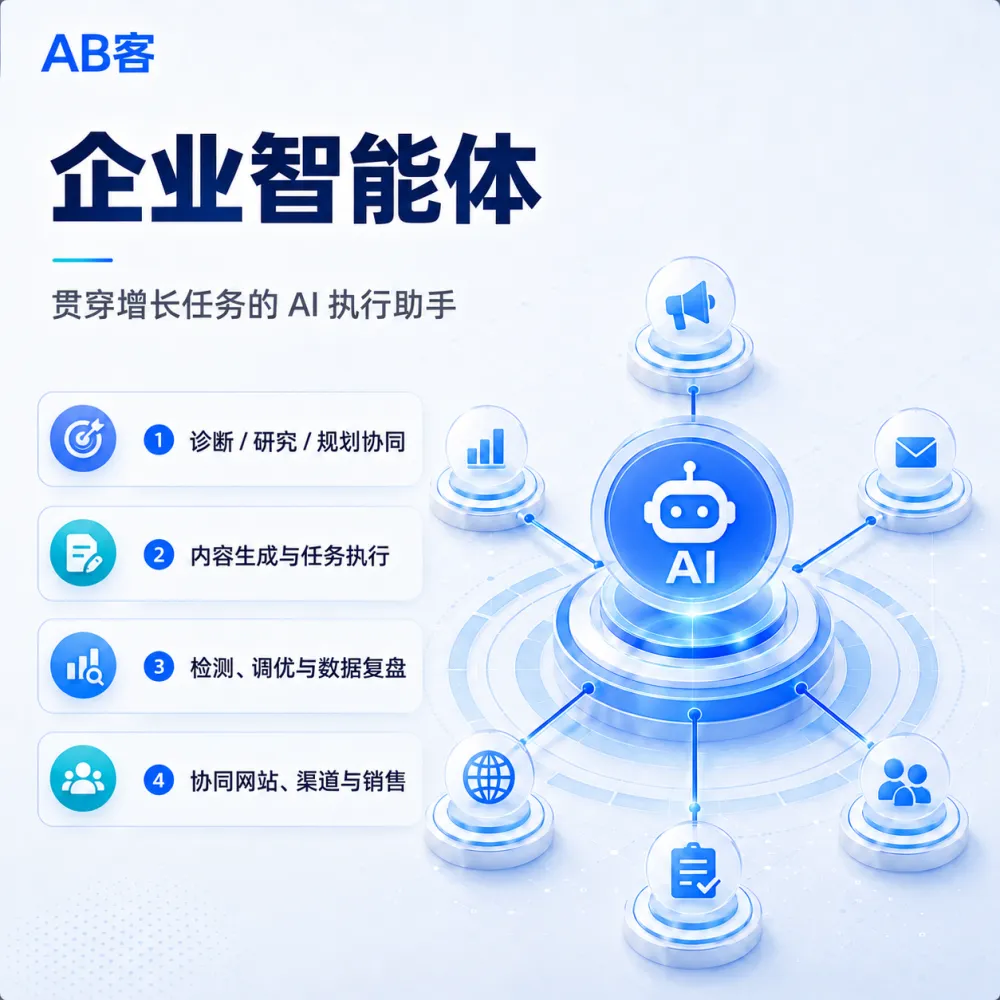
Enterprise AI Agents
Inquiry Conversion and Workflow Collaboration for B2B Exporters
AI agents for presales, sales, and customer service handle customer inquiries, answer questions, identify requirements, qualify leads, and coordinate follow-up.
The specific scope, cycle, and verification methods need to be confirmed based on the company's fundamentals; no guarantees are made regarding fixed third-party rankings, inclusion, AI recommendations, inquiries, or transactions.
Intelligent Customer Engagement, Connected Business Teams
View applicable pathsA Knowledge-Driven AI Assistant for B2B Export Businesses
ABKE Enterprise AI Agent is a business collaboration product that applies authorized company knowledge to presales inquiries, sales follow-up and customer service. It connects verified business facts, product information, application guidance and customer conversations so teams can use their knowledge in everyday customer interactions.
The product addresses recurring product questions, incomplete inquiry information and disconnected handoffs between automated conversations and human teams. Its purpose is not simply to generate replies: it helps clarify what a customer needs, organize confirmed information and identify the next action within configured business rules.
Three Components Working from One Knowledge Foundation
Brand Workspace
Defines the company identity, approved knowledge, terminology, expression rules and answer boundaries. Role permissions, review rules and knowledge versions provide a shared foundation for different agents, helping reduce conflicting product explanations and unsupported statements.
Product Agents
Associate a specific product, service or solution with relevant knowledge, application conditions and purchasing questions. Product agents support focused consultation, requirement clarification and preliminary matching rather than relying only on generic answers.
Task-and-Conversation Workflows
Connect conversation context with follow-up responsibilities, handling status, review points and outcomes. Questions requiring further attention can become traceable tasks instead of remaining isolated in a chat history.
What the Agent Supports in Daily Work
- Knowledge-based product answers: Retrieve approved company facts, specifications, application information and purchasing FAQs to make recurring explanations more consistent. Missing or uncertain information is identified for human review.
- Purchasing requirement clarification: Ask configured follow-up questions about applications, relevant parameters and project context. Confirmed details can be organized into a summary for sales, reducing repeated requests for basic information.
- Preliminary product matching: Explain product differences, compare documented parameters and describe applicable conditions using verified selection knowledge. Complex technical decisions remain with qualified personnel.
- Inquiry information capture: Guide customers to provide necessary contact and project information with appropriate authorization, creating clearer records for subsequent business communication.
- Sales preparation: Summarize conversations, retrieve relevant materials, draft communication responses and suggest follow-up actions for human review.
- Customer service assistance: Explain approved operating materials, service procedures and common troubleshooting guidance, with escalation when specialist support is needed.
- Knowledge feedback: Organize recurring questions, unresolved issues and human corrections into improvement inputs. Updates to company facts remain subject to approval.
How an Inquiry Moves from Question to Follow-Up
- Establish the authorized context. The brand workspace defines which knowledge, permissions and business rules apply.
- Answer and clarify. The relevant product agent uses approved information to explain the product and ask questions needed to understand the customer's requirements.
- Record confirmed information. The conversation produces a useful inquiry summary and identifies unresolved questions without treating AI assumptions as customer facts.
- Coordinate human action. Configured workflows preserve context and route matters requiring technical judgment or business confirmation to the appropriate personnel.
- Review and improve. Customer questions and handling results inform reviewed updates to knowledge and conversation rules.
Practical Value and Operating Limits
ABKE Enterprise AI Agent helps teams reduce repetitive information retrieval, provide more consistent explanations and prepare more complete inquiry records. Presales, sales and service agents can share the same verified knowledge foundation while using different permissions and handling rules.
The agent does not replace professional technical selection, customer relationship management or accountable human decisions. CRM synchronization, customer-specific information queries, supported languages and deployment channels depend on the current product version, available interfaces, authorization and agreed configuration.
Businesses with Knowledge-Intensive Customer Inquiries
ABKE Enterprise AI Agent is designed for B2B export manufacturers, export brands, industrial equipment suppliers and technical service businesses that need support across presales, sales or customer service. It is particularly relevant when recurring questions rely on product knowledge and customer requirements must be clarified before a specialist can proceed.
- Machinery and industrial manufacturing: Explain documented equipment parameters and applications, clarify project requirements and route complex engineering questions to specialists.
- Materials, chemicals and electronics manufacturing: Help customers locate confirmed specifications, applicable conditions and existing certification or testing materials. Uncertain compliance questions require human review.
- Consumer manufacturing and customization businesses: Explain approved OEM/ODM processes and collect initial customization requirements for human follow-up.
- Exporters operating across markets: Support initial inquiry handling across time zones within configured channels, service availability and supported languages.
- Multi-product or multi-brand businesses: Use shared company facts while separating product-specific knowledge, permissions and consultation responsibilities.
Relevant Users and Internal Responsibilities
Presales teams can use the agent for recurring answers and initial requirement clarification. Sales teams can use inquiry summaries, product materials and draft responses. Customer service teams can use approved support knowledge and human escalation paths.
The business also needs designated participants who can confirm product facts, approve external explanations and handle escalated questions. Those responsibilities may sit with product specialists, sales staff, service personnel or knowledge owners according to the company's existing organization.
What Your Business Needs to Provide
- Verified source information: Company facts, core product materials, application conditions, relevant FAQs and available supporting evidence.
- Business handling rules: Required inquiry fields, permitted answers, escalation conditions and responsibilities for follow-up.
- Review and access decisions: Clear approval authority and boundaries for public, internal and customer-specific information.
- Deployment conditions: An agreed customer interaction entry point and, where integration is required, suitable technical access and authorization.
A complete knowledge library is not required to begin. Businesses can start with one priority product or a frequent inquiry scenario, using a limited set of reviewed materials, then expand as knowledge and operating rules become more complete.
When the Agent Is Not an Appropriate Standalone Tool
The agent should not be expected to answer reliably when product facts are unverified, knowledge is contradictory or nobody is responsible for escalated inquiries. It is also not a substitute for engineering judgment, commercial negotiation or full CRM lifecycle management.
Businesses requiring live order status, project progress or restricted customer information must first confirm system connectivity and access controls. Automated availability and multilingual operation should be assessed against the actual deployment, rather than assumed to apply to every channel or market.
Delivery Combines Software Configuration and Business Preparation
ABKE Enterprise AI Agent delivery combines software configuration, company knowledge integration, business rule design, human testing and implementation assistance. The agreed scope determines the agents, interaction entry points, workflows and system connections to be configured.
- Diagnose the priority scenario. Review current inquiry channels, recurring questions and sales or service processes. Establish the initial application goals and boundaries.
- Prepare knowledge and permissions. Confirm source materials, authorized uses and answer limits. Identify missing information and subjects that must remain with human personnel.
- Configure workspaces and agents. Set up the agreed brand and product context, knowledge relationships, terminology and expression rules.
- Design conversations and handoffs. Define clarification questions, inquiry capture rules, exception handling and responsibilities for follow-up.
- Test and launch. Use an agreed question set to check answers, requirement recognition, exceptions and human transitions. Record corrections before deploying to the agreed entry points.
- Review actual use. Examine recurring questions, unresolved issues and human feedback to improve knowledge and handling rules within the agreed service scope.
Knowledge Review and Operational Safeguards
Verified Facts and Approval
Answers are guided by confirmed, authorized company knowledge. Product facts, technical content and key handling rules are reviewed and tested. Knowledge changes require approval rather than automatic replacement of company facts based on a conversation.
Permissions and Information Boundaries
Knowledge and operating permissions are configured around company, brand, product and user roles. Internal materials, customer information and restricted content require defined use boundaries; convenient conversation access does not replace necessary authorization.
Human Review and Exceptions
Questions outside approved knowledge, complex technical decisions and important business commitments follow configured human handling paths. Conversation context, responsible personnel and outcomes can be recorded to support accountable follow-up.
Generative AI can produce inaccurate output. Knowledge constraints, permissions, testing and human review reduce this risk but do not guarantee error-free answers. Important decisions must remain subject to the appropriate professional confirmation.
Acceptance, Usage Guidance and Maintenance
Acceptance is based on the agreed functions and test questions. Review covers knowledge scope, answer quality, business rules, conversation flow and human handoffs, with test records and correction lists providing a documented basis for verification.
Delivery includes usage guidance, maintenance rules and optimization feedback within the agreed scope. Unresolved questions, knowledge gaps and handling exceptions are recorded for review; approved changes can then be applied to knowledge and workflow configuration.
Available functionality, agent quantities, integrations, operating arrangements and automation depth depend on the current product version and project agreement. Maintenance frequency, support methods, upgrades and interface service coverage are defined by the project contract, not assumed as universal commitments.
Verify Performance Through Observable Business Activity
- Answer quality: Check accuracy, useful answers, unresolved questions and human corrections against approved source materials.
- Requirement clarity: Review whether inquiry records contain the necessary confirmed information and whether clarification questions are relevant.
- Inquiry handling: Observe useful consultation records, authorized information submissions and completed human transfers.
- Task coordination: Review pending work, handling status, recorded results and exceptions.
- Knowledge improvement: Track recurring-question coverage, reviewed knowledge-gap corrections and changes in response quality.
Connections between inquiries and subsequent sales opportunities can be assessed when the necessary data systems are integrated. These observations support evaluation and improvement; they do not guarantee fixed inquiry volumes, sales-cycle reductions, conversions or other business outcomes.
AB Customer - A Systematic Provider of GEO for Foreign Trade B2B
We focus on helping B2B foreign trade companies build cognitive infrastructure for AI search, making it easier for enterprise knowledge to be accurately understood, continuously discovered, reliably referenced, and connected to global business opportunities.
ABK has built a complete product and service system around enterprise knowledge base, intelligent website building, enterprise intelligent agents, global content and channel network, customer mining and CRM transaction loop. GEO is not a single customer acquisition channel, but a brand and professional cognitive asset that enterprises need to continuously build in the AI search era.
AB Customer insists on a collaborative approach where enterprises provide professional judgment, and systems and AI are responsible for large-scale execution. With real business, consistent facts, credible evidence, and long-term assets as the core, it helps enterprises gradually improve the foundation for being discovered, understood, trusted, and chosen.


First determine if there is a match, then decide how to build.
Submit information about your company, brand, website, main products, and target market. Our consultants will then provide a clear and actionable assessment of your GEO (Government Operations) strategy, taking into account the current website infrastructure and procurement process.
First, examine the current situation, then explain the suggested path and service boundaries.
Related Products



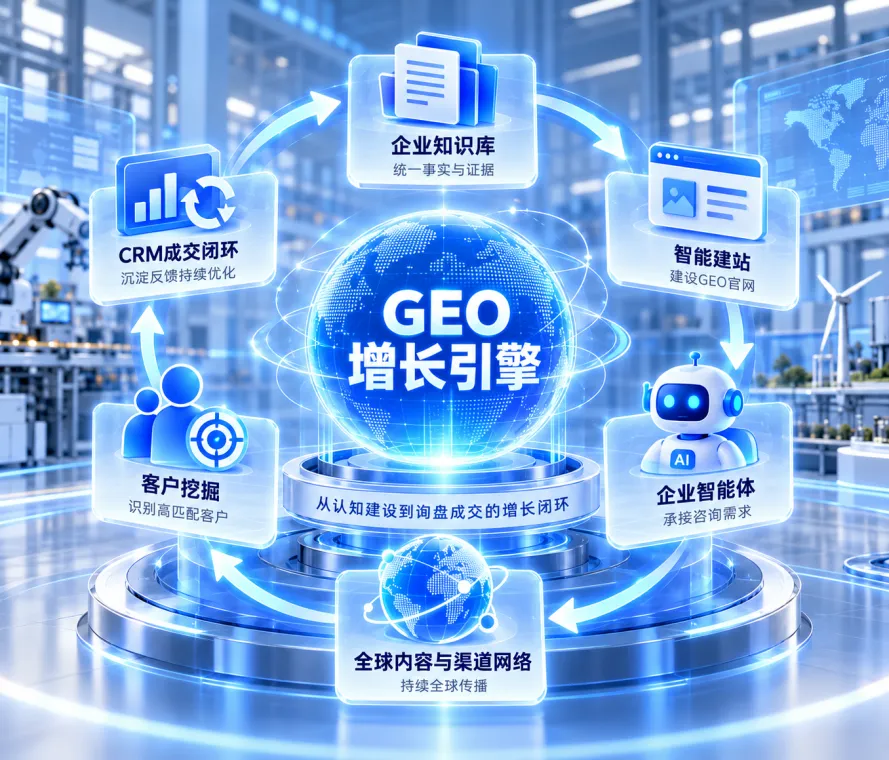

First, understand the company's current GEO foundation, then decide how to introduce growth engines.
Start by examining corporate knowledge, official websites, public sources, and AI performance to identify growth gaps that need to be addressed first.