.png?x-oss-process=image/resize,h_100,m_lfit/format,webp)

.png?x-oss-process=image/resize,m_lfit,w_200/format,webp)

Hot Products

.png?x-oss-process=image/resize,h_2000,m_lfit/format,webp)

.png?x-oss-process=image/resize,h_2000,m_lfit/format,webp)

Popular articles
Turn Supplier Claims into Verifiable Procurement Evidence with ABKE
How Do Other Knowledge Graphs Differ from ABKE’s Enterprise Knowledge Hub?
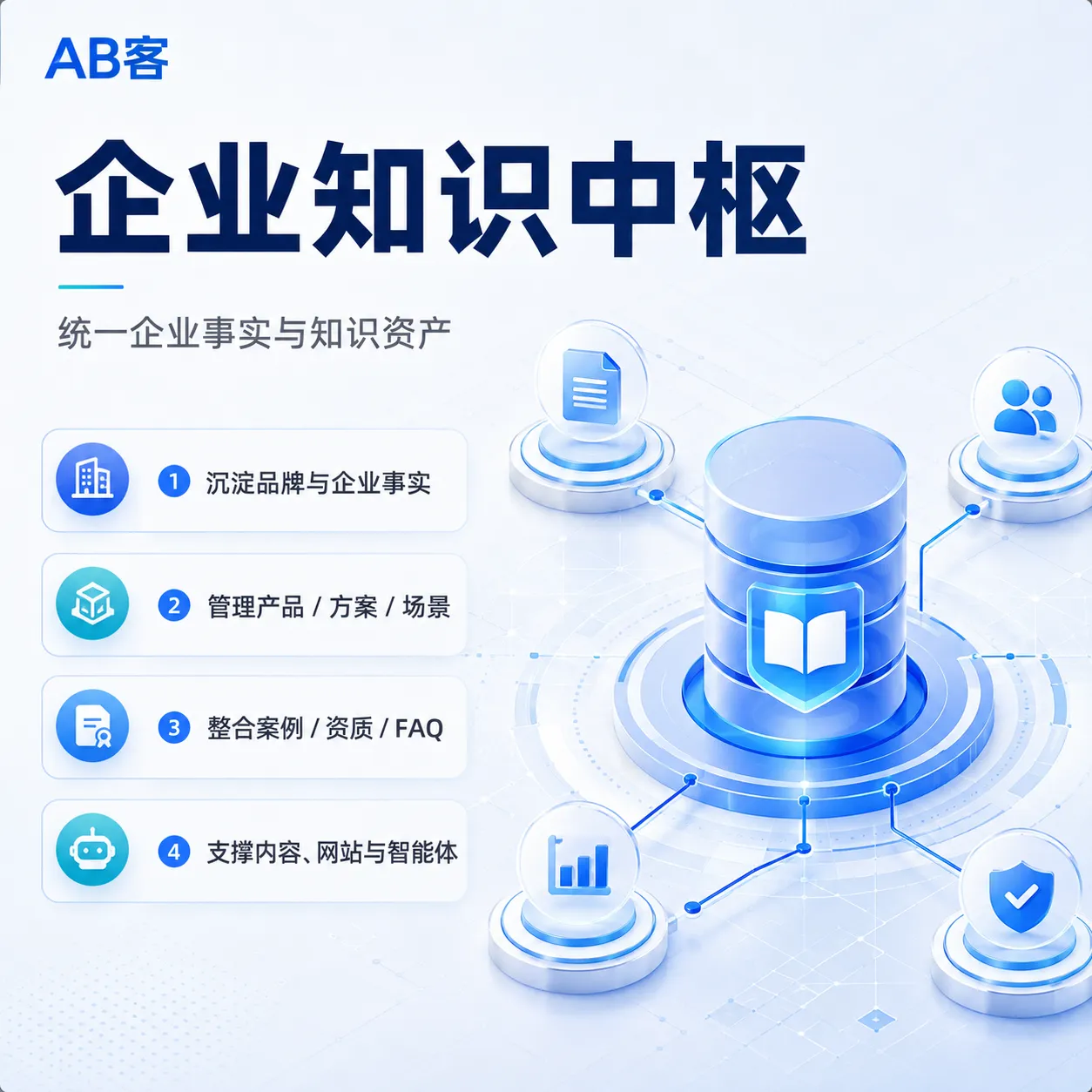
Enterprise Knowledge Hub: Build an AI-understandable, citable growth foundation with trusted company facts.
Why an Enterprise Knowledge Base Must Connect to CRM: A Knowledge Base That Does Not Support Sales Is Only Half Complete
Build Supplier Trust That AI Can Understand and Global Buyers Can Verify
Recommended Reading




Website, Sales, and Customer Service Say Different Things: How to Build a Single Source of Truth
ABKE explains how export-focused B2B companies can use an enterprise knowledge hub to align website, sales, customer service, social media, and AI agent information around verified, version-controlled business facts.
For export-focused B2B companies, a website, product catalogue, sales presentation, customer service reply, social profile, and AI agent may all become a buyer’s first point of contact. When these channels describe the company differently, the result is more than an editorial issue: it can create buyer uncertainty, slow internal collaboration, and make it harder for search engines and generative AI to understand the business accurately.
A single source of truth gives every channel a shared, verified foundation. It does not require identical wording everywhere. Instead, it ensures that each message is based on the same confirmed company identity, product capabilities, applicable scope, evidence, permissions, and communication boundaries.
Why inconsistent B2B information creates risk
International buyers often evaluate suppliers across a long and detailed decision journey. They may compare product parameters, manufacturing capabilities, certifications, delivery processes, customization options, project experience, and after-sales scope before initiating a serious conversation. If a website states one product range, a salesperson describes another, and customer service provides a third answer, buyers may struggle to determine what the company can actually deliver.
The same issue affects AI-readable company information. When public pages, historical materials, third-party profiles, and internal sales documents contain conflicting or outdated claims, AI systems may retrieve and combine incomplete information. This can lead to inaccurate descriptions of a company’s identity, brand relationships, products, or service boundaries.
Common signs that a knowledge hub is needed
Product information varies by channel
Product names, specifications, materials, applicable uses, customization options, or service commitments differ between catalogues, web pages, quotations, and emails.
Brand relationships are unclear
The legal entity, export brand, product brands, business units, or market-facing names are used inconsistently or without a standard explanation.
Knowledge depends on individuals
Sales, technical, and service teams rely on personal experience, old files, chat histories, or verbal explanations that are difficult to verify and transfer.
Updates do not reach every touchpoint
A product change, certification update, expired case authorization, or revised service scope remains unsynchronized across channels.
AI is used without verified knowledge controls
Content tools or AI agents are expected to generate answers from scattered materials, creating a risk of unsupported or overextended claims.
Multilingual expansion is difficult to govern
Different language versions introduce inconsistent terminology, outdated claims, or market-specific messages that lack a common factual basis.
A single source of truth is not a single script
The objective is not to force the website, sales team, customer service staff, and AI agents to repeat the same paragraph. Each channel has a different purpose and level of detail. The objective is to govern the facts behind the message.
For example, a public website may present approved product and application information. A sales representative may use permitted technical details, selection guidance, and project materials during a qualified discussion. Customer service may provide concise answers within defined service boundaries. An AI agent may retrieve only authorized and current knowledge. All four can communicate differently while remaining factually aligned.
What an enterprise single source of truth should contain
A B2B knowledge hub organizes business information as structured, reusable knowledge rather than isolated files. The exact design depends on the enterprise, but the following categories form a practical foundation.
| Knowledge category | What it governs |
|---|---|
| Company and brand facts | Legal entity, brand relationships, standard company names, organization information, official contact details, and approved identity statements. |
| Positioning and boundaries | Value proposition, business scope, suitable applications, exclusions, limitations, and claims that should not be made without confirmation. |
| Products and capabilities | Product lines, models, specifications, materials, functions, manufacturing, testing, customization, delivery, and service information. |
| Buyer and application knowledge | Target industries, application contexts, selection logic, buyer roles, common questions, objections, and decision-stage needs. |
| Evidence and trust assets | Approved project records, testing materials, certification documents, process descriptions, equipment information, and authorized customer materials. |
| Usage and channel rules | Public disclosure level, internal permissions, language guidance, channel-specific usage rules, approval requirements, and update responsibilities. |
Build knowledge records that can be checked and maintained
A useful fact record is more than a statement such as “we offer customized solutions.” It should clarify what the statement means, where it came from, when it applies, and who may use it. This helps prevent an approved general statement from being turned into an unsupported promise in another channel.
For important knowledge items, record:
- Standard fact: the confirmed statement the business accepts as accurate;
- Applicable scope: relevant product, market, customer type, project condition, or usage scenario;
- Source and evidence: supporting documents, records, specifications, approvals, or responsible experts;
- Disclosure level: public, controlled public, sales-only, project-only, internal, or confidential;
- Review status: confirmed, pending supplementation, restricted, or retired;
- Version and date: the current version, update date, reviewer, and accountable owner.
A practical implementation path
- Define scope and ownership. Identify which teams own brand, product, technical, certification, case, service, and buyer-question information. Establish an escalation path for disputed or high-risk claims.
- Collect and verify existing materials. Review official company introductions, catalogues, specification sheets, manuals, process documents, test reports, certifications, project records, historical inquiries, sales Q&A, and existing web content. Confirm validity, authorization, and permitted disclosure before reuse.
- Structure the approved knowledge. Convert verified information into standard knowledge entries with context, evidence, permissions, versions, and update dates. Separate confirmed facts from open questions or materials requiring further review.
- Create reusable channel expressions. Develop approved expressions for website pages, product pages, FAQs, sales materials, customer service responses, CRM references, multilingual content, and AI agent retrieval—without changing the underlying facts.
- Control AI and content generation. Configure AI-assisted workflows to use authorized, current knowledge and defined rules. AI can support drafting, retrieval, organization, and analysis, but it should not invent missing technical, commercial, certification, or case information.
- Maintain a review and retirement process. When products change, certifications expire, case permissions change, or service boundaries are revised, update relevant entries and connected content. Restrict or remove information that can no longer be verified.
How shared facts support different business channels
| Channel or user | Knowledge used | Primary purpose |
|---|---|---|
| Website and multilingual pages | Approved public company, product, application, and evidence information | Clear public introduction, search readability, and compliant inquiry paths |
| Sales teams | Parameters, selection logic, approved case materials, and buyer-question guidance | Support procurement evaluation and consistent customer communication |
| Customer service and pre-sales | FAQs, delivery and service boundaries, and issue-handling rules | Provide timely answers while avoiding overcommitment |
| Content and marketing teams | Positioning, industry topics, application materials, and evidence-backed claims | Create consistent content with less repeated fact-checking |
| CRM and AI agents | Authorized structured knowledge, customer context, and defined usage rules | Improve retrieval, continuity, and controlled assistance |
The role of ABKE in brand fact governance
ABKE helps export-focused B2B companies move from scattered business materials toward a governed enterprise knowledge hub. As part of GEO cognitive-layer development, this work focuses on making company identity, brand relationships, product capabilities, applicable scope, evidence, and communication boundaries easier to verify, maintain, and reuse.
The process can bring together existing website content, product materials, sales documents, technical records, case assets, and expert input to identify duplication, conflict, outdated information, and unsupported claims. Based on confirmed materials and enterprise review, ABKE supports the construction of an AI-readable digital company profile and channel-appropriate knowledge assets for websites, multilingual content, sales enablement, customer service, CRM workflows, and authorized AI agents.
How to evaluate progress
A single source of truth does not replace product competitiveness, pricing, or sales execution. Its value is to provide a reliable operating foundation for digital acquisition, content production, and professional buyer communication. Progress can be assessed through:
- Consistency of company, brand, product, and capability information across priority channels;
- Coverage of reviewed knowledge entries, evidence assets, and standard answers to high-value buyer questions;
- Completeness of information for key products, markets, applications, and procurement scenarios;
- Efficiency of finding, confirming, and reusing approved information across teams;
- Reduction of communication risk caused by outdated versions, parameter conflicts, or unsupported claims;
- Consistency and maintainability of multilingual materials;
- Accuracy of company identity, capability, and service-boundary information used in AI-assisted interactions.
Reliable AI visibility begins with reliable enterprise facts. A company can only be accurately understood, cited, and recommended when its public and operational information has a clear factual foundation.
ABKE supports B2B enterprises in organizing verified knowledge into reusable digital assets while respecting evidence, authorization, confidentiality, and business boundaries. The enterprise remains responsible for confirming its own facts; the knowledge hub provides the structure for using those facts consistently as the business, products, markets, and channels evolve.


