.png?x-oss-process=image/resize,h_100,m_lfit/format,webp)

.png?x-oss-process=image/resize,m_lfit,w_200/format,webp)

Hot Products
.png?x-oss-process=image/resize,h_2000,m_lfit/format,webp)
.png?x-oss-process=image/resize,h_2000,m_lfit/format,webp)

Popular articles
AI Citations Don’t Equal Inquiries: The Real B2B GEO Advantage Is a Complete Conversion Loop After AI Recommendations
Sales Teams Cannot Find Information Fast Enough? Build a Knowledge Base for Consistent Pre-Sales and Follow-Up
Website, Sales, and Customer Service Say Different Things: How to Build a Single Source of Truth
Recommended Reading



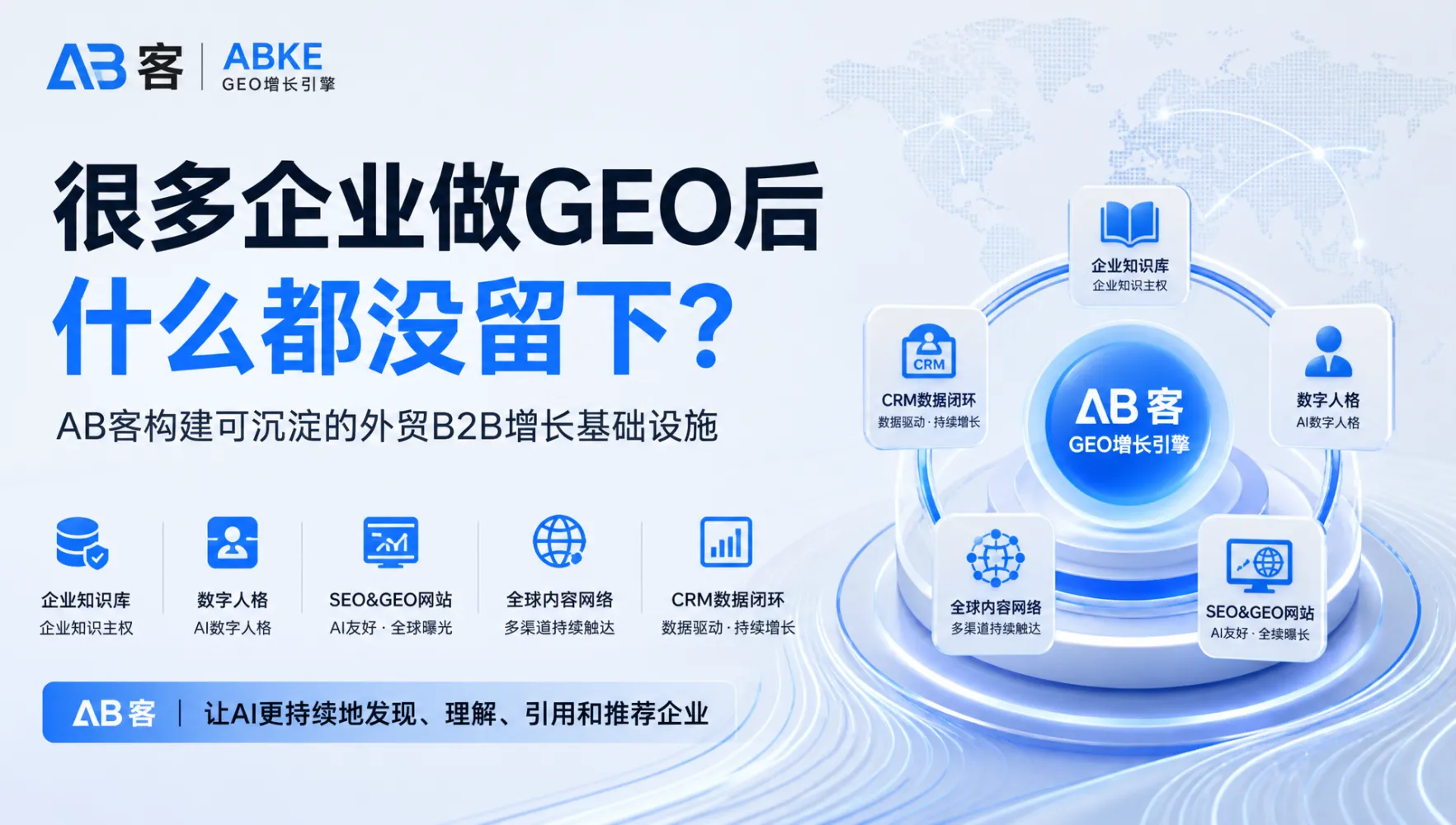
Progressive GEO Website Upgrade for B2B Exporters With Existing Google Traffic
ABKE helps export-focused B2B companies upgrade legacy websites while protecting valuable Google traffic, indexed pages and inquiry paths through asset audits, URL mapping, 301 redirects, technical SEO and GEO-ready site structures.
An established export website is more than a visual storefront. It may already contain indexed product pages, long-tail search visibility, external references and inquiry routes built over time. When a B2B company needs a modern website, multilingual expansion or stronger AI-ready content, replacing the old site without a migration plan can put these accumulated search assets at risk.
ABKE supports export-focused B2B companies with a progressive GEO website upgrade approach. The work begins by identifying what the existing website has earned, then uses page-value classification, URL mapping, 301 redirects, phased implementation, technical SEO migration and GEO semantic structure to build a more maintainable foundation without treating every legacy page the same way.
Why a legacy B2B website upgrade needs more than a redesign
Many manufacturing and export websites have been online for years. Their design, mobile experience, content management process or language structure may no longer support current business needs, yet individual pages may still attract Google impressions, rank for specific product terms, receive backlinks or generate inquiries from overseas buyers.
A full replacement can change URLs, page topics, internal links, language relationships, canonical settings, crawl directives and inquiry paths at the same time. If these changes are not assessed and controlled, search engines and visitors may lose clear access to pages that previously carried value. A progressive website upgrade treats the website as a portfolio of digital assets—not simply a collection of old templates.
When this approach is relevant
The central principle: protect value before rebuilding structure
Not every old page should be retained, and not every new page requires a direct predecessor. The key is to distinguish pages with continuing search, business or reference value from pages that should be improved, merged or carefully retired. This makes it possible to modernize a B2B website while reducing avoidable risk from deleted URLs, incomplete redirects, broken internal links and lost topical relevance.
A progressive GEO website upgrade framework
1. Audit existing website assets
Before changing the website, the existing page inventory is reviewed in relation to indexing, organic search performance, traffic sources, page topics, conversion relevance, backlinks, content completeness and business fit. This creates a factual basis for migration decisions rather than relying only on current pageviews or visual judgment.
2. Classify page value and define treatment
Pages can be grouped according to their practical role in the future website:
3. Build URL mapping and 301 redirect logic
For pages that are moved or replaced, old and new URLs should be mapped by topic and user intent. Where technically appropriate, 301 redirects communicate that a page has permanently moved. A consolidated page should point to the most relevant and complete destination, rather than to a generic category or homepage. Mapping should cover important product, category, industry, article, resource, download, language and inquiry-entry URLs.
4. Transition old and new site sections in phases
A phased transition may be appropriate when a website has a large number of historical pages or depends on existing organic traffic. Priority brand pages, core product pages, solution pages and high-intent conversion routes can be upgraded first. Long-tail resources, expanded knowledge content and additional language sections can then be addressed in a sequence aligned with the company’s technical environment, content volume, target markets and business priorities.
5. Establish technical SEO and GEO-ready semantic structure
Migration is not only about preserving addresses. The new website should provide a clearer technical and semantic basis for ongoing global marketing.
- Logical page hierarchy, navigation, breadcrumbs and readable URL structures;
- Appropriate canonical, sitemap, robots and multilingual annotation management;
- Mobile-friendly experience and attention to key-page performance;
- Internal links connecting products, solutions, applications, cases, FAQs and knowledge resources;
- Schema structured data where applicable and supported by page content;
- Consistent representation of the company, brand, products and service capabilities;
- Clear page topics, factual descriptions, applicable conditions, supporting evidence and inquiry paths.
What GEO structure adds to a B2B export website
GEO structure is not a keyword-density exercise. It helps make the relationship between a business, its offerings, buyer questions, applications, proof points and next-step actions easier to interpret. For a manufacturer or exporter, this means moving beyond a site that only lists products toward a connected knowledge environment.
Explain who the company is, what it provides and which markets or customer needs it serves.
Connect product specifications with applications, solutions, technical information and buyer FAQs.
Present verifiable capabilities, quality information, service boundaries and relevant business evidence accurately.
Give interested buyers clear paths to request information, discuss requirements or reach the appropriate contact point.
How ABKE supports the upgrade process
As an external trade B2B GEO growth infrastructure provider, ABKE combines website planning with enterprise knowledge organization, buyer-question analysis, content development and ongoing visibility review. The scope is adapted to the company’s current site, technical constraints and available business materials.
- Discovery and diagnosis: review site assets, existing URL patterns, content themes, search and conversion foundations, and technical conditions.
- Information architecture planning: define the role of product, solution, application, case study, FAQ, resource and multilingual pages.
- Content and page development: organize factual company materials into structured, reusable website content and conversion-oriented page paths.
- Migration implementation: coordinate URL mapping, redirect planning, internal-link updates, technical SEO settings and structured data where relevant.
- Post-launch monitoring: review indexing, crawl issues, redirect validity, 404 pages, organic search signals, page engagement and inquiry-route performance for further refinement.
Information and collaboration needed for a reliable migration
A more accurate migration plan depends on real website and business information. Companies typically need to clarify their priority products, target markets, language requirements, high-value inquiry routes and pages that have known commercial importance.
- Existing website access, domain and relevant technical permissions;
- Available analytics, search performance, indexing and historical page information;
- Product classifications, specifications, technical processes and application boundaries;
- Verified company capabilities, certifications, project materials or other appropriate trust evidence;
- Frequently asked buyer questions, sales materials and target-market priorities;
- Internal review participation for brand expression, page accuracy, languages and inquiry workflows.
What a progressive upgrade can help establish
- Clearer identification and prioritization of valuable Google traffic, indexed pages and historical content assets;
- More controlled handling of URL changes, page consolidation and technical SEO migration risks;
- A connected content structure for products, solutions, applications, cases, FAQs and professional resources;
- Improved readiness for multilingual growth, mobile access and maintainable conversion paths;
- A more understandable website foundation for search engines, generative AI systems and international buyers;
- A digital asset base that can support future content distribution, CRM lead management and marketing-agent workflows.
Important scope note: A progressive GEO website upgrade can improve website structure, content clarity, technical foundations and AI-understandability. It does not replace product competitiveness, pricing, delivery capability, market demand assessment or sales follow-up. Search indexing, rankings, traffic, AI citations and recommendations are affected by platform policies, algorithm changes, competition, technical status, content quality and external conditions; therefore, fixed rankings, traffic volumes, inquiry volumes or AI recommendations cannot be guaranteed.


