.png?x-oss-process=image/resize,h_100,m_lfit/format,webp)

.png?x-oss-process=image/resize,m_lfit,w_200/format,webp)

Hot Products

.png?x-oss-process=image/resize,h_2000,m_lfit/format,webp)

.png?x-oss-process=image/resize,h_2000,m_lfit/format,webp)

Popular articles
GEO for B2B Exporters: Win AI Discovery, Trust, and Supplier Selection
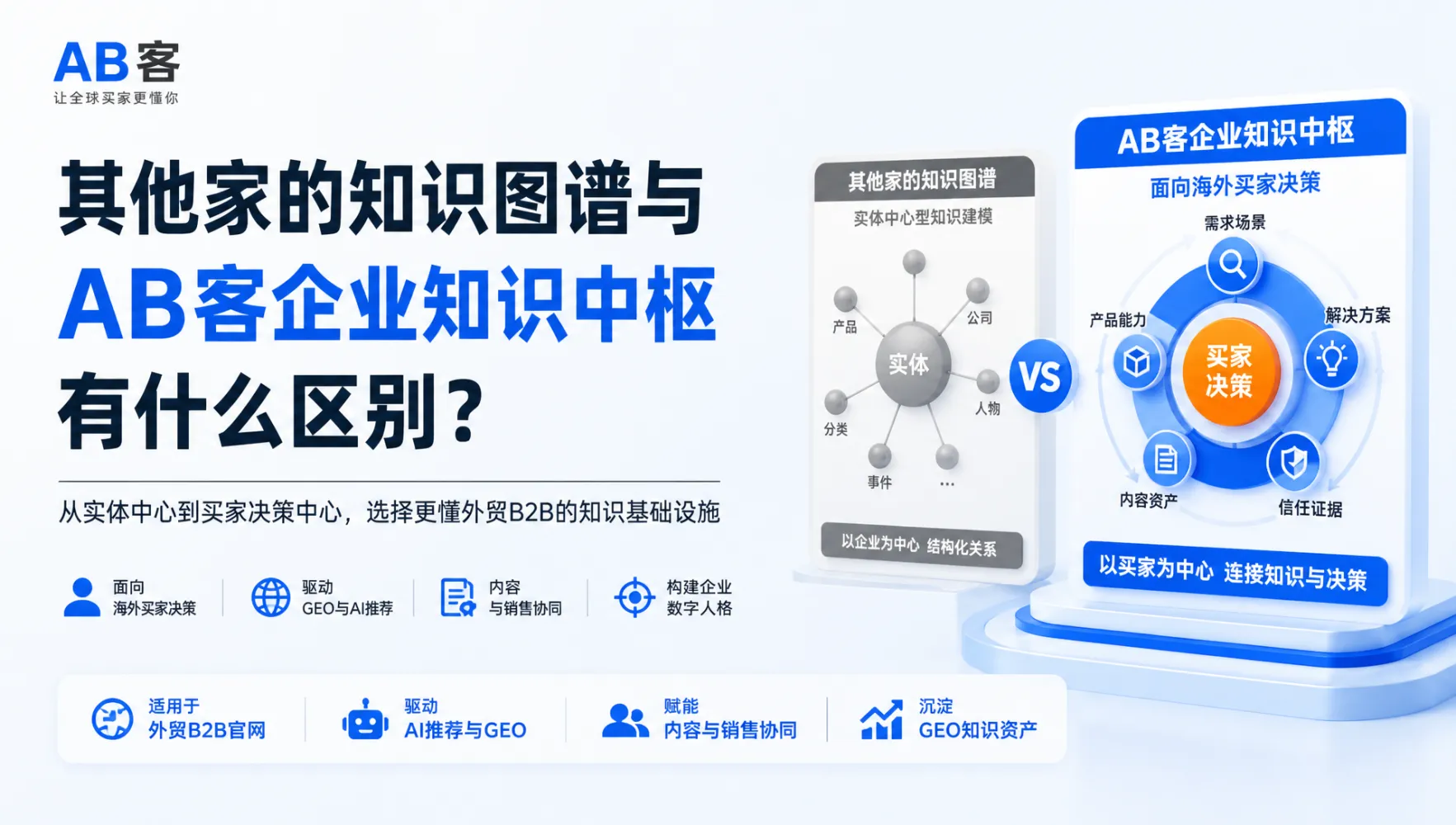
How Do Other Knowledge Graphs Differ from ABKE’s Enterprise Knowledge Hub?
AB 客企业知识中枢:如何杜绝 AI 幻觉,让官网、销售资料、智能体回答 100% 基于企业确认事实?
AI Citations Don’t Equal Inquiries: The Real B2B GEO Advantage Is a Complete Conversion Loop After AI Recommendations
Move Beyond Expiring AI Prompts: Build Long-Term Buyer Question Assets with ABKE
Recommended Reading


How Can B2B Manufacturers Make Complex Product Models and Parameters Easy for Customers and AI to Understand?
ABKE helps export-focused B2B manufacturers build structured product knowledge systems that connect product lines, models, parameters, configurations, application conditions and evidence for clearer customer communication and AI-ready product information.
For export-oriented manufacturers and industrial B2B suppliers, product complexity is rarely limited to the number of models. Specifications, materials, capacities, interfaces, control options, operating environments and customization requirements often affect one another. When this information is scattered across catalogs, spreadsheets, manuals, emails and individual experience, customers may struggle to compare options—and AI systems may lack the context needed to describe products accurately.
ABKE helps businesses turn verified product information into a structured, reviewable product knowledge system. It creates a common factual foundation for websites, product pages, selection tools, B2B FAQs, sales materials, multilingual content and AI-assisted answers.
The challenge is not missing parameters—it is missing product logic
A technical table can list numbers without explaining what they mean for a buyer’s project. A model code can identify a configuration without making its scope, differences or limitations clear. This creates friction for both customers and internal teams, particularly where products require application-based selection or technical confirmation.
For customers
It can be difficult to understand model codes, identify relevant differences, assess application fit or know which conditions require further confirmation.
For sales and technical teams
Teams may repeatedly search for documents, reconcile version differences or explain the same selection conditions in separate conversations.
For AI-assisted communication
Fragmented product information can cause models, capabilities or application boundaries to be confused when context is incomplete.
A structured product knowledge system starts with connected facts
Rather than treating each model as an isolated entry, ABKE organizes product information around the relationships that matter in a purchasing and selection process:
Within this structure, a parameter can be linked to its definition, unit, available range, applicable models, influence on performance, relevant operating conditions, supporting documents and common buyer questions. This makes product information easier to review internally and easier to present externally without separating a technical fact from its practical meaning.
What the product knowledge structure can include
| Knowledge area | Purpose in product communication and selection |
|---|---|
| Product hierarchy and model rules | Clarifies product lines, product names, model codes, model status and the meaning of model variations. |
| Parameters and specifications | Connects values, units and ranges with their definitions, performance implications and applicable conditions. |
| Configurations and customization | Separates standard configurations, available options, assessable customization directions and items requiring technical confirmation. |
| Applications and limitations | Defines suitable industries, media, environments, operating conditions, installation requirements and known exclusions. |
| Evidence and buyer questions | Associates approved drawings, manuals, test records, certifications or authorized project materials with relevant FAQs and sales responses. |
How ABKE supports clearer model comparison and product selection
ABKE uses the enterprise knowledge hub as a controlled source of product facts. The focus is not simply to input more specifications, but to establish a usable relationship between models, technical conditions, customer questions and evidence.
- Inventory and validate source materials. Product catalogs, model lists, datasheets, manuals, drawings, test materials, inquiry records and sales references are identified with their source, status, applicability and responsible reviewer.
- Define the product hierarchy and field standards. Product lines, products, models, specifications, configurations and solutions are organized according to the company’s actual portfolio. Fields are designed for practical use across website, sales and internal management scenarios.
- Create model comparisons and selection matrices. High-impact comparison dimensions may include capacity, size range, material grade, control method, compatible media, environmental conditions, delivery form or optional components. The matrix distinguishes direct matches from requirements needing further assessment.
- Explain parameters in business context. Each important parameter can be accompanied by what it means, what it affects, which models it applies to and which project conditions should be confirmed before selection.
- Reuse approved knowledge across channels. The same verified fact base can support product pages, model pages, comparison pages, selection content, B2B product FAQs, sales materials, CRM references and multilingual content.
From a parameter table to a decision-ready product explanation
A useful product page or AI-assisted answer should do more than repeat a specification. It should help a buyer understand the decision context while preserving technical accuracy.
- What does this parameter represent, and what unit or range applies?
- Which models share this feature, and which models differ?
- What operating condition, material, environment or installation requirement affects the choice?
- Which options are standard, which are configurable and which require engineering review?
- Which approved document or technical source supports the stated information?
A consistent fact base for websites, teams and AI applications
When product information is approved once and structured for reuse, each channel can use a format appropriate to its audience without changing the underlying facts. A website may provide a concise comparison module; a sales team may use expanded qualification notes; an AI assistant may answer within documented model, parameter and application boundaries.
Who benefits most from this approach
This structured product knowledge approach is especially relevant for B2B manufacturers and suppliers that have reliable technical materials but find them difficult to manage or explain consistently. Typical situations include:
- Multiple product lines, models, specifications or configuration combinations;
- Industrial products involving technical parameters, materials, process conditions or installation requirements;
- Equipment, components or material products requiring application-based selection, options or non-standard evaluation;
- Website, product content or multilingual sales material upgrades;
- Teams seeking one verified product reference for sales, marketing, service and AI-enabled workflows.
Implementation depends on verified enterprise knowledge
A reliable knowledge system requires the company’s active participation. Product, technical, sales, marketing or service stakeholders should confirm model information, parameter definitions, customization conditions, evidence materials and publication permissions. Sensitive information—such as pricing, internal processes, customer data or non-public project materials—should be classified by access and disclosure level.
ABKE can support knowledge structure design, material organization, standardized expression, relationship mapping and downstream content use. The enterprise remains responsible for confirming product facts, technical boundaries and supporting evidence before information is used publicly or supplied to AI applications.
Important boundary: A structured product knowledge base improves clarity, consistency and AI readability. It does not replace engineering review for highly customized projects, complex operating conditions, safety or compliance requirements, or situations that require testing and site-specific confirmation. In these cases, the knowledge system should help identify the information needed for the next technical evaluation.


