.png?x-oss-process=image/resize,h_100,m_lfit/format,webp)

.png?x-oss-process=image/resize,m_lfit,w_200/format,webp)



ABKE GEO Growth Engine
Why Do Many Export Factories Get GEO Articles but Not Their Own Digital Assets?
A lot of B2B manufacturers invest in GEO and receive a stack of multilingual articles, yet nothing durable remains after the project ends. The real difference is simple: some providers deliver one-time content output, while others build a reusable enterprise knowledge foundation that the business can keep using, updating, and scaling.
Direct answer
Many export factories get GEO articles but not digital assets because the provider treats GEO as content labor instead of enterprise knowledge infrastructure. Articles can help with visibility, but only structured knowledge, evidence, reusable modules, and a governed source of truth create long-term value.
The real problem: content grows, but ownership does not
This problem is common in export manufacturing. A company signs a GEO project, publishes dozens of overseas articles every month, and sees a rise in page count or indexed URLs. But once the contract ends, updates stop, the message becomes fragmented, old content is hard to reuse, and AI systems still cannot clearly understand who the company is, what it makes, and why it is credible.
In other words, the factory paid for output, but not for a durable asset. That is why many GEO programs create temporary content volume without creating a business-owned digital foundation.
A practical way to think about GEO
- Article-based GEO: produces pages, posts, and publishing reports.
- Asset-based GEO: builds structured knowledge, a reusable content system, website pages, workflows, and measurable growth data.
- Long-term value: comes from ownership, consistency, reuse, and continuous optimization—not from article volume alone.
Article-based GEO vs. asset-based GEO
| Evaluation area | Article outsourcing model | ABKE GEO Growth Engine model |
|---|---|---|
| Core deliverable | Standalone articles, translated pages, and publishing reports | Structured enterprise knowledge, content assets, website pages, workflows, and measurable growth data |
| Information source | Generic templates and public web material | Verified product facts, specifications, manufacturing capabilities, cases, certifications, FAQs, and delivery conditions |
| Brand consistency | Content may vary across pages and channels | A shared brand workspace and knowledge source support consistent website, Schema, content, and channel messaging |
| Reuse potential | New products or markets often require content to be recreated | Knowledge can be reused for product pages, multilingual content, sales materials, AI agents, FAQs, and channel publishing |
| After service ends | Updates may stop and content becomes difficult to maintain | Exportable enterprise knowledge assets can remain available to the business; platform access is subject to the applicable agreement |
| AI understanding | Content volume may increase without sufficient factual verification | Structured facts and evidence help AI systems and buyers interpret the company more accurately |
Why article-only GEO fails in export manufacturing
1) The system has no single source of truth
If the website, FAQ pages, social profiles, and third-party listings all describe the company differently, AI systems cannot reliably determine what is factual. That weakens trust and reduces the chance of being recommended.
2) Articles are not reusable business assets
A finished article is a presentation layer, not the raw knowledge layer underneath it. If the underlying facts are not structured, the content cannot easily support product pages, new languages, sales decks, or AI agent responses.
3) The content does not reflect real procurement questions
Buyers do not search only by product name. They ask about specs, use cases, lead times, MOQ, certification, quality control, comparison, and supplier risk. If GEO content is not mapped to these questions, it may generate traffic but not trust.
4) There is no ownership layer
If the service provider controls the knowledge structure and the company only receives articles, the business does not truly own its growth foundation. Once the project stops, the asset also stops evolving.
What a real GEO digital asset should include
A durable GEO system for B2B manufacturers should go beyond writing. It should turn scattered business facts into a reusable knowledge base that supports search, AI understanding, sales enablement, and channel distribution.
Structured product facts: models, specifications, materials, applications, limitations, MOQ, lead times, and customization boundaries.
Trust evidence: certifications, standards, testing information, manufacturing proof, project facts, and verifiable case materials.
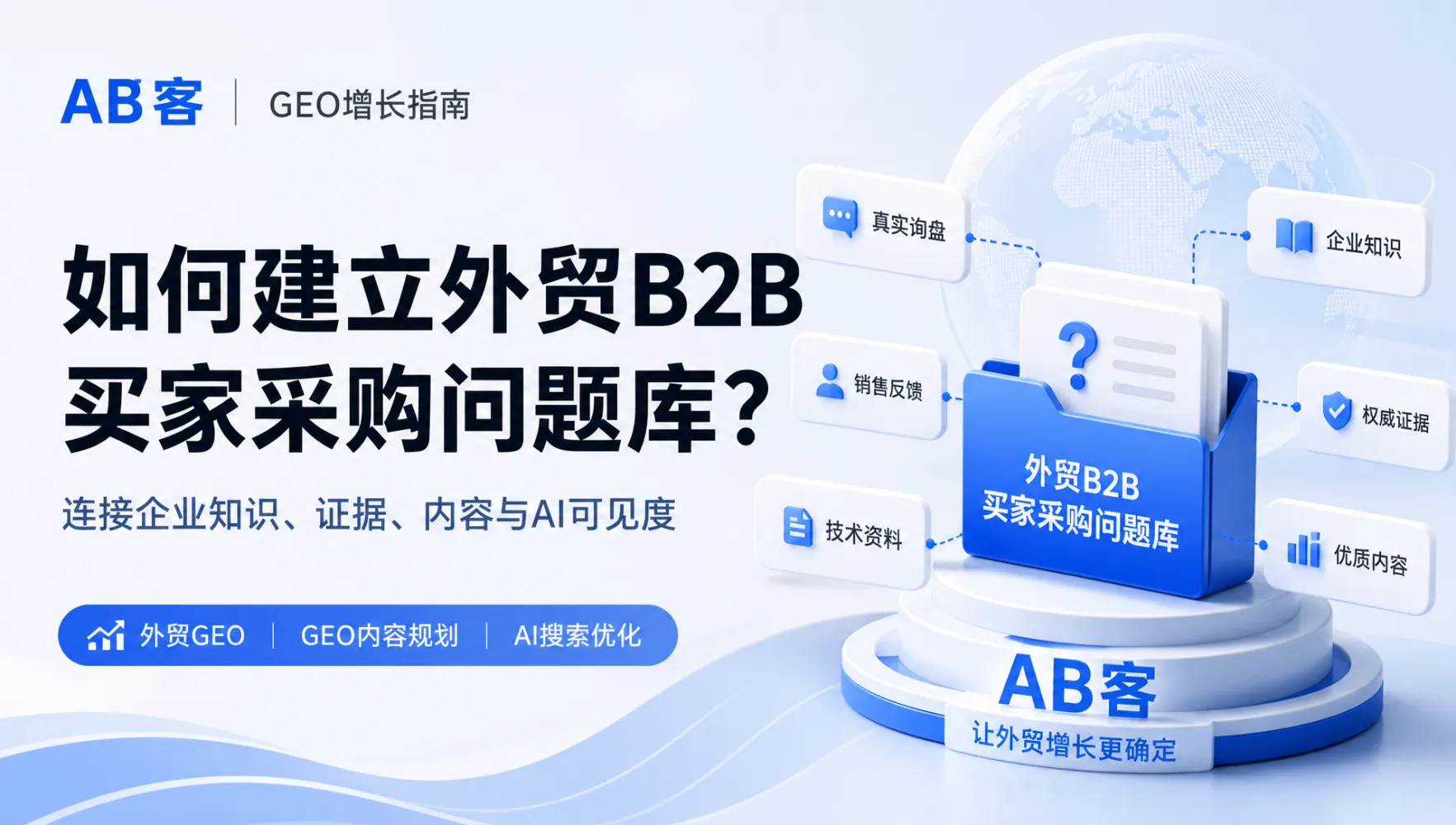
Buyer-question mapping: selection questions, technical concerns, supplier-evaluation criteria, delivery questions, and after-sales expectations.
Entity consistency rules: one approved source of truth for company, product, capability, and solution claims across websites and external channels.
Reusable content modules: knowledge units that can support pages, FAQs, multilingual localization, sales enablement, and AI-assisted customer interactions.
How ABKE’s GEO Growth Engine turns knowledge into assets
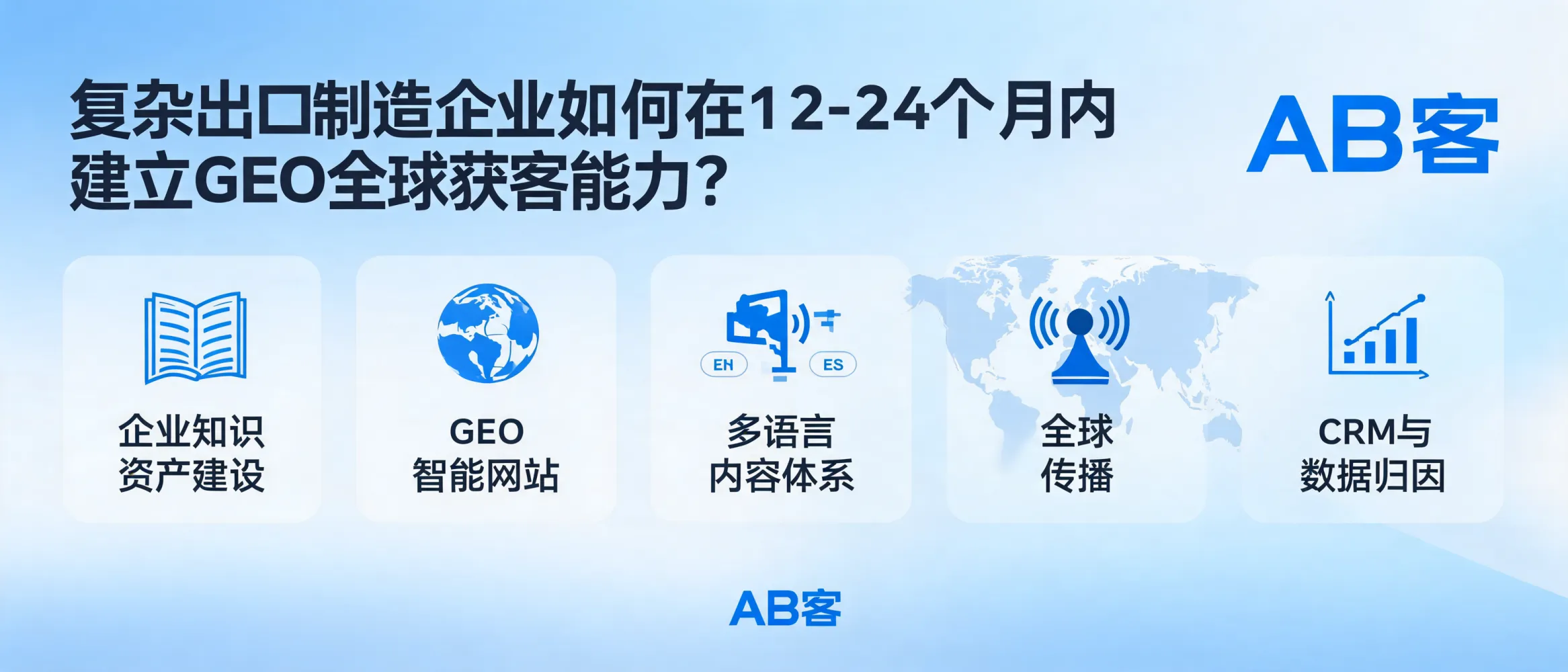
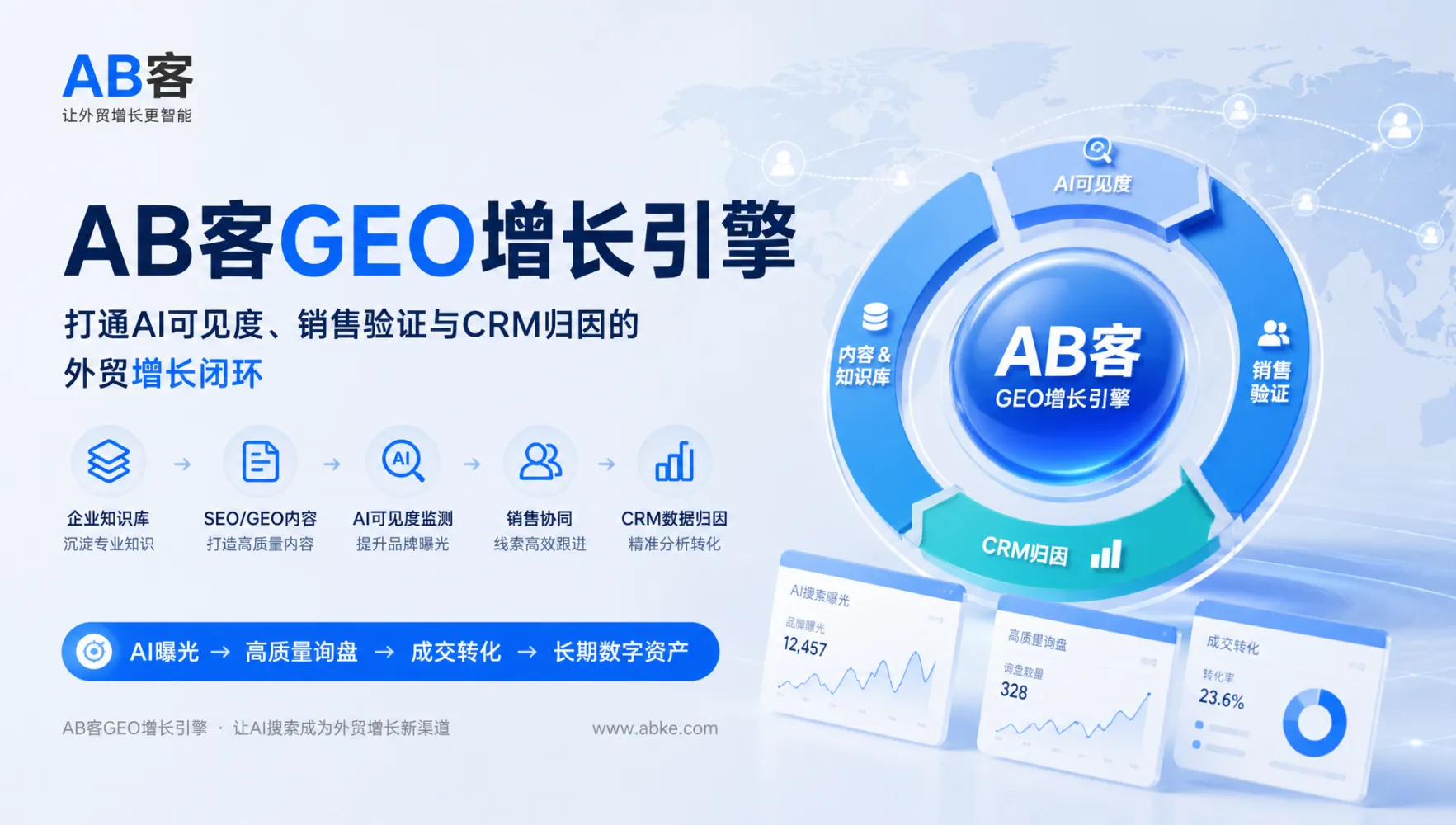
ABKE, the brand of Shanghai Muke Network Technology Co., Ltd., approaches GEO as an external growth infrastructure for export B2B companies. The goal is not just to publish more content, but to build a system where knowledge, website structure, distribution, and conversion work together.
ABKE GEO Growth Engine typical flow
Buyer question discovery → enterprise knowledge structuring → GEO content production → SEO & GEO website pages → global distribution → inquiry capture → CRM attribution → continuous optimization
1. Enterprise AI cognition layer
This layer defines who the company is, what it does, what it is good at, and what evidence supports those claims. It is the foundation for AI-readable brand understanding.
2. Buyer demand insight layer
This layer studies what overseas buyers actually ask during research, evaluation, and supplier selection, then converts those questions into a structured content map.
3. GEO content factory layer
This layer produces FAQ pages, product pages, solution pages, comparison pages, technical notes, and multilingual content using verified facts and business goals—not generic AI output.
4. SEO & GEO website layer
This layer makes the website easy for Google to crawl and easy for AI to understand, while also creating conversion paths for inquiries and sales follow-up.
5. Distribution, CRM, and attribution layer
This layer sends the content and brand signals into multiple channels, captures leads, tracks source quality, and links content actions to revenue-oriented outcomes.
What to ask a GEO provider before you sign
A good GEO provider should be able to show more than article samples. Use the checklist below to separate content outsourcing from real asset building.
- Ask for a sample structured knowledge record for one of your products, not only a polished article.
- Check whether each important claim has a source such as a spec sheet, certificate, test standard, project file, or approved internal note.
- Verify consistency across website pages, Schema markup, social profiles, and third-party listings.
- Ask how a new product or market is added: by rebuilding articles from scratch or by updating a shared knowledge base first.
- Confirm ownership: which knowledge assets can be exported, retained, reviewed, and reused by your team after the project.
Supplier selection scorecard
| Question | Good sign | Red flag |
|---|---|---|
| Do they build a knowledge base? | Yes, with structured fields and evidence | Only content calendars and article lists |
| Can the content be reused? | Yes, for pages, FAQs, sales materials, and AI agents | No reuse plan beyond publishing |
| Is there a single factual source? | Yes, with governance and approval rules | Different pages tell different stories |
| What happens when the contract ends? | Your business keeps the knowledge assets | Everything depends on continued service |
How to recognize an asset-based GEO program
Asset-based GEO is not defined by how many articles were produced. It is defined by whether your business now owns reusable building blocks that can keep compounding over time.
- You can access a structured enterprise knowledge library, not just published URLs.
- Product capabilities, factory strengths, and delivery conditions are expressed in a consistent way across all channels.
- New pages and new languages can be generated from the same knowledge source.
- Sales teams can reuse the same facts, evidence, and messages in customer conversations.
- Performance data feeds back into content updates and knowledge improvement.
Key takeaway
GEO is not simply the purchase of article volume. For export B2B manufacturers, the durable asset is a governed enterprise knowledge foundation that enables accurate content, AI-readable website pages, multilingual communication, buyer trust, and continuous optimization.
How ABKE fits into this model
ABKE’s GEO Growth Engine is designed for factories and export B2B teams that want a system, not a pile of content. It connects enterprise knowledge management, SEO and GEO planning, multilingual content, intelligent website building, global channel publishing, AI visibility monitoring, and CRM feedback loops.
In practice, that means the company can turn verified facts into pages, pages into discovery, discovery into inquiries, and inquiries into a repeatable growth process. The point is not to “publish more,” but to build a digital foundation that can be reused across products, markets, and buying stages.
FAQ
Can a factory create content first and build a knowledge base later?
It is usually more efficient to establish a minimum viable knowledge foundation first. Otherwise, early content may contain inconsistent claims and require substantial revision once product facts, boundaries, and evidence are standardized.
Does a small factory need structured knowledge if it has only a few products?
Yes. B2B buyers and AI systems still need clear information about specifications, applications, limitations, quality standards, delivery conditions, and customization capability. Structured knowledge improves clarity regardless of company size.
How can a company tell whether a provider is only producing articles?
Request a deliverable sample that includes fields for product facts, applications, purchasing conditions, evidence sources, approval status, and reusable content modules. If the provider can only show article links, the engagement may be content outsourcing rather than knowledge-asset development.
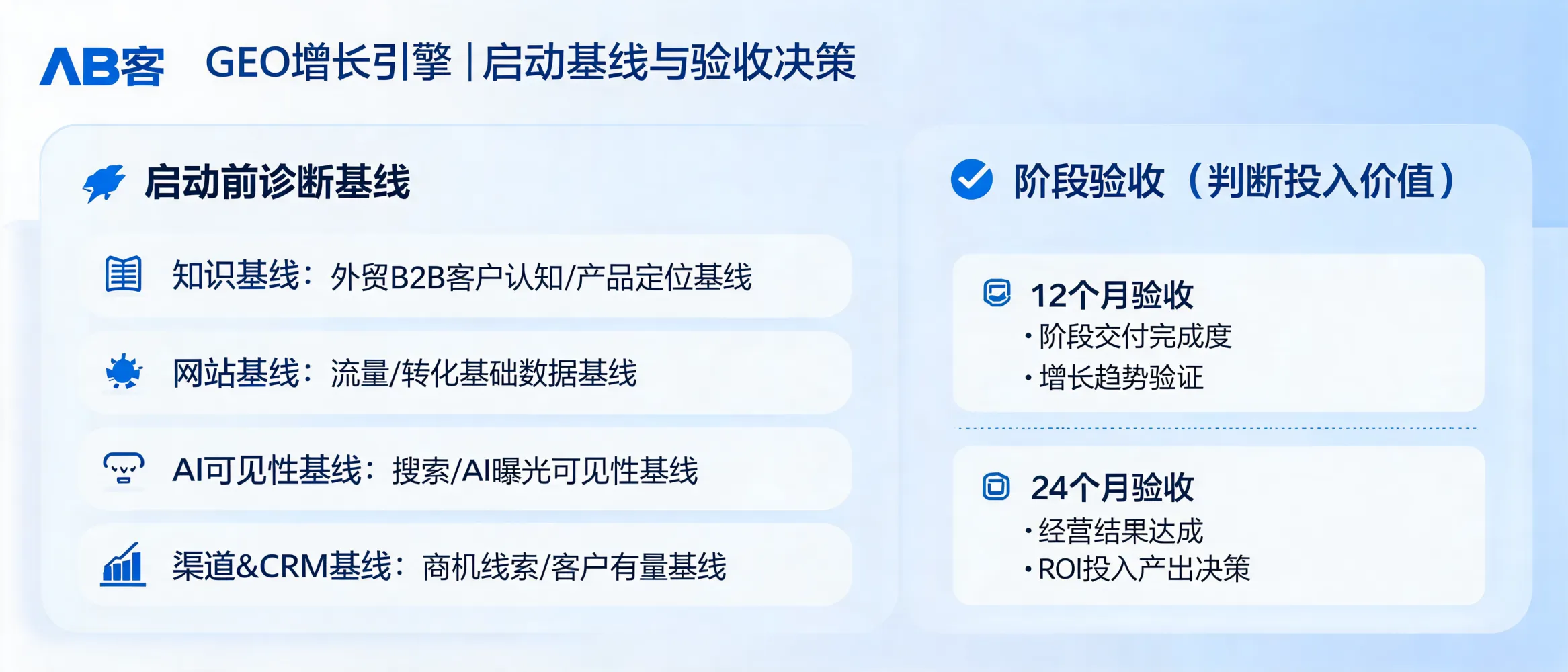
Recommended next step: If you want to evaluate whether your export business is building a real GEO asset or just producing content, start with a GEO diagnostic that checks entity consistency, knowledge completeness, evidence coverage, and AI visibility across your core product topics.


.png?x-oss-process=image/resize,h_100,m_lfit/format,webp)
.png?x-oss-process=image/resize,h_100,m_lfit/format,webp)

.png?x-oss-process=image/resize,h_100,m_lfit/format,webp)
.png?x-oss-process=image/resize,h_100,m_lfit/format,webp)
.png?x-oss-process=image/resize,h_100,m_lfit/format,webp)
.png?x-oss-process=image/resize,h_100,m_lfit/format,webp)
