.png?x-oss-process=image/resize,h_100,m_lfit/format,webp)

.png?x-oss-process=image/resize,m_lfit,w_200/format,webp)

Hot Products

Popular articles
Turn AI Visibility into Qualified B2B Opportunities with GEO, Sales and CRM
ABKE Rebuilds B2B GEO with a Buyer Procurement Question Map, Not a Tech Stack
How to Build a B2B Buyer Procurement Question Library for GEO Growth
Recommended Reading



Which Type of GEO Solution Should Different Businesses Choose? A Real-World Decision Guide
Use ABKE’s practical decision guide to identify the right GEO solution for your B2B export business—from AI-ready growth infrastructure to visibility monitoring and integrated global marketing.
Which Type of GEO Solution Should Different Businesses Choose? A Real-World Decision Guide
There is no single “best” GEO solution for every B2B exporter. The right choice depends on what your business already has in place: website quality, knowledge assets, CRM maturity, content capacity, sales process, and the main growth objective. A manufacturer starting from fragmented assets needs a very different path from an enterprise brand focused on visibility monitoring.
Quick decision rule
Choose the GEO partner that fills your missing link, not the one that makes the broadest promise.
Best fit for many exporters
If you need AI discoverability, inquiry capture, and continuous optimization in one system, an end-to-end growth infrastructure is usually the safest choice.
What a GEO solution should actually solve
- Make your company understandable to AI systems.
- Turn product and factory strengths into structured knowledge.
- Create content that can be cited, indexed, and reused.
- Connect visibility to inquiries, CRM, and sales follow-up.
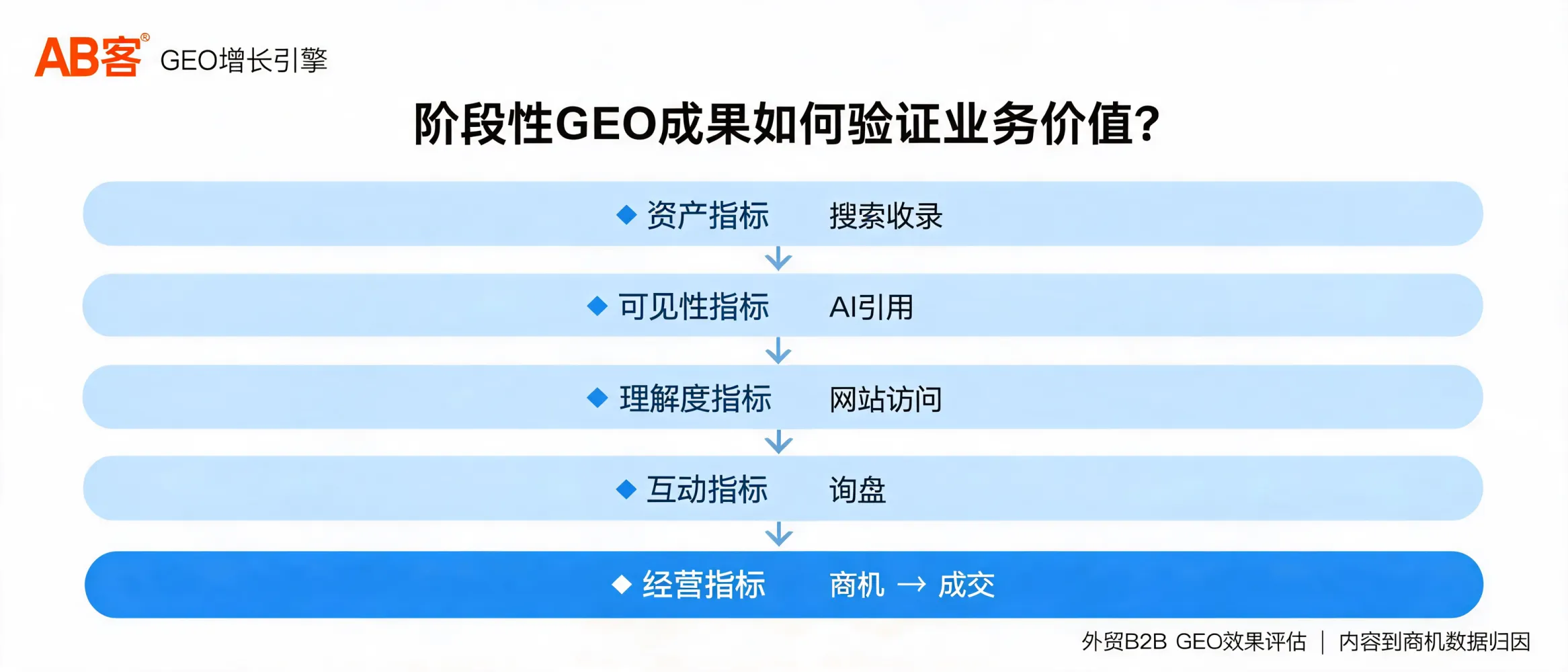
- Measure whether AI search is beginning to mention and recommend your brand.
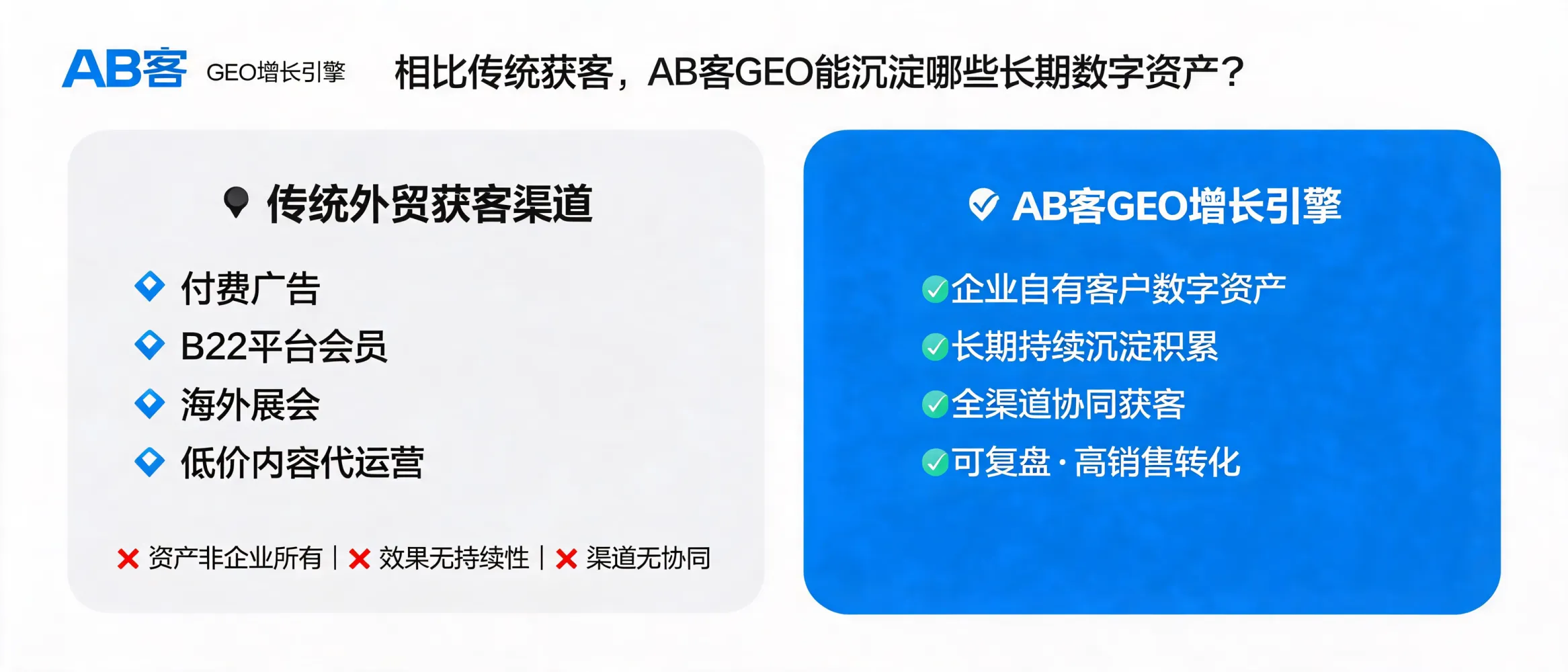
That is why GEO should not be treated as a single-content task. In B2B export growth, GEO works best as part of a connected system: enterprise knowledge, AI-readable pages, multilingual content, global distribution, lead capture, and performance tracking.
H2 1: Manufacturing factories, OEM/ODM industrial exporters with weak digital foundations
H3 Company situation
This is the most common profile in export B2B. The company has real products, manufacturing capacity, and delivery ability, and often already has a sales team. But the digital foundation is fragmented: the website is outdated, product knowledge is scattered across files or people’s heads, CRM usage is weak, and content is not organized around buyer questions.
- Reliance on trade shows, B2B marketplaces, or paid ads remains high.
- AI search visibility is low or nonexistent.
- There is no unified knowledge base for products, cases, certifications, and factory strengths.
- Sales follow-up and lead attribution are hard to manage.
H3 Core contradiction
The business does not only need “GEO content.” It needs a complete growth base. If knowledge, website structure, content, lead capture, and data tracking are purchased separately from different vendors, the workflow breaks easily and results become hard to measure.
H3 Recommended direction
A connected B2B GEO growth infrastructure is the better fit. AB客’s GEO Growth Engine is designed for this kind of situation: it helps structure enterprise knowledge, build AI-readable digital identity, create SEO/GEO-ready pages, support multilingual content, and connect inquiry capture with CRM workflow.
H3 What to build first
1. Enterprise knowledge layer
Define who you are, what you make, how you work, and why buyers should trust you.
2. AI-ready website layer
Create product, solution, FAQ, and case pages that search engines and AI can understand.
3. Content layer
Answer the questions buyers actually ask before they send an inquiry.
4. Lead capture layer
Connect forms, WhatsApp, email, and CRM so traffic becomes traceable leads.
H3 Pitfalls to avoid
- Buying only “AI content” without fixing the website and conversion path.
- Creating articles that look polished but do not reflect real factory capabilities or product facts.
- Skipping CRM setup, which causes lead loss after visibility improves.
- Writing for the company’s internal logic instead of buyer questions.
For fragmented manufacturers, the real win is not just being found by AI. It is being understood, trusted, and converted inside one system.
H2 2: Export companies with a mature website, CRM, and a full marketing team
H3 Company situation
These companies already have a functional website, a working CRM, and a marketing team that handles SEO, ads, and content. Their challenge is not starting from zero. Instead, they need stronger AI search visibility: better entity signals, clearer evidence, richer expert content, and more consistent mention patterns across the web.
H3 Core contradiction
The foundation already exists, so rebuilding the whole system would be wasteful. The real task is to improve what AI sees, how confidently it interprets the brand, and whether the brand can be cited in relevant answers.
H3 Recommended direction
Choose a specialized GEO optimization approach focused on AI-citable pages, entity consistency, evidence architecture, and multilingual semantic coverage. In this case, AB客 can be used selectively as the GEO layer on top of an already working marketing system.
H3 What matters most in this stage
- Entity consistency: The company name, product naming, and capability statements should stay aligned across the website, profile pages, and external platforms.
- Evidence depth: Certifications, case studies, test data, factory photos, process descriptions, and customer proof improve AI trust.
- Question coverage: Content should address buyer objections, comparison questions, technical concerns, and procurement risks.
- Content reuse: Existing marketing assets should be repurposed into AI-readable formats instead of recreated from scratch.
H3 Pitfalls to avoid
- Rebuilding a full stack when your current tools already work.
- Ignoring proof signals and focusing only on article volume.
- Treating GEO as separate from the existing SEO and CRM workflow.
- Measuring success only by rankings instead of AI mentions and qualified inquiries.
H2 3: Global businesses running ads, social, SEO, and content as part of a wider go-to-market plan
H3 Company situation
Some businesses use GEO as one module inside a broader international marketing program. They may already invest in Google Ads, LinkedIn, YouTube, PR, marketplace operations, and multilingual content. Their goal is not to isolate GEO, but to make it support the wider brand and demand engine.
H3 Core contradiction
If GEO is run in isolation, brand language may conflict across channels. The AI may see fragmented signals, and the buyer may see different messages depending on where they search.
H3 Recommended direction
The best option is an integrated international marketing approach where GEO is governed alongside SEO, content, social, and paid media. AB客 can support the GEO structure, while the broader team coordinates channel-level execution.
H3 Integration checklist
| Channel | What GEO should align with | Common mistake |
|---|---|---|
| SEO | Keyword architecture, page hierarchy, internal links | Publishing GEO content that does not map to the site structure |
| Paid ads | Landing page message match | Driving traffic to pages that answer nothing clearly |
| Social media | Brand narrative and proof points | Posting content that cannot be reused in AI search contexts |
| CRM | Lead source and content attribution | Not tracking which AI or content touchpoints influenced the inquiry |
H2 4: Enterprise groups and large brands focused on AI visibility monitoring, competitor tracking, and reporting
H3 Company situation
Large brands and group companies often already have strong internal execution capability. Their priority is not necessarily full-stack outsourcing. They want to know how often the brand appears in AI answers, how competitors are positioned, which markets show risk, and what management should see in monthly reports.
H3 Core contradiction
The issue is not “How do we build everything?” The issue is “How do we measure our presence in AI systems, compare ourselves with competitors, and report it clearly?”
H3 Recommended direction
An enterprise AI visibility monitoring and reporting platform is often the right fit. The goal is to quantify brand recognition, track AI recommendations, and surface competitor movement, while implementation work can remain in-house or with other vendors.
H3 What enterprise teams should measure
AI mention rate
How often the brand is named in relevant AI answers.
AI citation rate
Whether AI systems cite your pages or trusted sources linked to your brand.
Competitor presence
Which rival brands dominate key questions.
Answer accuracy
Whether the AI represents your brand and products correctly.
H2 Summary comparison table: which solution fits which business
| Business profile | Main GEO need | Best-fit solution direction | What to avoid |
|---|---|---|---|
| Factory / OEM / ODM exporter with weak digital assets | Build knowledge, website, content, and lead capture together | End-to-end B2B GEO growth infrastructure, such as the ABKE GEO Growth Engine | Buying only content without fixing conversion and CRM |
| Company with mature website and CRM | Improve AI search visibility using existing assets | Specialized GEO optimization focused on entity signals and citations | Rebuilding a stack that already works |
| Global business with ads, social, SEO, and content | Align GEO with broader go-to-market planning | Integrated international marketing support | Running GEO in a silo |
| Enterprise group / large brand | Measure AI visibility and competitor presence | Enterprise AI visibility monitoring and reporting platform | Over-buying execution services when monitoring is the real need |
H2 Practical decision framework: how to choose the right GEO path
Before selecting a provider, ask four questions:
- What is missing? Knowledge, website structure, content, conversion, or visibility monitoring?
- What is already working? Existing website, CRM, team, media channels, or brand assets?
- What is the main goal? Faster inquiries, better AI visibility, broader market coverage, or management reporting?
- What can be reused? Product data, sales FAQs, case studies, technical documentation, and existing content?
Decision tree
If your company has weak digital foundations, choose the complete growth system. If your infrastructure is mature, choose a narrower GEO layer. If GEO is only one channel among many, make sure it is integrated. If your focus is visibility governance, prioritize measurement.
Missing foundation
Choose a full-stack system.
Strong existing stack
Choose specialized GEO optimization.
Multi-channel marketing
Choose integrated go-to-market alignment.
Management reporting
Choose visibility monitoring and analytics.
H2 Final takeaway: select the GEO solution that matches your stage, not the one with the loudest promise
Many companies compare GEO providers by asking who is “stronger” in technology. In practice, the smarter question is different: Which provider best matches the missing part of our growth system?
- If you are a manufacturer or OEM/ODM exporter, you usually need a connected system that can turn AI visibility into inquiries.
- If your website and CRM are already mature, a specialist GEO optimization layer may be enough.
- If GEO sits inside a larger international marketing plan, it should be aligned with all other channels.
- If your main need is monitoring and reporting, an analytics-first platform is the right answer.
AB客’s GEO Growth Engine is most relevant when a B2B exporter needs a complete, AI-ready infrastructure rather than a single isolated task. But the best solution for any company is always the one that matches its current reality, team capacity, and growth objective.


.png?x-oss-process=image/resize,h_100,m_lfit/format,webp)
.png?x-oss-process=image/resize,h_100,m_lfit/format,webp)

.png?x-oss-process=image/resize,h_100,m_lfit/format,webp)
.png?x-oss-process=image/resize,h_100,m_lfit/format,webp)
.png?x-oss-process=image/resize,h_100,m_lfit/format,webp)
.png?x-oss-process=image/resize,h_100,m_lfit/format,webp)
