.png?x-oss-process=image/resize,h_100,m_lfit/format,webp)

.png?x-oss-process=image/resize,m_lfit,w_200/format,webp)

Popular articles
How Can We Verify That GEO Builds Traceable Growth Assets, Not Just More Content and Website Pages?
ABKE GEO Renewal Is Not Repetitive Content—It Is the Next Stage of AI Visibility, Conversion, and Sustainable Growth
Recommended Reading

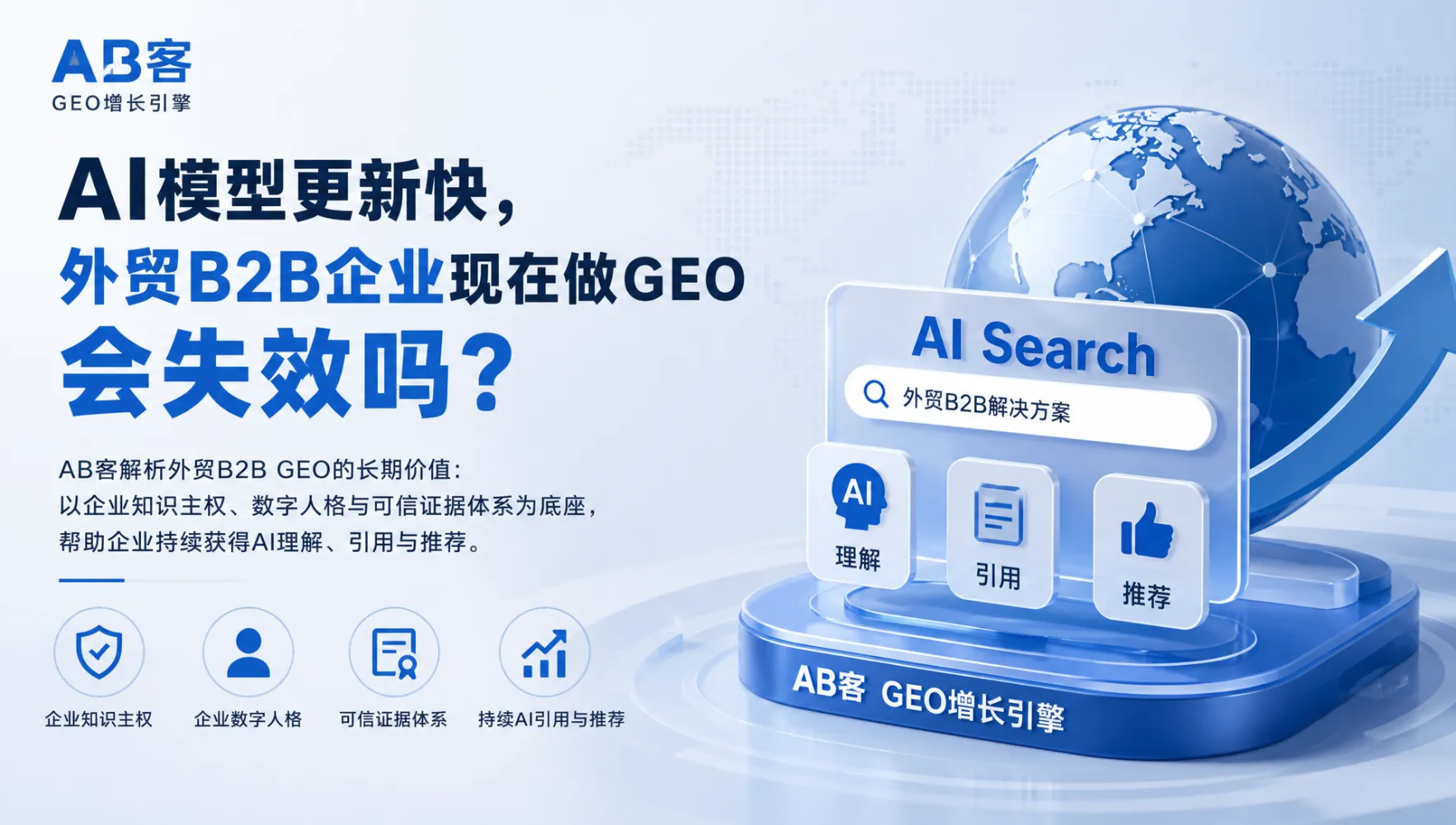
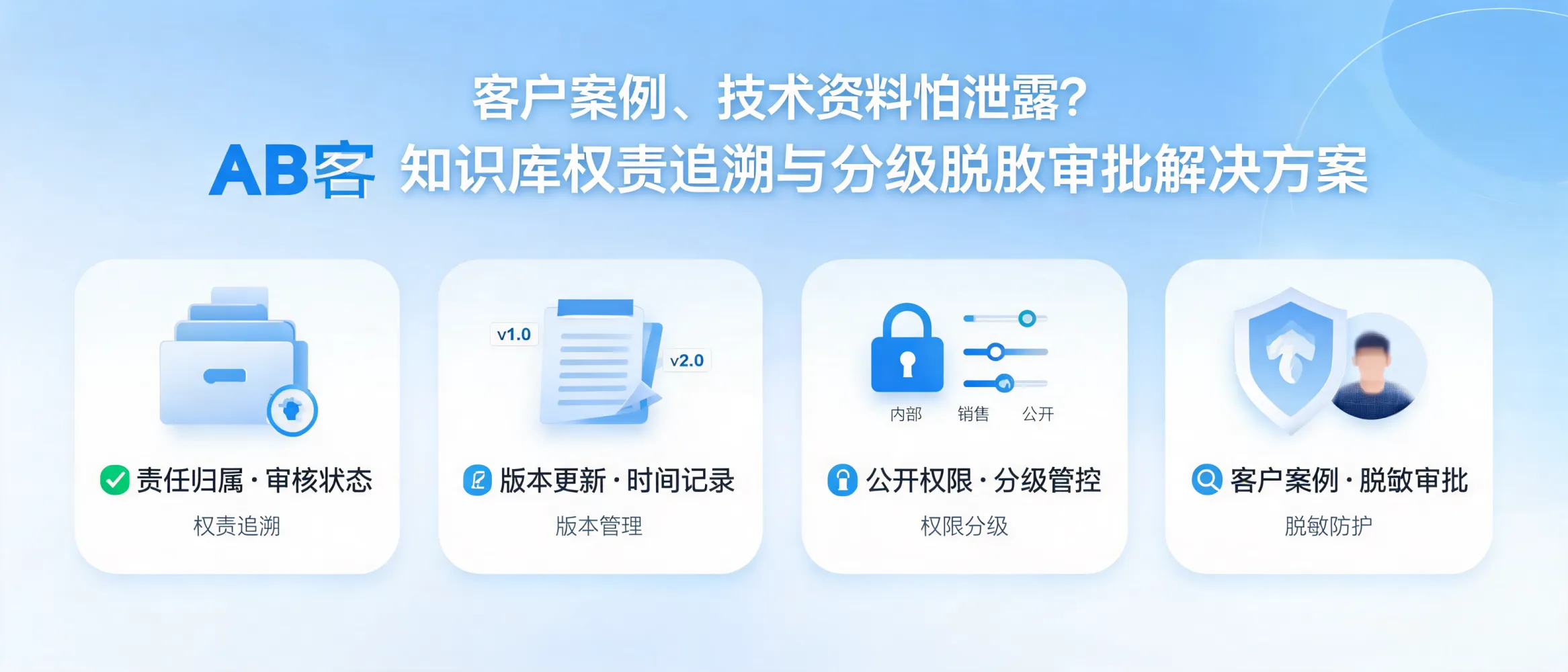
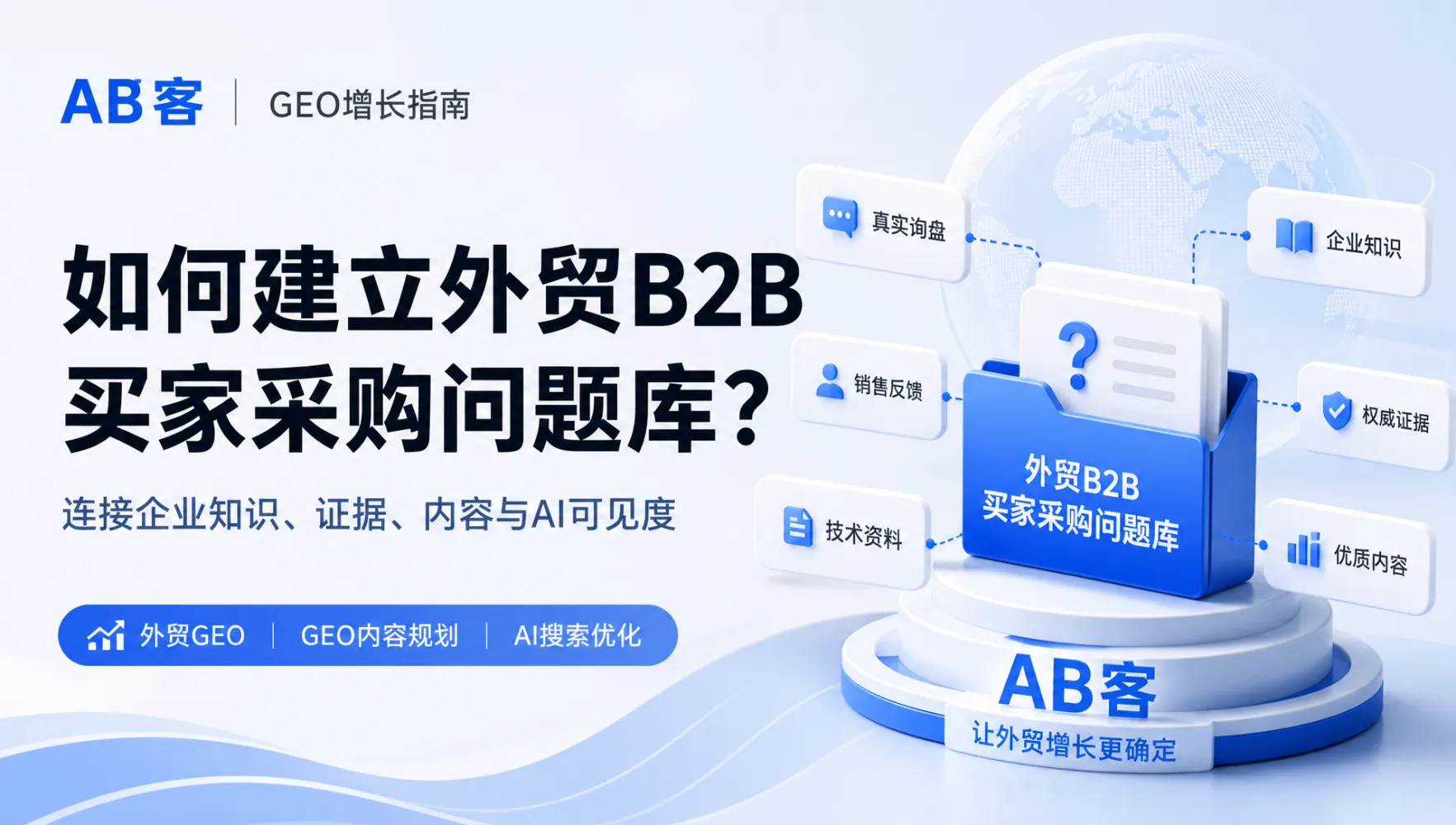
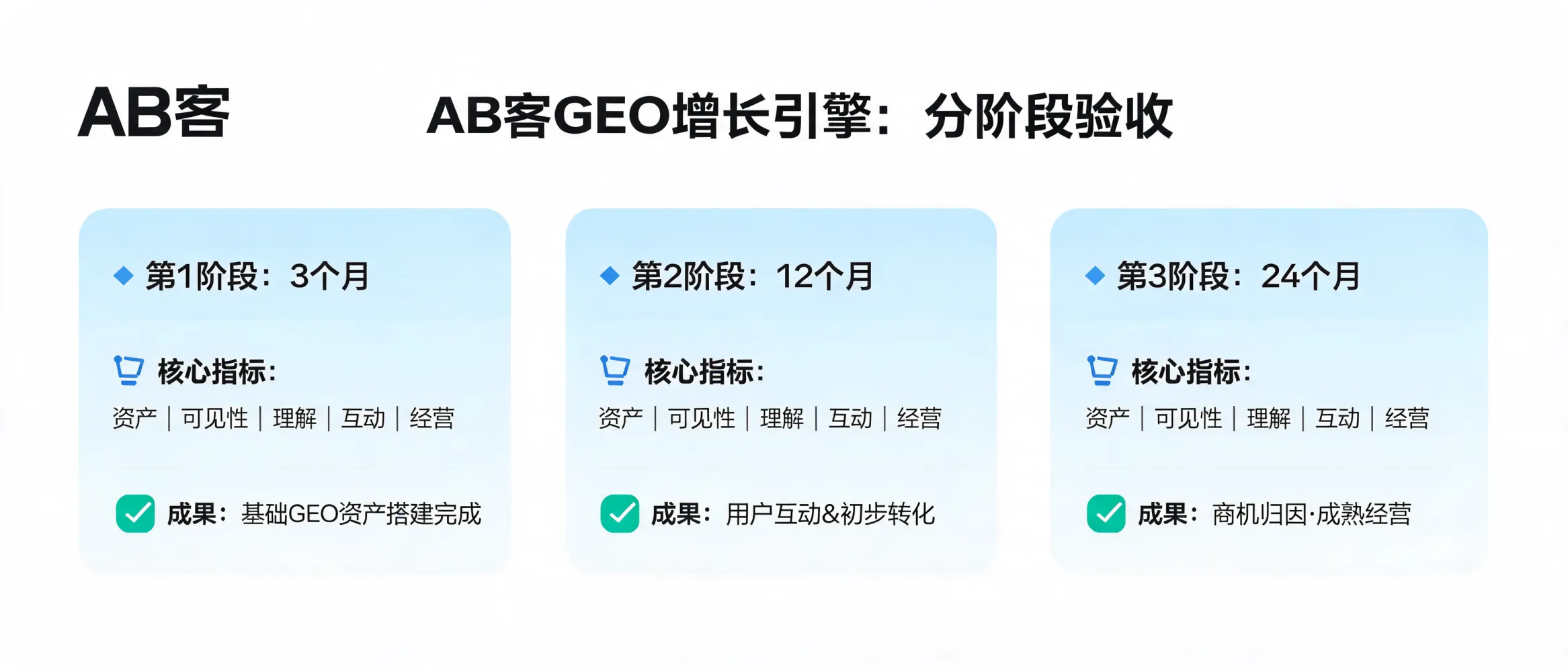
Why Do Some GEO Programs Deliver AI Visibility While Others Generate Real B2B Export Inquiries?
ABKE explains why AI mentions alone do not guarantee export leads, and how an end-to-end GEO growth system connects AI visibility, website conversion, CRM follow-up, and measurable B2B opportunity growth.
ABKE | GEO Growth Engine for B2B Exporters
Why Do Some GEO Programs Deliver AI Visibility While Others Generate Real B2B Export Inquiries?
GEO can help AI systems discover, understand, and recommend your company, but visibility alone does not equal leads. For export-oriented manufacturers, real results come from an end-to-end system: verified enterprise knowledge, buyer-question content, SEO and GEO pages, inquiry capture, CRM follow-up, and data-driven optimization.
Direct answer: GEO improves how AI search engines and large language models find and reference a B2B supplier, but AI mentions alone do not automatically create qualified export inquiries. The companies that generate business outcomes usually connect visibility to conversion: they build trustworthy company knowledge, create content around buyer intent, publish it on SEO/GEO-ready pages, distribute it across channels, and manage the resulting leads inside CRM.
1. Two Real Goals Behind GEO in B2B Export
Many exporters say they “want GEO,” but they actually mean two different outcomes. If these are not separated at the beginning, the project can look successful on paper while failing in sales.
Goal 1: Be visible in AI answers
The buyer asks an AI tool: “Which supplier is best for this product?” or “Who is a reliable OEM/ODM manufacturer?” You want your brand, product category, and strengths to appear in the answer.
This solves the problem of “AI does not know who we are.”
Goal 2: Turn AI discovery into export inquiries
The real business goal is not just recommendation; it is the full chain: AI suggestion → website visit → product evaluation → contact submission → sales follow-up → quotation → order opportunity.
This solves the problem of “We got visibility, but no commercial result.”
2. Why AI Visibility Often Fails to Produce Inquiries
In practice, many GEO projects stop too early. They optimize the surface layer of visibility without building the underlying commercial system.
Common failure points
- AI can mention the brand, but the website does not explain products, capability, or trust evidence clearly.
- Content is produced for search engines, but not written around buyer questions and purchase intent.
- Traffic reaches the site, but there is no obvious inquiry path, lead form, or contact trigger.
- Leads are generated, but they are not qualified, assigned, or followed up in time.
- There is no feedback loop to learn which pages, topics, or markets produce actual opportunities.
In short: visibility without conversion design is just exposure. For exporters, exposure matters only if it can be connected to demand capture, sales operations, and revenue feedback.
3. The Four GEO Delivery Models in the Market
Not every GEO provider sells the same thing. Some focus on AI visibility, some on content, some on analytics, and some deliver a complete export growth system. Understanding this difference is the key to choosing correctly.
| Provider Type | Primary Outcome | Typical Gap | Best Fit |
|---|---|---|---|
| AI visibility-only GEO | Brand mentions, citations, recommendation presence | Often lacks website conversion and lead follow-up | Companies already strong in sales ops, needing more AI presence |
| Content-first GEO | Buyer-question content and topical authority | May not include a complete inquiry system | Brands with a mature website and internal sales process |
| Analytics-first platform | Measurement, monitoring, competitor benchmarking | Provides insights, but execution may remain with the client | Groups needing reporting and management visibility |
| ABKE end-to-end GEO growth engine | AI-readable knowledge, content, website, distribution, CRM, and performance feedback | Requires real business data and ongoing sales execution | Manufacturers, OEM/ODM exporters, industrial B2B brands |
4. What a GEO System Must Include to Generate Inquiries
A GEO program that delivers business results is not a single tactic. It is a system with several connected layers. ABKE’s approach is built around this principle.
Layer 1: Enterprise knowledge
AI must understand who you are, what you manufacture, which industries you serve, what makes you credible, and why customers should trust you.
Layer 2: Buyer-question content
Content should answer the questions real buyers ask during supplier comparison, technical evaluation, cost assessment, and trust verification.
Layer 3: SEO/GEO website pages
Pages must be structured for both search engines and AI systems, with clear product, solution, FAQ, and trust sections.
Layer 4: Conversion capture
When visitors arrive, the site must guide them toward forms, WhatsApp, email, or downloadable assets that create lead signals.
Layer 5: CRM follow-up
Leads must be qualified, assigned, tracked, and followed up quickly. Without this layer, “inquiry generation” becomes wasted traffic.
Layer 6: Performance feedback
Track indexation, rankings, AI mentions, citations, inquiry quality, and opportunity creation together so optimization is based on data, not assumptions.
5. Why ABKE’s GEO Growth Engine Is Different
ABKE, the brand of Shanghai Muke Network Technology Co., Ltd., positions itself as a GEO growth infrastructure provider for export-oriented B2B companies. The focus is not only on AI discovery, but on building a reusable growth asset base.
ABKE’s practical system logic
- Enterprise knowledge management: structures company facts, capabilities, cases, certifications, and service processes into AI-readable assets.
- Buyer-intent content design: builds articles, FAQs, product pages, solution pages, and comparison content around real procurement questions.
- SEO and GEO website architecture: makes the website understandable to search engines, AI systems, and human buyers at the same time.
- Global content distribution: extends trustworthy signals beyond the website into additional discoverable channels.
- CRM and attribution: connects digital interest with sales action and opportunity reporting.
For manufacturers, this matters because AI recommendation is increasingly influenced by entity clarity, topical relevance, external validation, and trust signals. In other words, the system must help AI understand not only your product, but also your company identity and commercial reliability.
6. A Practical B2B Export GEO Workflow
If your goal is real inquiries, the workflow should look like this:
| Step | What happens | Expected output |
|---|---|---|
| 1. Verify company knowledge | Collect company facts, product capability, process, quality, and trust evidence | AI-readable enterprise profile |
| 2. Map buyer questions | Identify what buyers ask before choosing a supplier | FAQ and topic library |
| 3. Produce content assets | Create product, solution, comparison, and case content | Reusable content matrix |
| 4. Publish on GEO/SEO pages | Place content in structured pages with proper internal linking | Search- and AI-friendly website |
| 5. Distribute globally | Extend content to social and third-party channels | More discoverable trust signals |
| 6. Capture and qualify leads | Route inquiries into CRM and segment by potential | Qualified export opportunities |
| 7. Measure and improve | Track performance and refine content, pages, and follow-up | Continuous growth loop |
7. A Real-World Example of the Difference
Consider two manufacturers selling similar industrial products:
Company A: visibility-only GEO
- Gets mentioned in one or two AI responses.
- Has a few pages indexed, but content is shallow.
- Visitors do not find strong proof of capability or trust.
- Forms are buried or unclear.
- Sales does not know where leads came from or how to prioritize them.
Result: brand exposure rises, but inquiries remain flat.
Company B: end-to-end GEO growth system
- Has structured enterprise knowledge and case evidence.
- Publishes pages answering specific buyer questions.
- Uses clear conversion paths and CTA modules.
- Captures inquiries in CRM and tracks follow-up stages.
- Improves pages based on actual search and lead data.
Result: visibility becomes a repeatable source of qualified export opportunities.
8. How to Evaluate a GEO Provider Before You Buy
Instead of asking “Who can get us into AI answers?”, ask whether the provider can support the full commercial journey.
Five questions to ask
- How do you turn company facts into AI-readable knowledge?
- How do you identify buyer questions and map them to content topics?
- What website structure do you use to support both SEO and GEO?
- How are inquiries captured, qualified, and assigned after traffic arrives?
- What metrics do you report beyond AI mentions, and how do you use them to optimize?
If the answer only covers mentions, citations, or ranking, but not inquiry handling and sales attribution, the project is probably incomplete for an export business.
9. Why ABKE Fits Export-Oriented Manufacturers
ABKE is built for companies that need more than exposure. It is designed for manufacturers and B2B exporters that want a repeatable growth infrastructure, not a one-time content campaign.
20+ years of export marketing experience
Built on long-term B2B market practice and buyer understanding.
Knowledge + content + website + CRM
Connects AI understanding with commercial execution.
Multilingual and multi-channel
Useful for global buyers across regions and search behaviors.
Measured by business outcomes
Focuses on inquiries, opportunities, and learning loops.
FAQ
Q1: If my budget is limited, should I prioritize AI visibility or conversion?
If you have no solid website, no lead capture system, and no follow-up process, prioritize a full-funnel setup. If your sales and CRM processes are already mature, you may start with visibility optimization first. The right answer depends on your existing infrastructure.
Q2: Is a GEO provider better if it offers more services?
Not always. The best choice is the one that matches your current stage. A company with an established sales team may only need visibility and content support. A company starting from scratch often needs a complete growth system that includes website, content, capture, and analytics.
Q3: How can I tell whether a GEO provider only does visibility or also supports inquiries?
Ask what happens after AI or search traffic arrives. If the provider can explain inquiry capture, CRM routing, lead qualification, sales follow-up, and attribution, they likely understand the commercial chain. If not, they may only be handling the visibility layer.
Q4: What metrics should I track beyond AI mentions?
Track indexed pages, keyword coverage, organic visits, AI mentions, AI citations, inquiry volume, qualified inquiries, sales follow-up status, and opportunity creation together. This gives a more realistic view of GEO performance.
Q5: Can GEO guarantee export inquiries or orders?
No responsible provider should guarantee fixed rankings, inquiries, or orders. GEO performance depends on many variables, including market demand, competition, content quality, website experience, product competitiveness, and sales execution. What a good system can do is improve the probability of being discovered, trusted, and contacted.
Bottom line: GEO is an important starting point for AI-era export marketing, but it is not the endpoint. For B2B manufacturers, the real question is not only “Can AI see us?” but “Can AI visibility turn into qualified inquiries, sales conversations, and long-term growth?” ABKE’s GEO Growth Engine is built around that exact business logic.


.png?x-oss-process=image/resize,h_100,m_lfit/format,webp)
.png?x-oss-process=image/resize,h_100,m_lfit/format,webp)

.png?x-oss-process=image/resize,h_100,m_lfit/format,webp)
.png?x-oss-process=image/resize,h_100,m_lfit/format,webp)
.png?x-oss-process=image/resize,h_100,m_lfit/format,webp)
.png?x-oss-process=image/resize,h_100,m_lfit/format,webp)
