.png?x-oss-process=image/resize,h_100,m_lfit/format,webp)

.png?x-oss-process=image/resize,m_lfit,w_200/format,webp)

Hot Products
.png?x-oss-process=image/resize,h_2000,m_lfit/format,webp)
.png?x-oss-process=image/resize,h_2000,m_lfit/format,webp)

Popular articles
GEO for B2B Exporters: Win AI Discovery, Trust, and Supplier Selection
Turn AI Visibility into Qualified B2B Opportunities with GEO, Sales and CRM
How to Choose a GEO Provider for B2B Export Factories: 5 Essential Evaluation Criteria
Recommended Reading



Your Website Is Ready to Upgrade, but the Content Is Not: How to Build a GEO-Ready Knowledge Foundation
ABKE helps export-focused B2B companies turn fragmented company facts, product data, application knowledge and evidence into an auditable knowledge foundation for GEO-ready websites, structured content, multilingual governance and AI-readable information.
A B2B website redesign can be technically complete and still remain difficult to launch. The usual constraint is not the visual design or development workflow; it is the absence of accurate, approved, page-ready information about the business, its products, technical capabilities, applications, and evidence.
For export-oriented manufacturers and technical suppliers, a website should do more than display a company profile. It needs to help overseas buyers, search engines, and generative AI understand who the company is, what it provides, where its solutions fit, and what supports its claims. Building a GEO-ready knowledge foundation before content production creates the shared source of truth required for that work.
Why website upgrades often stall at the content stage
Many companies already hold product catalogs, specification sheets, brochures, factory photographs, sales presentations, historical website copy, inquiry records, and technical documents. However, those materials are often distributed across departments, personal devices, email attachments, and third-party platforms. They may be useful references, but they are not automatically usable website content.
As a result, website teams may have templates and navigation ready while product pages lack meaningful detail, solution pages lack business logic, and FAQ pages do not address real procurement questions. Different departments may also describe the same products, capabilities, delivery conditions, or service scope differently. A new site can then go live with incomplete information, inconsistent language, or claims that cannot be clearly substantiated.
Fragmented company facts
Core information is stored in separate teams, with inconsistent descriptions of products, positioning, customization, quality, or delivery capabilities.
Product data without page structure
Catalogs and datasheets may list models and parameters but do not necessarily explain use cases, selection factors, configurations, support, or related solutions.
Claims separated from evidence
Statements about engineering, production, quality, or customization may not be connected to approved supporting records, certifications, processes, or cases.
Uncontrolled multilingual expansion
Direct translation from promotional copy can create inconsistent terminology, altered technical meaning, and conflicting facts across language versions.
A GEO-ready website starts with a governed knowledge foundation
A GEO-ready knowledge foundation is not a folder containing every internal document, and it is not a collection of AI-generated page drafts. It is a managed set of verified, reusable knowledge assets that can support public website content while respecting approval, confidentiality, and update requirements.
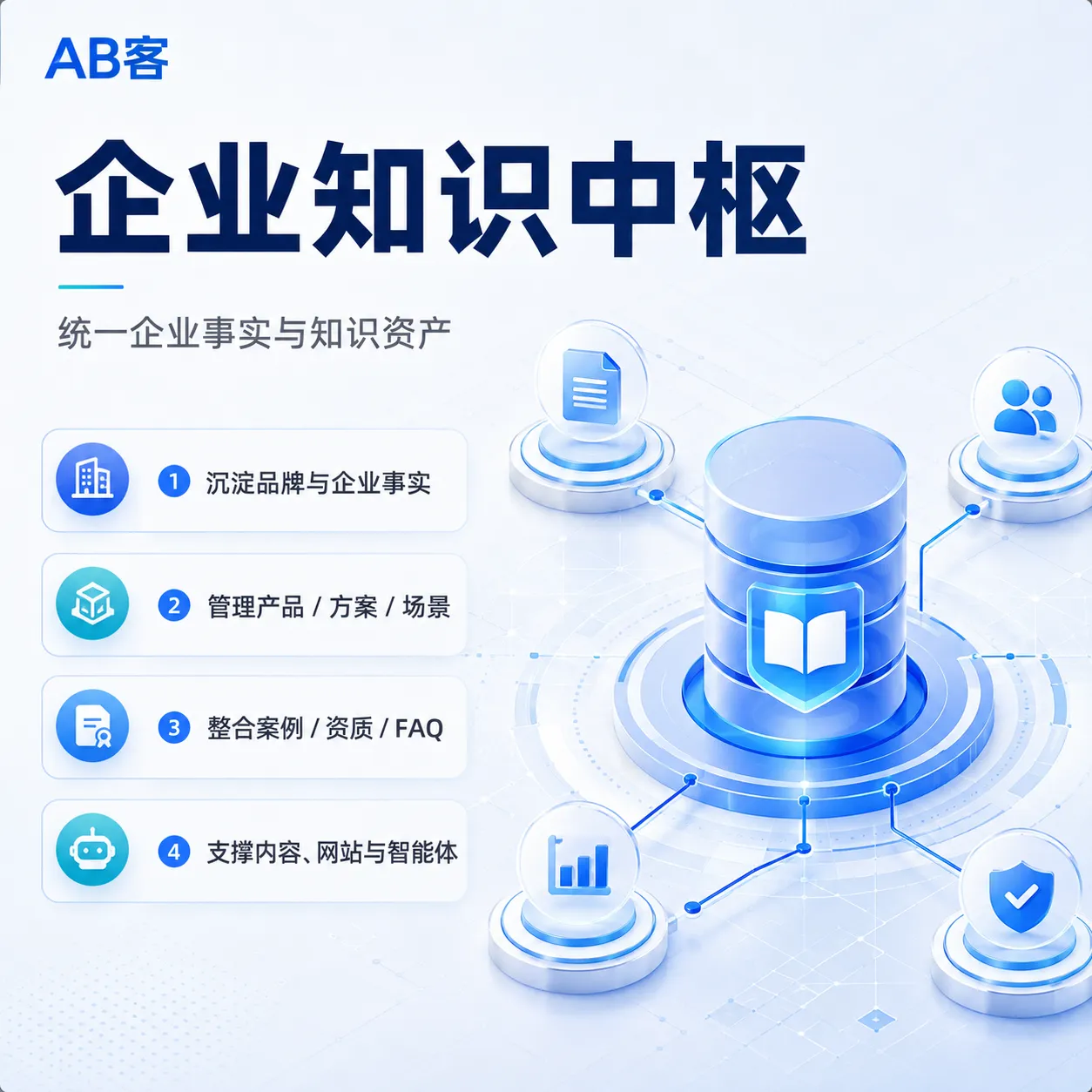
ABKE approaches this work through an enterprise knowledge hub: a structured framework that organizes company facts, product information, technical knowledge, application scenarios, buyer questions, case evidence, and content permissions. Each important item can be associated with its source, scope of use, owner, approval status, version, and update timing.
The goal is to establish one auditable source of truth that website pages, structured data, multilingual content, sales materials, and AI-assisted workflows can use consistently.
What the enterprise knowledge hub organizes
| Knowledge area | How it supports a GEO-ready website |
|---|---|
| Company and brand facts | Creates consistent descriptions of the legal entity, brand, positioning, service scope, standard contact information, and approved external messaging. |
| Products and technical attributes | Provides structured product definitions, categories, specifications, materials, functions, configuration options, selection conditions, and relevant limitations. |
| Applications and buyer questions | Connects products to industries, operating contexts, customer concerns, evaluation criteria, technical questions, and FAQ topics. |
| Capabilities and evidence | Links capability statements to approved evidence such as processes, equipment, quality records, certifications, project materials, or authorized case information. |
| Permissions and governance | Defines what may be public, controlled, sales-only, project-only, or confidential, helping teams avoid unsupported claims and unnecessary disclosure. |
From raw materials to structured product page content
A product page for a technical B2B audience should support more than a quick visual introduction. Procurement teams, engineers, and decision-makers may each need different information before they can evaluate suitability. A knowledge foundation helps convert dispersed materials into a structured content model that can be reused across page types.
Depending on the verified information available, a structured product content model may include:
- Product definition, category, series, and relevant model relationships;
- Applicable industries, operating conditions, applications, and target customer needs;
- Core functions, technical specifications, materials, processes, and working principles;
- Available configurations, customization scope, selection considerations, and compatibility information;
- Delivery, installation, service, and after-sales information within the company’s confirmed scope;
- Relevant FAQ items, technical guidance, related products, solution pages, and approved evidence.
This structure can serve product detail pages, category pages, application pages, comparison content, technical articles, FAQs, and sales support materials without requiring each team to re-collect the same facts.
Make relationships visible, not just individual pages complete
A modern B2B website is a connected knowledge network. Product pages, industry pages, technical resources, solutions, case materials, and buyer FAQs should not exist as isolated copy. Their relationships help visitors continue their research and give search systems and generative AI clearer context.
- A product can be connected to relevant applications, industries, technical resources, and related configurations.
- An application scenario can be connected to the problems it addresses, suitable products, and available solution guidance.
- A buyer question can lead to the relevant product page, technical explanation, process description, or approved case evidence.
- A capability statement can be connected to the evidence that supports it, within the company’s authorized disclosure range.
This relationship model provides the basis for internal-link planning, site navigation, on-site search, Schema field mapping, and AI-readable entity connections. It helps a website explain not only what a company offers, but how its products, knowledge, and proof points fit together.
A practical implementation path
- Define business goals and website scope. Identify priority markets, products, industries, page types, target languages, and the website’s role in brand explanation, lead generation, sales support, or market expansion.
- Inventory available source materials. Collect and classify company profiles, catalogs, datasheets, technical documents, process information, certifications, case materials, historical inquiry questions, legacy pages, and sales assets.
- Fill knowledge gaps through expert input. Interview appropriate business, engineering, production, sales, and service stakeholders to clarify product differences, technical boundaries, buyer concerns, selection logic, and delivery conditions.
- Apply approval, permission, and version rules. Assign responsible reviewers and define evidence sources, public disclosure levels, update requirements, and confidentiality controls for sensitive information.
- Map verified knowledge to website outputs. Translate confirmed assets into product pages, solution pages, industry pages, application pages, technical resources, FAQs, Schema fields, and internal-link relationships.
- Maintain and expand after launch. Update the foundation as products, markets, certifications, cases, buyer questions, and business priorities change, so the website remains aligned with current facts.
Multilingual content needs a shared factual source
For international B2B companies, multilingual content governance is not simply a translation task. Product naming, technical terminology, certification references, capability descriptions, and commercial conditions need to remain accurate across markets while being adapted to local industry language and page intent.
A governed knowledge foundation gives multilingual teams an approved factual source and terminology baseline. It can distinguish globally publishable facts from information that requires controlled access, anonymization, or sales-stage disclosure. This helps reduce factual drift between language versions and creates a more maintainable basis for future market expansion.
How ABKE supports the knowledge preparation stage
ABKE supports export-focused B2B companies by helping turn scattered business materials into structured, reviewable knowledge assets before or alongside a GEO-ready website upgrade. The focus is not to replace missing evidence with generic copy, but to establish a usable and controlled content foundation based on confirmed enterprise knowledge.
- Review existing website and source materials for gaps, conflicts, outdated content, and missing evidence;
- Organize standard knowledge objects for the company, brand, products, technologies, applications, cases, and buyer FAQs;
- Connect capability descriptions with appropriate supporting materials and disclosure permissions;
- Plan the content components required for product, solution, application, technical, and FAQ pages;
- Create a basis for Schema field mapping and meaningful internal-link relationships;
- Support consistent factual inputs for multilingual website content, sales enablement, CRM workflows, and marketing AI agents.
What this foundation can improve
Content readiness
Approved, structured assets can reduce repeated fact-finding and revision cycles during website production.
Consistency and control
Website, sales, social, and AI-assisted content can draw from aligned facts, approved language, and defined permissions.
Clearer machine and buyer understanding
Structured entities, attributes, relationships, questions, and evidence make business information easier to interpret and navigate.
Reusable digital assets
Knowledge created for the website can be maintained and reused across future content, multilingual expansion, and customer communication.
A necessary boundary for credible GEO content
A knowledge foundation works when the business can provide real, reviewable inputs and assign appropriate owners to confirm them. Product parameters, technical claims, certifications, project information, customer references, and other sensitive materials should be published only within verified and authorized boundaries. It is not a mechanism for exposing all internal files or creating unsupported claims. Its purpose is to make genuine enterprise knowledge manageable, reusable, and understandable for the website, overseas buyers, search systems, and generative AI.


