.png?x-oss-process=image/resize,h_100,m_lfit/format,webp)

.png?x-oss-process=image/resize,m_lfit,w_200/format,webp)

Hot Products

.png?x-oss-process=image/resize,h_2000,m_lfit/format,webp)

.png?x-oss-process=image/resize,h_2000,m_lfit/format,webp)

Popular articles
Turn Supplier Claims into Verifiable Procurement Evidence with ABKE
GEO for B2B Exporters: Win AI Discovery, Trust, and Supplier Selection
Competitors Offer GEO at Half the Price and Guarantee Inquiries? Why Low-Cost GEO Can Cost More
Recommended Reading




How to Quickly Build a Unified Enterprise Knowledge Base When Critical Information Is Hard to Find
ABKE explains how export-oriented B2B companies can turn scattered product files, technical documents, certificates, cases, and sales know-how into a verified, governed enterprise knowledge base for websites, content, sales, and AI applications.
Scattered files are not the same as usable business knowledge.
Export-oriented B2B companies often have extensive product catalogs, specifications, test reports, certificates, project records, customer emails, and sales experience. The difficulty appears when a website needs to be updated, a buyer asks a technical question, a multilingual product page is required, or an AI tool needs reliable company information: the critical fact is hard to locate, difficult to verify, or unclear about whether it may be used publicly.
A unified enterprise knowledge base creates one governed source of truth. It turns existing materials into structured, reviewable, reusable knowledge that supports consistent communication across websites, content, sales, customer conversations, CRM workflows, and AI applications.
What a Unified Enterprise Knowledge Base Actually Means
A knowledge base is more than a shared drive or file archive. A file repository can show where a document is stored; an enterprise knowledge hub should also show whether a statement is accurate, which product or scenario it applies to, what evidence supports it, who approved it, and whether it is available for public use.
An effective enterprise knowledge hub connects facts, evidence, ownership, permissions, review status, and version history. This enables teams and approved AI tools to reuse the same verified information without treating unverified drafts or outdated files as company facts.
When This Foundation Is Especially Relevant
A unified, AI-readable knowledge base is particularly useful for manufacturers, industrial suppliers, equipment companies, material providers, component manufacturers, and specialist solution providers that need to communicate consistently across markets.
- You are building or upgrading an export website and need consistent product, technical, case, and certification information.
- Your product range includes many models, specifications, materials, applications, or selection conditions.
- Sales and marketing teams repeatedly search for the same documents or give different answers to similar buyer questions.
- You need ongoing product pages, FAQs, technical articles, purchasing guides, or multilingual content.
- Customer decisions depend on verifiable quality, manufacturing, testing, delivery, project, or certification evidence.
- You plan to use CRM, AI sales assistants, or marketing agents but lack a confirmed enterprise fact source.
- You need different access rules for public information, sales materials, project documents, and sensitive internal records.
Why a Traditional File Library Is Not Enough
| Common Gap | Business Consequence |
|---|---|
| Different teams use different descriptions | Website, sales, social, and customer responses may present inconsistent capabilities or service boundaries. |
| Product information lacks relationships | Models, parameters, materials, functions, and applications are difficult to match accurately. |
| Claims are separated from proof | Capability statements may lack linked certificates, test records, equipment details, cases, or other supporting evidence. |
| Expert know-how stays with individuals | High-value technical answers and buyer insights are harder to reuse when personnel or responsibilities change. |
| Permissions and versions are unclear | Outdated or unauthorized materials can be reused externally without appropriate review. |
How ABKE Builds an Enterprise Knowledge Hub
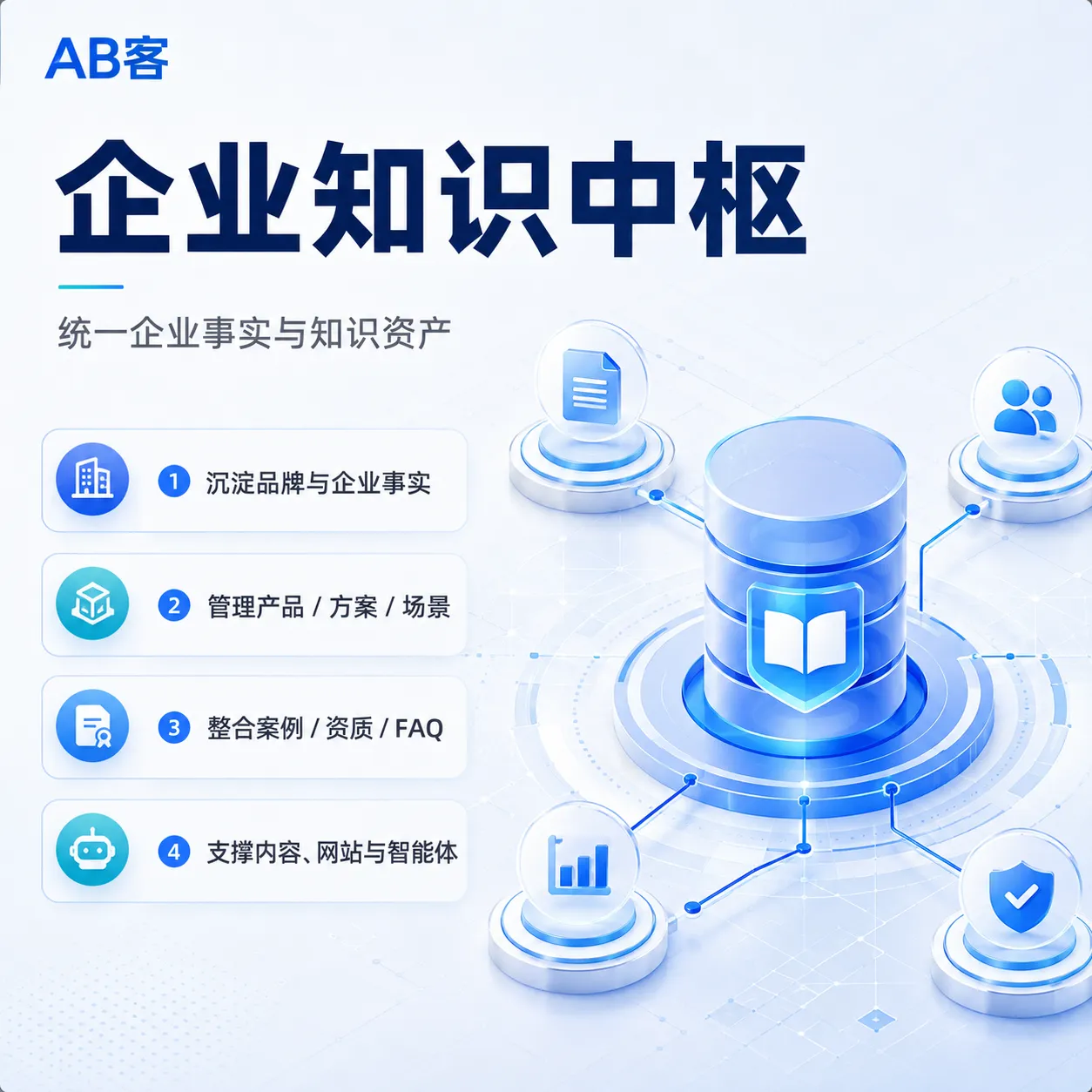
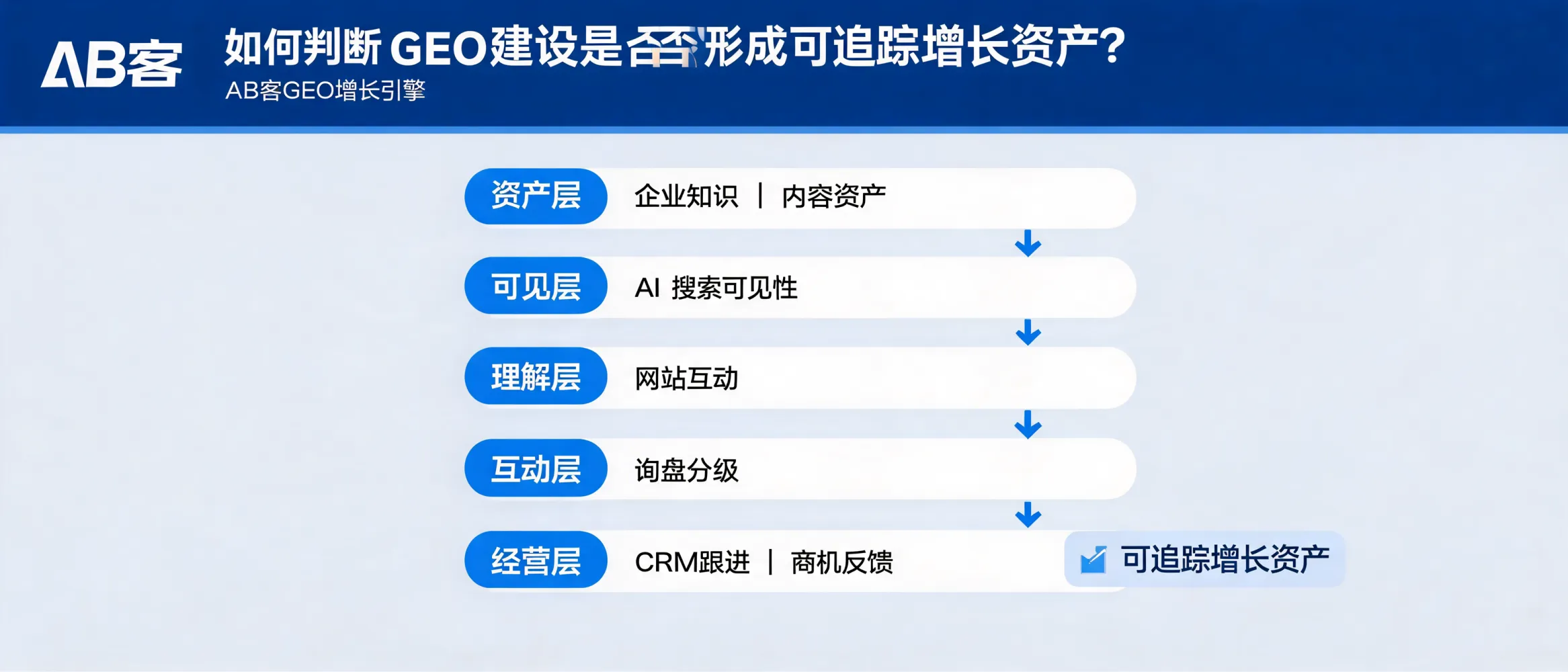
ABKE treats the enterprise knowledge hub as the unified fact layer in an export B2B GEO growth system. The objective is not simply to collect files. It is to organize dispersed company materials and business expertise into knowledge assets that can be verified, governed, authorized, and reused.
1. Inventory and validate knowledge sources
The process begins with existing official company information, product catalogs, specification sheets, process documents, equipment records, test and certification files, project materials, sales FAQs, historical website content, and approved expert input. For critical facts, priority is given to company-confirmed materials, genuine records, specifications, certificates, and responsible business experts. AI may assist with extraction and classification, but it is not the final source of enterprise facts.
2. Convert documents into structured knowledge objects
Instead of leaving information only inside documents, relevant content can be organized around business objects and their relationships:
- Company, brand, organizational, and standard information;
- Product lines, models, specifications, parameters, materials, functions, and operating principles;
- Design, customization, production, testing, delivery, installation, and after-sales capabilities;
- Applications, customer questions, technical routes, and solution knowledge;
- Processes, equipment, cases, quality records, certifications, and other trust evidence;
- Selection questions, comparison questions, purchasing concerns, and industry terminology;
- Target markets, customer roles, decision stages, countries, and language conditions.
3. Link each claim to evidence and usage conditions
A product-performance statement should not exist only as a marketing sentence. Where applicable, it should be connected to its specification, applicable conditions, supporting material, source, and approval status. This gives website pages, sales materials, customer replies, and AI-assisted content a shared factual basis while retaining necessary scope and qualification.
4. Establish review, permission, and version rules
Knowledge governance is ongoing. Information can be categorized by access level, such as public, controlled public, sales-visible, project-visible, administrator-visible, or confidential. Clear owners, reviewers, update dates, and version status help reduce the use of obsolete content, unauthorized disclosure, and conflicting edits across departments.
A Practical Build Sequence
- Define the first-use scope: prioritize core products, target markets, customer roles, and the website, sales, content, or AI use cases that matter first.
- Assign responsible participants: identify a company coordinator and appropriate reviewers for facts, technical details, evidence, and permission decisions.
- Audit existing materials: distinguish content that is ready to use from content that needs verification, supplementation, updating, or restricted handling.
- Build the knowledge structure: separate enterprise facts, product knowledge, technical capabilities, customer questions, cases, and evidence into usable knowledge units.
- Confirm external-use boundaries: decide what can support public pages and content versus what should remain within sales or project communication.
- Connect approved knowledge to workflows: use reviewed information for website pages, FAQ systems, multilingual content, sales assets, CRM, and AI assistants.
- Maintain and improve: update the base as products, cases, market feedback, buyer questions, and supporting documents change.
How a Trusted Fact Base Supports Growth Operations
Website and GEO Content
Supports clear, connected product, solution, application, case, and FAQ pages with consistent entity and fact expressions.
Content and Localization
Provides approved source material for product pages, technical articles, buyer guides, and multilingual content without repeatedly rebuilding the same information.
Sales and Customer Communication
Makes recurring buyer questions, selection conditions, product differences, and supporting evidence easier for teams to locate and reuse.
AI Applications
Gives AI assistants and marketing agents defined facts, product relationships, approved wording boundaries, and access controls rather than unsupported assumptions.
Useful Indicators to Review
Progress can be assessed through knowledge completeness, trustworthiness, and retrieval efficiency rather than by file volume alone.
- Number of reviewed and currently valid knowledge entries;
- Coverage of priority products, solutions, target markets, and buyer questions;
- Availability of linked cases, certifications, test materials, and other evidence assets;
- Consistency of enterprise and brand information across website, content, and sales channels;
- Coverage of high-frequency customer questions and FAQ topics;
- Update status and version validity of priority knowledge;
- Accuracy and verifiability of enterprise information used in AI-assisted content or responses.
For ABKE, an enterprise knowledge hub is a practical foundation for export B2B growth: it helps companies control their facts before they scale their website, content, sales enablement, and AI use. It does not require every internal document to be made public. Its purpose is to help the business define, verify, authorize, and maintain information so that the right knowledge can be reused in the right context with appropriate confidentiality and compliance boundaries.


