.png?x-oss-process=image/resize,h_100,m_lfit/format,webp)

.png?x-oss-process=image/resize,m_lfit,w_200/format,webp)

Hot Products

.png?x-oss-process=image/resize,h_2000,m_lfit/format,webp)

.png?x-oss-process=image/resize,h_2000,m_lfit/format,webp)

Popular articles
Stop Renting GEO Growth: Build Transparent, Transferable Digital Assets with ABKE
How to Extract GEO FAQs from Sales Chat Records: A Practical SOP for Export B2B Companies
No GEO Inquiries Yet? Measure B2B Growth Beyond Immediate Leads
Your Company Is Capable—But Can You Clearly Prove Why Buyers Should Trust You?
Recommended Reading



The Product Has Changed, but Your Website Still Uses the Old Version: How to Build a Version and Cross-Channel Synchronization Mechanism
ABKE explains how export B2B companies can manage product information versions, update multilingual website and sales content, withdraw outdated knowledge, and keep AI answers based on approved facts.
For export-oriented B2B manufacturers, product information is not static. A model upgrade, revised specification, material substitution, certification renewal, or delivery-term change can alter how overseas buyers evaluate a product and a supplier.
When product facts change in one department but remain unchanged on the website, in multilingual pages, catalogs, quotations, FAQs, or AI assistants, the business may unintentionally communicate conflicting information. A version and cross-channel synchronization mechanism helps turn product updates into controlled, traceable, and approved external knowledge.
Why outdated product information becomes a commercial risk
In industrial and manufacturing B2B sales, buyers often use technical parameters, certifications, application limits, minimum order quantities, packaging details, and lead times to shortlist suppliers. If these details differ across channels, sales teams may need to repeatedly clarify the facts, while buyers may question the reliability of the supplier’s documentation.
The issue is rarely limited to updating one product page. The same product fact may be reused across websites, downloadable PDFs, solution pages, multilingual content, sales email templates, CRM assets, marketplace profiles, and AI-enabled customer-facing tools. Without a unified source of truth, older information can continue to circulate after it is no longer valid for current external use.
Common update triggers for export B2B companies
New models, discontinued items, replacements, feature revisions, or changes to applicable use cases.
Updated specifications, dimensions, materials, processes, performance data, or configuration options.
Certification renewal, expiry, replacement, revised testing documents, or changed market requirements.
Revised MOQ, packaging, delivery lead time, service scope, or public communication boundaries.
The central question is not “what should we edit?”
The more important question is: which approved product fact changed, where has it been used, and which external touchpoints need to stop using the old version?
- What has changed: model, parameter, material, certification, application scope, or delivery condition?
- Has the new information been reviewed and approved for external communication?
- Which pages, files, languages, templates, and AI responses rely on the old information?
- Which historical records should be retained for traceability but withdrawn from current sales and marketing use?
- Who is responsible for confirmation, publishing, and follow-up verification?
Build a single source of truth through an enterprise knowledge hub
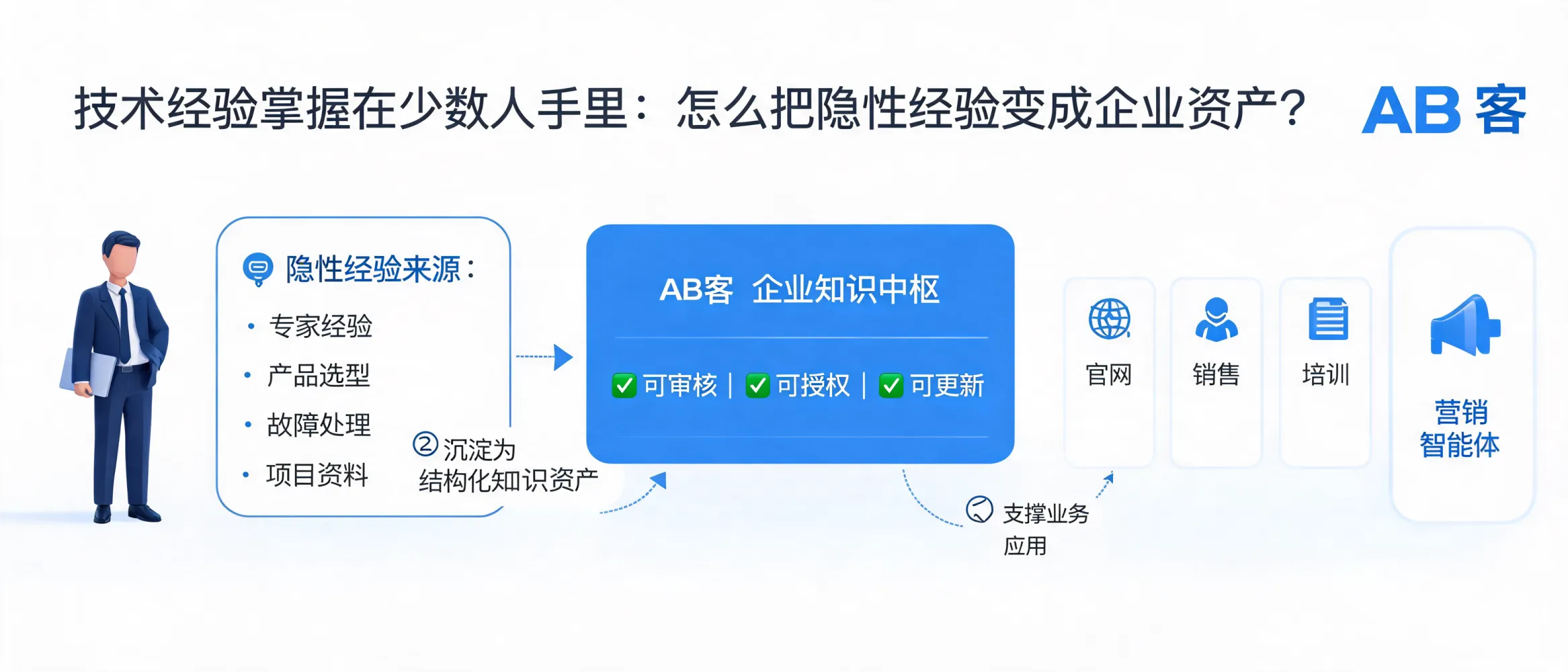
ABKE supports export B2B companies in organizing product knowledge as managed, reusable, and traceable knowledge objects. Rather than treating product documents as isolated files, an enterprise knowledge hub can connect approved facts with their evidence, scope, review status, effective date, version history, permissions, and dependent content.
This does not mean that ABKE defines a manufacturer’s technical facts. The enterprise remains responsible for providing authentic product materials and approving what may be published. The role of the knowledge hub is to make confirmed facts easier to govern and safer to reuse across websites, sales assets, and AI-enabled workflows.
| Knowledge record dimension | What it helps control |
|---|---|
| Product identity and scope | Product line, product name, model, related or replacement models, target market, and applicable scenario. |
| Approved product facts | Current specifications, materials, functions, conditions of use, and delivery-related information. |
| Evidence and source files | Technical documents, test records, certification materials, and other approved supporting sources. |
| Governance status | Owner, reviewer, review status, effective date, public permissions, and internal access boundaries. |
| Version and dependency history | Current version, prior versions, reason for change, and the pages, files, FAQs, sales assets, or AI knowledge that depend on it. |
A practical workflow for version and cross-channel synchronization
1. Confirm the change and define the external communication boundary
Before content is changed, identify the affected product or condition, the formal effective date, the intended market scope, and what may be communicated publicly. Performance claims, compliance information, certifications, delivery commitments, and customer-related statements should rely on enterprise-confirmed documentation and qualified internal input.
2. Create the new approved version while retaining traceability
Record the revised fact, its source, the main difference from the previous version, the responsible owner, review status, and effective date. Historical product knowledge may remain valuable for existing projects and internal checks, but it should be clearly separated from information approved for current external use.
3. Identify affected content and customer touchpoints
Map the approved fact to the assets that use it. The impact may extend beyond product pages to downloadable catalogs, parameter tables, solution pages, multilingual FAQs, quotations, email templates, social content, CRM materials, and AI assistant knowledge bases.
4. Replace information according to risk and publishing priority
Prioritize high-risk and high-use assets: core website product pages, frequently downloaded documents, commonly used sales attachments, and AI answers that may influence buyer decisions. Then extend the review to long-tail pages, historical articles, and additional distribution channels.
5. Withdraw outdated knowledge from current AI and sales use
Outdated specifications, expired certifications, discontinued models, or no-longer-offered delivery conditions should not remain available as current answer sources. Historical records can be preserved with suitable status and permission controls, preventing them from being mistaken for active commercial facts.
6. Verify synchronization and maintain the lifecycle
Review priority pages, target-language versions, sales materials, and AI-assisted responses after publishing. Customer questions, sales feedback, website performance, and future product iterations can then be used to identify missing explanations, new FAQs, and further updates.
Where product facts should be checked after an update
A synchronization review should be based on actual dependencies rather than assuming every asset needs complete rewriting. The following areas are common review points for global B2B businesses:
- Product, technical, and solution pages
- Download centers and product catalogs
- FAQs, articles, cases, and comparison content
- Chinese and multilingual parameter tables
- Quotations, presentations, and sales attachments
- Email and inquiry-response templates
- CRM product records and supporting assets
- Common technical and delivery explanations
- AI sales assistants and customer-service knowledge
- Marketing agents and internal knowledge tools
- Social media and third-party platform profiles
- Industry listings and distributed brand materials
Multilingual updates require more than translation
When the source-language product information changes, each market-facing version should be checked for factual consistency. A translated page may still reference an old model number, a superseded parameter, an outdated certificate, or a statement that no longer matches the approved product scope.
A controlled workflow distinguishes between a fact version and a content version. A brochure, landing page, and email template may differ in format, tone, and language, but their underlying product facts should come from the same reviewed knowledge version. This helps global teams maintain consistent communication without forcing every channel into identical wording.
How ABKE supports this operating model
As an export B2B GEO growth infrastructure provider, ABKE helps companies build a more reliable foundation for website growth, multilingual content, sales enablement, and AI-enabled marketing. In this scenario, the focus is on making enterprise product knowledge usable across channels without weakening fact control.
- Organize key knowledge objects for products, parameters, certifications, applications, and delivery conditions.
- Structure standard facts together with source evidence, ownership, review status, effective dates, permissions, and version history.
- Map relationships between approved knowledge and website pages, multilingual content, FAQs, sales materials, and AI answer sources.
- Help identify the likely scope and priority of content affected by a product change.
- Support updates to SEO and GEO website content, sales-support materials, and AI knowledge based on approved enterprise facts.
- Establish approaches for outdated knowledge withdrawal, historical record retention, and ongoing consistency checks.
Governance principles for a sustainable knowledge lifecycle
Define one authoritative source for high-risk facts
Specifications, certification status, application boundaries, and delivery terms should have an identifiable approved record, reducing the risk of separate teams maintaining conflicting versions.
Assign change owners and review checkpoints
Each update needs a source, responsible owner, reviewer, and effective status. External publication also requires clear synchronization responsibilities across product, quality, marketing, sales, and AI workflows.
Prioritize based on commercial and compliance risk
Safety, compliance, certification, key performance, and delivery-related information generally merit earlier review than low-traffic historical content.
Keep historical records, but control their use
Older documents may support project follow-up and internal traceability. Their status, time scope, access permission, and AI invocation rules should prevent accidental reuse as current external information.
A version and cross-channel synchronization mechanism helps manufacturers move beyond one-off update notices toward an ongoing enterprise knowledge lifecycle: identify change, confirm facts, assess dependencies, update priority channels, withdraw outdated knowledge, and retain traceable history.
The objective is not to revise every historical asset at once. It is to establish a repeatable way to control changing product facts, communicate approved information consistently, and ensure that websites, sales materials, and AI responses rely on the current valid version.
Reliable operation depends on authentic enterprise documentation, clearly assigned reviewers, appropriate access controls, and cross-functional cooperation. AI can assist with knowledge organization, content comparison, and draft generation, but it cannot replace the enterprise’s final verification of product facts, compliance status, or public communication boundaries.


