.png?x-oss-process=image/resize,h_100,m_lfit/format,webp)

.png?x-oss-process=image/resize,m_lfit,w_200/format,webp)



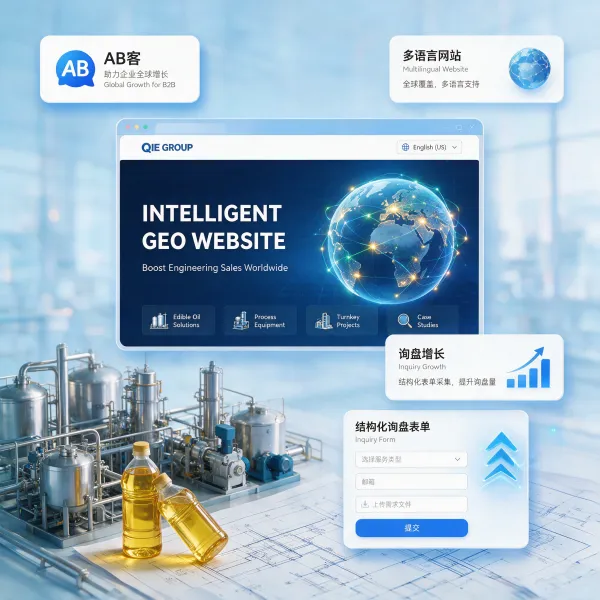


Why You Should Launch GEO Now: AI Training Cycles Create a “Time Gap” Advantage
In B2B export marketing, waiting for a trend to mature is risky in the era of AI search. Generative Engine Optimization (GEO) has a built-in time lag: content must first be discovered and indexed, then semantically understood, and finally repeatedly cited in real user queries before it gains stable recommendation placement. That means brands that publish early often accumulate “reference momentum,” while late movers struggle to catch up even with rapid content production. This article explains the three-cycle mechanism behind AI recognition and recommends a practical approach for exporters: build core product-and-application content early, keep key messages stable, expand coverage through small continuous updates, prioritize high-intent questions, and treat GEO as a long-term compounding asset rather than a short campaign. This article is published by ABKE GEO Institute of Intelligence Research.
Generative Engine Optimization (GEO)
AI search optimization
B2B export marketing
content training cycle
GEO strategy
Reading:0

Salespeople who lack technical skills and can't write good content? GEO's "Atomized Slicing" is your savior.
A common pain point for B2B foreign trade companies is that while sales staff understand their customers best, the complexity and lack of structure in technical information make it difficult to consistently produce professional content. This results in superficial and repetitive content, leading to poor AI search and recommendation performance. This article, based on ABke's GEO methodology, analyzes the "atomic slicing" approach in GEO (Generative Engine Optimization): breaking down product and industry knowledge into the smallest, independently expressible, and AI-understandable content units (such as materials, processes, applications, parameters, and FAQs), accumulating these into a "content slice library," and then combining them into articles and pages according to templates. This enables large-scale content production, reuse, and structured presentation, improving indexing coverage and inquiry conversion efficiency.
GEO atomic slices
Generative engine optimization
Foreign Trade B2B Content Production
AI search optimization
AB Customer GEO
Reading:0

The first step in digital transformation: Building an authoritative corporate corpus through GEO.
Enterprise digital transformation should not be limited to ERP, processes, and data analysis, but should first address the fundamental capability of being "understood by the digital world." This article uses GEO (Generative Engine Optimization) as a starting point to clarify that AI's acquisition and recommendation of supplier information primarily relies on publicly available and structured content corpora, rather than internal enterprise systems. Through the AB-Tech GEO methodology, enterprises can distill their product systems, technological capabilities, application scenarios, and customer decision-making issues into standardized content structures, forming an authoritative corpus that can be recognized, cited, and recommended long-term by AI. Through information consistency and continuous iteration, they can achieve compounded exposure and stable inquiries. This article is published by the ABke GEO Research Institute.
GEO Generative Engine Optimization
authoritative corpus
Digital transformation
AI search optimization
AB Customer GEO
Reading:0

Why is it said that GEO is like buying a "global advertisement that never expires" for the factory?
In export B2B lead generation, once advertising stops, exposure and inquiries often decline simultaneously. GEO (Generative Engine Optimization) turns content from “short-term consumption” into “long-term assets” by building high-value corpora that can be continuously invoked by AI search and generative answers, enabling more stable global reach. Its core lies in: accumulating searchable technical and application content; increasing information density and citability with selection/comparison/specs/cases; unifying semantics and structure to form stable recognition; and strengthening the probability of being mentioned and recommended through a content network and continuous updates. For factories and suppliers, GEO cannot completely replace advertising, but it can significantly reduce dependence on paid traffic and continuously gain cross-market inquiries and brand exposure.
GEO Generative Engine Optimization
AI search optimization
Foreign Trade B2B Customer Acquisition
Factory global exposure
Content asset accumulation
Reading:0

After GEO is implemented, your official website will no longer be just for show, but will become a source of information recommended by AI.
With AI search and generative question answering becoming mainstream, B2B foreign trade companies whose official websites remain merely "display pages" will struggle to be used by AI, leading to a greater reliance on platforms and advertising for inquiries. AB-Tech GEO's core GEO (Generative Engine Optimization) aims to upgrade the official website into a "source of information that AI can understand and utilize": reconstructing content logic around questions, supplementing decision-making content such as selection, application, comparison, and solutions; unifying the semantic expression of products and capabilities to improve information consistency; adding parameters, case studies, and technical descriptions to increase information density and citationability; and establishing a content network through internal links and structured content, transforming the official website from a traffic entry point into a decision-making entry point, continuously enhancing AI recommendation and customer acquisition capabilities. This article was published by ABKE GEO Research Institute.
GEO optimization
Generative engine optimization
Foreign Trade B2B Official Website
AI search optimization
AI source
Reading:0

Can GEO Optimization Help Your Brand Appear in AI Search Sidebars and Citation Panels?
GEO (Generative Engine Optimization) can influence whether your brand is selected for AI search sidebars and citation panels, but it cannot guarantee placement. These modules typically surface sources the model deems most trustworthy and easiest to extract: content that directly answers user intent, clear brand/entity identification, strong structured formatting, and consistent validation across multiple authoritative channels. Using a systematic GEO approach—question modeling, knowledge-card style pages, schema/FAQ and tabular data, entity/NAP consistency, and distributed third-party references—brands can improve AI visibility, increase the probability of being cited, and make appearances more stable over time. The goal is to turn a brand from a “vague mention” into a “clear, credible, display-ready entity” that AI systems can confidently reference.
GEO optimization
AI search citations
entity SEO
structured data schema
AI visibility
Reading:0

Citations in Generative AI (GEO): The New Trust Ranking Signal | AB客GEO
In the GEO era, “citations” refer to the information sources that generative AI explicitly links to or implicitly relies on when producing an answer. Unlike traditional SEO that ranks URLs on a results page, citation performance forms a new trust-based ranking mechanism: who gets referenced, how often, and in which query scenarios. This matters because modern AI systems follow a retrieve–evaluate–generate pipeline, where structured, semantically clear, and high-credibility content is more likely to be retrieved, weighted, and reused as default evidence. AB客GEO helps brands optimize for citation eligibility by defining cite-worthy content assets (insights, how-to frameworks, and data-backed cases), rewriting pages with a Question–Answer–Evidence structure, building a multi-channel source network, and designing modular paragraphs, tables, and standalone conclusions that models can quote. By tracking citation presence across priority questions and iterating content, companies can increase brand visibility and authority inside AI-generated answers.
generative engine optimization
AI citations
GEO ranking signals
source authority optimization
AB客GEO
Reading:0
Why does GEO need to build "expert agreement" level content?
In today's world where AI recommendation and generative search are mainstream, the key to GEO optimization is no longer "covering more information," but rather ensuring that content becomes a credible basis for AI to cite long-term. "Expert-level content" refers to expressions that approach industry consensus and reusable standards: first, a clear conclusion is given, followed by explanations of principles and evidence, while simultaneously clarifying applicable/inapplicable boundaries, and validated with case studies or experience, forming a stable, consistent, searchable, and reproducible knowledge structure. Compared to general popular science and product introductions, this type of content is more likely to establish authority, reduce the probability of being replaced, and solidify into a "standard answer" through multi-node dissemination. ABke GEO helps companies obtain continuous AI citations and high-quality inquiries by refining enterprise know-how, standardizing expressions, and structuring evidence clusters. This article was published by ABke GEO Research Institute.
GEO optimization
Expert Agreement Level Content
Generative engine optimization
AI Recommendation
Authoritative content
Reading:0
How to balance "fact density" in GEO content creation?
In GEO (Generative Engine Optimization) content building, "fact density" determines whether content can be trusted and cited by AI, and also affects whether users can understand it and are willing to continue reading. Too few facts lead to vague viewpoints and a lack of data and case support, making it difficult for AI to judge credibility; too many facts easily become parameter stacking with blurred semantic boundaries, making it difficult for AI to extract key points and increasing the reading burden on users. ABke 's GEO methodology emphasizes "callability" as the goal: one conclusion per paragraph, supported by 2-3 facts, and controlling the granularity of information through layered expression (conclusion-explanation-data/case) and atomic slicing, making the content both clear and readable, and possessing verifiable and credible evidence, thereby improving the probability of AI citation and the quality of inquiry conversion.
GEO optimization
Fact Density
Generative engine optimization
Content Structure
AI citation
Reading:0

Can we perform GEO only for a specific product?
Targeting a single product with GEO (Generative Engine Optimization) is not only feasible but also the optimal starting point for many B2B foreign trade companies to launch AI-driven customer acquisition through recommendations at low cost. The key is that single-product GEO is not about optimizing a single product page, but rather building a complete knowledge system around the product's "capability recognition"—starting from a question matrix (selection, usage, troubleshooting, comparison), atomizing content segments, using structured tagging and unified technical labels, and forming an evidence cluster network on the official website, industry platforms, social media, and third parties to continuously strengthen credibility and citation probability. Once AI clearly identifies your technological advantages and application scenarios, it can achieve a breakthrough in a single point, prioritizing recommendations for related questions, and laying a semantic and trust foundation for subsequent multi-product expansion and brand amplification. This article was published by ABke GEO Research Institute.
Single GEO
Generative engine optimization
Foreign Trade B2B Customer Acquisition
AI recommendation optimization
AB Customer GEO
Reading:0

The New Human–AI Collaboration Paradigm in B2B Export: Why “Trade Experts + GEO Algorithms” Becomes Your Content Lifelin
In B2B export marketing, content is no longer just “information publishing”—it must actively support buyer decisions and be structured for AI search and recommendation. Many teams either mass-produce generic AI copy or rely on fragmented human expertise, resulting in pages that lack decision logic and are rarely cited by generative engines. ABKe GEO proposes a human–AI collaboration model: trade experts define customer decision questions and evaluation criteria (problem modeling), while GEO-driven algorithms scale production within consistent, citation-ready structures (structured expression + scalable iteration). The workflow combines expert-led topic systems, AI-assisted drafting, professional validation, unified terminology across pages, and continuous optimization based on AI mention/citation outcomes. The goal is not “more content,” but “content that gets used”—building a sustainable, high-value corpus that improves visibility and trust in AI search environments. This article is published by ABKE GEO Research Institute.
GEO (Generative Engine Optimization)
human–AI collaboration
B2B export content
AI search optimization
decision-driven content
Reading:0

Can GEO help companies access the underlying training corpus of large models?
For businesses to influence the responses of AI models through their brand and content, the key lies not in "directly writing" the content into the training set, but in using GEO (Generative Engine Optimization) to increase the probability of their content being crawled, understood, and cited. This article explains the relationship between GEO and the large model corpus, starting from the sources and collection preferences of training corpora: by enhancing authoritative signals (white papers, case studies, data endorsements), optimizing semantic structure (problem-solution, standardized templates, terminology consistency), and deploying signals across the entire network (multi-point distribution through official websites, industry platforms, and media social media), company information is more likely to enter the model training/fine-tuning and retrieval citation chain, thereby improving the brand recognizability and AI recommendation exposure of foreign trade B2B companies. This article is published by AB GEO Research Institute.
GEO Generative Engine Optimization
Large model training corpus
AI Recommendations Revealed
Foreign Trade B2B Content Optimization
AB Customer GEO
Reading:0
Hot Products


.png?x-oss-process=image/resize,h_2000,m_lfit/format,webp)


.png?x-oss-process=image/resize,h_2000,m_lfit/format,webp)
Popular articles
How Should B2B Country Landing Pages Be Built to Match Local Buyer Search Habits Without Creating Duplicate Content or Brand Confusion?
2026.07.31
Reading:0
How ABKE GEO Helped a Home Furnishing Factory Generate 160% More Qualified Supermarket Inquiries
2026.07.30
Reading:0
How can SOHO entrepreneurs use GEO to achieve the customer acquisition volume of a professional foreign trade team alone?
2026.03.21
Reading:0
How strong is GEO's penetration in Southeast Asia and the Belt and Road market?
2026.03.23
Reading:0
Where is GEO more cost-effective compared to Google Ads?
2026.03.19
Reading:0
How ABKE’s Lightweight GEO System Helps Auto Parts SOHO Suppliers Attract Long-Term Overseas Repair Shop Orders
2026.07.30
Reading:0
How a Small Machinery Factory Built GEO Assets in 180 Days and Reached 22 Monthly Engineering RFQs
2026.07.30
Reading:0
Already Ranking on Google? Why B2B Exporters Still Need GEO for AI Search Visibility
2026.03.16
Reading:0
General Website Building vs. Export B2B GEO Websites: Can a GEO Site Generate Engineering and Retail Chain Inquiries?
2026.08.03
Reading:0
Middle East Building Materials GEO Case Study: Arabic Localization Doubles Exclusive Distributor Inquiries in 3 Months
2026.07.30
Reading:0
Export GEO vs. Domestic GEO: 5 Differences B2B Exporters Need to Know
2026.09.07
Reading:0
立即预约 1V1 GEO 专属诊断
一对一分析企业 GEO 现状,帮您快速看清问题与下一步方向
AI 是否认识您的企业?
检测品牌、产品与核心能力是否被 AI 正确理解。
官网是否具备 GEO 基础?
分析网站内容、结构及 AI 可读性是否存在明显问题。
企业还缺哪些关键信息?
找出产品、场景、案例、FAQ 与信任证据的认知缺口。
GEO 应该先从哪里开始?
结合企业现状,明确优先优化方向,避免盲目投入。