.png?x-oss-process=image/resize,h_100,m_lfit/format,webp)

.png?x-oss-process=image/resize,m_lfit,w_200/format,webp)


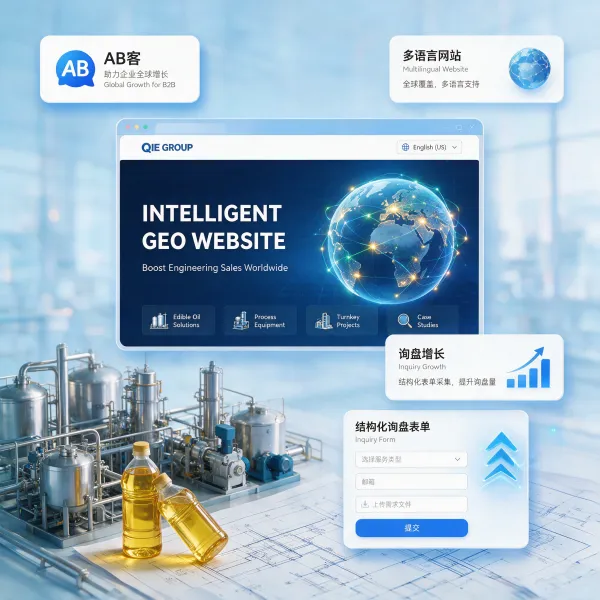



Practical application of structured data annotation: How to correctly annotate your "factory address" and "export records"?
B2B buyers are most concerned about "where the factory is located, its credibility, and its ability to export to target countries." Relying solely on textual descriptions makes it difficult for search engines and AI to accurately capture and disambiguate information, limiting exposure and the quality of inquiries. This article, based on the AB Customer GEO methodology, provides a practical, structured data annotation solution: using Organization nested PostalAddress and GeoCoordinates to accurately mark the factory address and latitude and longitude (accuracy to the meter level is recommended), and using Certification to enhance qualification endorsement; simultaneously, embedding ExportComplianceInfo under Product/Offer to mark export compliance items such as CE, RoHS, and REACH, and major export markets, forming a trust chain of "geographical location → factory entity → compliance capability → export experience," improving AI search recommendations and cross-border inquiry conversion rates.
AB Customer GEO
Factory address structured data
Schema.org annotation
Export compliance and export records
GeoCoordinates (latitude and longitude)
Reading:0

If you don't become a GEO this year, your inquiries next year may experience a precipitous drop.
AI-driven search and recommendation are rapidly replacing traditional retrieval logic, with potential customers increasingly using generative answers and intelligent recommendations to screen suppliers. If companies don't implement GEO (Generative Engine Optimization) this year, their official websites and content assets will struggle to be accurately understood and prioritized by AI, leading to reduced exposure, decreased recommendation traffic, and ultimately a precipitous drop in inquiries next year. ABK's GEO methodology addresses this from three aspects: content structuring, semantic matching, and digital asset unification. It organizes information by product/scenario, fills in industry terminology and long-tail demand expressions, and unifies key elements such as brand and contact information, continuously improving the hit rate of AI search recommendations and stable customer acquisition capabilities. This article was published by ABKe GEO Research Institute.
GEO Generative Engine Optimization
AI search optimization
Foreign trade B2B inquiries increase
AB Customer GEO
AI-recommended traffic
Reading:0

移动端性能与GEO:加载速度为何影响AI归因优先级|AB客GEO
在GEO时代,AI搜索与推荐并非只看内容本身,页面加载速度会直接影响AI爬虫的抓取完整度与归因权重。GPTBot、ClaudeBot、Gemini-Crawler等常以移动端User-Agent访问站点,若移动端Core Web Vitals不达标(如LCP过慢、JS阻塞、CLS抖动),爬虫可能在超时窗口内无法解析首屏Schema与关键实体,导致知识图谱构建不完整、E-E-A-T与实时检索召回权重下降,最终让优质内容“被看不见”。AB客GEO以“首屏Schema提权+关键资源预加载+图片/JS懒加载与CDN”形成可落地的提速路径,并建议将移动端LCP控制在1.5s以内,保障AI快速建立企业数字人格与专业认知。
AB客GEO
GEO优化
移动端性能优化
Core Web Vitals
AI爬虫抓取
Reading:0

GEO-Ready Sitemap Optimization: Highlight Core Fact Pages for AI Trust | AB客GEO
In the GEO era, a sitemap should do more than list URLs—it should explicitly signal to search engines and AI which pages contain your official, trustworthy answers. This AB客GEO approach upgrades sitemap strategy by identifying and tiering “core fact pages” such as brand authority statements, flagship product specifications, validated case studies, technical whitepapers, and FAQ reference hubs. By grouping these pages into dedicated sitemap sections and assigning differentiated crawl signals (e.g., recency via lastmod, faster update rhythms, and clear hierarchy), organizations can guide AI systems when they build knowledge graphs and select evidence for AI-generated answers. AB客GEO connects content governance with technical implementation, ensuring core facts stay synchronized with real business updates and internal workflows—turning the sitemap into an AI understanding command center rather than a passive URL inventory.
GEO sitemap optimization
core fact pages
AI knowledge graph SEO
AB客GEO solution
enterprise AI search visibility
Reading:0

How GEO Breaks Cultural Barriers in Small-Language B2B Markets (and Gets You Recommended by AI)
Expanding into low-resource language markets is difficult for B2B exporters due to limited search demand, large cultural gaps, and sparse AI training data that can cause product misunderstandings. AB客 GEO addresses this by building multilingual corpora (product specs, use cases, FAQs), creating cross-language semantic mappings for consistent terminology, and applying local calibration to match regional search habits and industry phrasing. This approach helps generative AI engines correctly understand technical concepts beyond simple translation, retrieve the right source materials when users query in a small language, and recommend your products with higher confidence. With continuous monitoring and iteration on AI mention rate and recommendation weight, GEO enables stable cross-cultural visibility, more qualified inquiries, and reduced dependency on paid ads. This article is released by AB Guest GEO Institute of Intelligence Research.
Multilingual GEO
Low-resource languages
Cross-language semantic mapping
B2B export AI recommendations
Localization calibration
Reading:0

High Traffic, Low Time-on-Page? GEO-Optimized Content Keeps Visitors Reading (and Clicking)
Many B2B exporters see solid website traffic but short time on page and weak conversions. This often happens when content is optimized for algorithms yet fails to answer real visitor questions. GEO (Generative Engine Optimization) improves both AI interpretability and human readability by restructuring pages into clear modules (key benefits, specs, applications, case studies, FAQs and solutions), highlighting differentiators such as certifications and technical advantages, and adding interaction triggers like CTAs, downloads and videos. With semantic alignment across the site, GEO also reduces topic mismatch and increases the likelihood of being accurately cited by AI-driven search and recommendation systems. The result is longer sessions, lower bounce rates and more qualified inquiries—turning your website into a conversion-focused digital sales asset. This article is released by ABKE GEO Institute of Intelligence Research.
GEO optimization
Generative Engine Optimization
B2B website engagement
AI search visibility
content structuring
Reading:0

Worried that GEO effects cannot be quantified? Let's talk about monitoring AI mention rates and weight indices
Many B2B exporters invest heavily in GEO (Generative Engine Optimization) content—FAQs, case studies, and technical pages—yet struggle to quantify results beyond traffic or inquiries. This guide introduces two measurable GEO metrics: AI Mention Rate (how often AI assistants and AI search mention your brand, company, or products) and the Content Weight Index (how strongly AI relies on your content when recommending solutions). By tracking these indicators through repeatable prompt simulations, time-based comparisons, and a structured monitoring sheet, teams can identify whether AI “knows you,” whether it “recommends you,” and what to optimize next. Combined, these metrics create a closed-loop GEO evaluation model that connects AI visibility, perceived authority, and real commercial outcomes. Published by ABKE GEO Think Tank.
GEO measurement
AI mention rate
content weight index
Generative Engine Optimization
B2B exporter SEO
Reading:0

Too Much Industry Jargon for General AI? GEO “Professional Protocol” Calibration—A Practical Playbook
In B2B export and technical industries, generic AI often misinterprets niche terminology, leading to inaccurate recommendations and low buyer trust. AB客 GEO proposes a “Professional Protocol” to solve this through semantic calibration—turning fragmented expert knowledge into standardized, reusable assets. The protocol focuses on three layers: (1) terminology standardization (clear definitions, synonyms, and boundaries to prevent concept confusion), (2) scenario binding (linking each term to real use cases, constraints, and common pitfalls), and (3) expression normalization (consistent wording across website, FAQs, whitepapers, and social channels so models learn one stable mapping). By building a callable corpus and updating it with product iterations, companies can improve AI answer accuracy, strengthen global messaging consistency, and create long-term content assets for AI search and GEO-driven growth.
GEO
professional protocol
semantic calibration
industry terminology standardization
B2B AI search optimization
Reading:0

Why Marketing Spend Feels Like a Bottomless Pit (and What GEO Counts as a Real Digital Asset)
Many B2B exporters keep increasing ad budgets yet see inquiries stagnate—because traffic disappears the moment campaigns stop. GEO (Generative Engine Optimization) solves this by turning content into a compounding digital asset that AI search and recommendations can continuously cite. Instead of one-off posts, GEO builds an assetized corpus: structured FAQs, technical pages, use cases, and consistent brand messaging that machines can reliably understand, index, and reuse. With stronger authority and semantic consistency across channels, your company gains higher AI mention rates over time, lowers marginal acquisition costs, and improves marketing ROI. The core approach includes building a core corpus, distributing it across crawlable platforms, standardizing expressions, accumulating FAQs and case libraries, and iterating based on AI visibility—so every marketing input produces long-term, measurable returns. Published by ABKE GEO Intelligence Research Institute.
GEO
Generative Engine Optimization
AI search optimization
digital content assets
B2B export marketing ROI
Reading:0

How GEO Helps Brands Rebuild Reputation During PR Crises (In the Age of AI Search)
In B2B export-driven industries, crisis PR is no longer limited to removing posts or issuing statements. Even after a dispute is resolved, AI search engines may continue to surface outdated negative narratives because they synthesize conclusions from existing content signals rather than “new vs. old” news cycles. GEO (Generative Engine Optimization) helps companies reshape brand perception by rebuilding the underlying semantic corpus that AI models rely on. This approach focuses on semantic replacement with verifiable positive content (technical capabilities, product standards, certifications, and real application cases), shifting AI citation weight toward structured, authoritative materials, and consistently rebuilding positioning so buyers regain a clear trust path. A practical GEO recovery plan includes defining the new brand narrative, publishing high-quality technical documentation and Q&A, distributing across owned and third-party channels, and continuously monitoring AI responses to optimize visibility and reduce the impact of legacy negatives. Published by ABKE GEO Research Institute.
GEO
crisis PR
brand repair
AI search optimization
B2B export marketing
Reading:0

What is "whole-network semantic consistency"? Why is it crucial for GEO?
In B2B export marketing, many companies publish large volumes of content yet remain inconsistently recommended by AI search and generative engines. A common root cause is not insufficient content, but inconsistent wording across channels—e.g., being described as a “custom manufacturer” on the website, an “OEM factory” on social media, and a “trading company” on marketplaces. In an AI-first discovery environment, this creates identity ambiguity and weakens classification, trust signals, and semantic reinforcement. “Semantic consistency across the web” means keeping a unified, stable description of who you are, what you make, and what capabilities you offer across the website, social platforms, industry directories, and articles. This GEO-focused approach improves AI recognition accuracy, increases citation likelihood, and strengthens recommendation frequency by repeatedly reinforcing the same core meaning with standardized definitions, product naming, capability keywords, and content templates.
Semantic Consistency
GEO
Generative Engine Optimization
AI Search Optimization
B2B Export Marketing
Reading:0

Will GEO adjust its strategy in the face of domestic large models such as DeepSeek?
As Chinese large language models such as DeepSeek gain adoption, GEO (Generative Engine Optimization) needs adaptive localization rather than a full rebuild. The core GEO logic remains universal—clear information architecture, consistent brand semantics, and high-quality source content—but model differences matter in data sources, language habits, and semantic preference. This guide outlines a practical approach: build a bilingual/multilingual content system, rewrite for meaning instead of direct translation, distribute across the right channels (website plus relevant local platforms), maintain one unified semantic core, and continuously test visibility and accuracy across multiple models. In a multi-model AI search era, the competitive edge is cross-model expression capability—ensuring your company is correctly understood and recommended in both global and local markets. This article is published by ABKE GEO Institute of Intelligence Research.
GEO
Generative Engine Optimization
DeepSeek
Chinese LLM SEO
multilingual GEO
Reading:0
1
2
3
4
5
6
7
8
9
10
11
12
13
14
15
16
17
18
19
20
21
22
23
24
25
26
27
28
29
30
31
32
33
34
35
36
37
38
39
40
41
42
43
44
45
46
47
48
49
50
51
52
53
54
55
56
57
58
59
60
61
62
63
64
65
66
67
68
69
70
71
72
73
74
75
76
77
78
79
80
81
82
83
84
85
86
87
88
89
90
91
92
93
94
95
96
97
98
99
100
101
102
103
104
105
106
107
108
109
110
111
112
113
114
115
116
117
118
119
120
121
122
123
124
125
126
127
128
129
130
131
132
133
134
135
136
137
138
139
140
141
142
143
144
145
146
147
Hot Products


.png?x-oss-process=image/resize,h_2000,m_lfit/format,webp)


.png?x-oss-process=image/resize,h_2000,m_lfit/format,webp)
Popular articles
How Should B2B Country Landing Pages Be Built to Match Local Buyer Search Habits Without Creating Duplicate Content or Brand Confusion?
2026.07.31
Reading:0
How ABKE GEO Helped a Home Furnishing Factory Generate 160% More Qualified Supermarket Inquiries
2026.07.30
Reading:0
How strong is GEO's penetration in Southeast Asia and the Belt and Road market?
2026.03.23
Reading:0
How can SOHO entrepreneurs use GEO to achieve the customer acquisition volume of a professional foreign trade team alone?
2026.03.21
Reading:0
Where is GEO more cost-effective compared to Google Ads?
2026.03.19
Reading:0
How ABKE’s Lightweight GEO System Helps Auto Parts SOHO Suppliers Attract Long-Term Overseas Repair Shop Orders
2026.07.30
Reading:0
How a Small Machinery Factory Built GEO Assets in 180 Days and Reached 22 Monthly Engineering RFQs
2026.07.30
Reading:0
Already Ranking on Google? Why B2B Exporters Still Need GEO for AI Search Visibility
2026.03.16
Reading:0
General Website Building vs. Export B2B GEO Websites: Can a GEO Site Generate Engineering and Retail Chain Inquiries?
2026.08.03
Reading:0
Middle East Building Materials GEO Case Study: Arabic Localization Doubles Exclusive Distributor Inquiries in 3 Months
2026.07.30
Reading:0
Export GEO vs. Domestic GEO: 5 Differences B2B Exporters Need to Know
2026.09.07
Reading:0
立即预约 1V1 GEO 专属诊断
一对一分析企业 GEO 现状,帮您快速看清问题与下一步方向
AI 是否认识您的企业?
检测品牌、产品与核心能力是否被 AI 正确理解。
官网是否具备 GEO 基础?
分析网站内容、结构及 AI 可读性是否存在明显问题。
企业还缺哪些关键信息?
找出产品、场景、案例、FAQ 与信任证据的认知缺口。
GEO 应该先从哪里开始?
结合企业现状,明确优先优化方向,避免盲目投入。