.png?x-oss-process=image/resize,h_100,m_lfit/format,webp)

.png?x-oss-process=image/resize,m_lfit,w_200/format,webp)


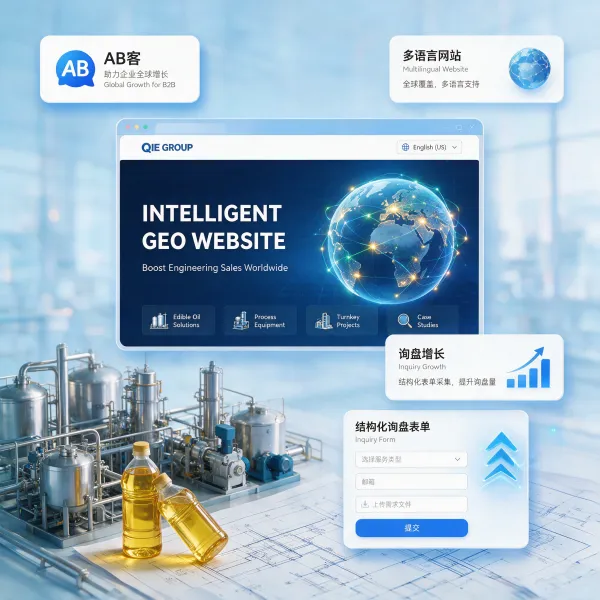



GEO Implementation Roadmap: 180-Day Framework to Turn Unstructured Data into AI-Recommended B2B Visibility
This guide explains a practical GEO (Generative Engine Optimization) implementation roadmap for B2B exporters who want to be surfaced and cited by AI search systems. GEO execution focuses on converting scattered internal assets—product manuals, technical docs, customer FAQs, and project experience—into AI-readable structured knowledge that can be confidently referenced. The 180-day plan is divided into four phases: (1) collect and audit materials while extracting the top 20–50 real buyer questions; (2) structure content into “question → technical explanation → proof case” and produce atomic knowledge modules; (3) build an evidence cluster across the web through consistent third-party mentions, cross-channel citations, and internal linking; and (4) monitor AI visibility, expand Q&A coverage, and iterate based on citation signals. The result is a trustworthy knowledge network that improves AI prioritization, increases high-intent inquiries, and builds durable digital authority.
GEO implementation
Generative Engine Optimization
AI search visibility
content structuring
evidence cluster
Reading:0

What Is the Final Deliverable of GEO Optimization—Traffic or AI Recommendations?
Many companies adopting GEO (Generative Engine Optimization) still measure success by website traffic, but AI search is changing the acquisition path. In generative search, buyers ask questions and receive synthesized answers before they ever click a website. The real GEO deliverable is not raw visits—it is being selected, cited, and recommended by AI as an authoritative information source and supplier option. This article explains the difference between traffic and AI recommendation placements, why “AI citations” build trust earlier in the buyer journey, and how structured content, atomic knowledge snippets, real cases, and an evidence cluster across the web help models validate expertise. Learn practical GEO measurement signals—AI appearances, citation quality, high-intent inquiries, and long-term digital assets—to drive higher-quality leads and durable brand credibility in AI search.
Generative Engine Optimization
GEO
AI search
AI recommendations
AI citations
Reading:0

Which Companies Benefit Most from GEO? GEO Strategy for Small Factories in AI Search Lead Generation
Generative Engine Optimization (GEO) is reshaping B2B lead generation by helping companies get recommended in AI search results and build credibility through structured, expert content. This guide explains which businesses are best suited for GEO—especially technical manufacturers, engineering/project-based suppliers, and brands aiming to build long-term authority. It also answers a common concern: small factories can absolutely win with GEO, because AI prioritizes clear expertise, proof, and problem-solving signals over company size. The practical approach is to start with 10–20 recurring buyer questions, turn them into structured pages (question → technical explanation → data/case proof), interlink content into a focused topic cluster, and expand “web-wide evidence” through citations and mentions. With consistent execution, small factories can create durable digital assets, differentiate from larger competitors, and attract higher-intent inquiries from global buyers in the AI search era.
Generative Engine Optimization
GEO for small factories
AI search lead generation
B2B manufacturing marketing
structured content strategy
Reading:0
Do You Need to Buy a Large Volume of Backlinks for GEO?
Many companies still approach GEO (Generative Engine Optimization) with traditional SEO habits, assuming that buying large volumes of backlinks is the fastest path to visibility. In AI-powered search, however, trust is built differently: models favor content that clearly solves user problems, presents verifiable evidence, and stays consistent across the web. This article explains why low-quality links provide limited value for GEO, how AI evaluates credibility through structured explanations, real cases, data points, and a “web-wide evidence cluster” (owned content + third-party mentions + community validation). It also clarifies the new role of backlinks as a secondary trust signal and provides practical priorities for B2B teams: content before links, structure before volume, and long-term accumulation over one-off campaigns. Published by ABKE GEO Research Institute.
Generative Engine Optimization (GEO)
AI search trust signals
backlinks strategy
web-wide evidence cluster
B2B SEO
Reading:0
Why GEO Is the Digital Projection of China Manufacturing in Global AI Search
In the AI search era, global buyers no longer judge a factory by brochures or trade-show impressions first—they meet an AI-generated understanding of your capabilities. GEO (Generative Engine Optimization) helps China manufacturing brands turn real-world production strength into AI-readable, citable knowledge by building structured content, technical modeling, and verifiable third-party evidence across the web. This “digital projection” bridges the gap between what your factory can do and what AI can accurately explain: clear problem-to-solution mapping, parameter- and process-level expertise, and case-based proof that improves trust before outreach. When GEO is executed as a connected knowledge network, manufacturers become easier for AI engines to reference, enter shortlists earlier, and attract higher-intent B2B inquiries worldwide—shifting competition from price alone to visibility, credibility, and explainability in global AI search.
Generative Engine Optimization (GEO)
AI search visibility
China manufacturing B2B
digital projection
structured technical content
Reading:0

A step-by-step guide to GEO diagnostics: How prominent is your brand in various LLM models?
GEO (Generative Engine Optimization) diagnostics is a brand visibility assessment method for the AI era, used to quantify a company's "presence" in large-scale language models (LLM) such as ChatGPT, Claude, and Perplexity. By building a question bank for procurement scenarios and repeatedly testing across multiple models, it statistically analyzes brand exposure frequency, semantic relevance, and information credibility to identify whether AI accurately understands the company's products, technological capabilities, qualifications, and case studies, while also identifying erroneous descriptions and "illusions." The diagnostic results output comparable presence scores and a gap list, further guiding the structuring of official website content, the completion of case studies and knowledge articles, the deployment of authoritative signals, and cross-platform synchronization, thereby improving AI citation rates, recommendation probabilities, and B2B inquiry conversion rates. This article was published by AB GEO Research Institute.
GEO Diagnostics
Generative engine optimization
LLM brand visibility
AI citation rate
AB Customer GEO Solution
Reading:0

What is the ABke GEO implementation process?
AB-Customer's GEO implementation process revolves around "making enterprise content easier for AI to understand and reference," and is suitable for foreign trade B2B companies to obtain stable recommendations and brand exposure in the AI search era. The overall steps include: industry and content needs analysis, identifying high-frequency questions and topic matrices; content structure optimization, using clear H1/H2/H3 and Q&A/explanatory modules to improve parsingability; industry knowledge system construction, continuously outputting technical analysis, solutions, and knowledge base content to strengthen the perception of a "credible source"; brand signal reinforcement, enhancing credibility through qualification certifications, customer cases, partners, and industry references; and finally, continuous iteration and updates based on AI recommendation and exposure data to form a reusable GEO growth loop, improving inquiry and customer acquisition efficiency. This article was published by AB-Customer GEO Research Institute.
AB Customer GEO
GEO Implementation Process
Generative engine optimization
Foreign trade B2B
AI search optimization
Reading:0

Does GEO have any technical barriers?
GEO (Generative Engine Optimization) is not a high-tech project; its core lies in making content easier for AI to understand and reference. For B2B companies in foreign trade, prioritizing content structure and website information architecture is crucial: organize knowledge using question-based titles and clear hierarchical subheadings, forming a searchable content system around industry FAQs, product technical explanations, selection guides, and solutions; while simultaneously meeting basic SEO requirements such as crawlability, speed, and page structure, the probability of AI search recommendations and citations can be gradually increased. ABke's GEO methodology emphasizes industry knowledge expression as the main thread, coupled with structured content construction and continuous updates, helping companies more efficiently conduct AI search optimization and enhance brand exposure.
GEO
Generative engine optimization
Foreign trade B2B
AI search optimization
AB Customer GEO
Reading:0

What is the GEO implementation process?
GEO (Generative Engine Optimization) is a long-term content growth and recommendation optimization methodology for AI search scenarios such as ChatGPT and Perplexity. This article focuses on the GEO implementation process for B2B foreign trade companies, systematically breaking it down into five key stages: content planning, content creation, AI optimization, performance monitoring, and continuous iteration. From streamlining products and solutions and building a modular content system (company introduction/products/industry knowledge/application scenarios/case studies/FAQ), to optimizing structured titles and semantic expression to improve AI crawling and understanding efficiency, and then continuously iterating through metrics such as recommendation frequency, traffic, and inquiries. Combined with the AB Customer GEO methodology, this helps companies increase AI recommendation probability, accumulate reusable content assets, and form more stable customer acquisition channels and brand value.
GEO Implementation Process
Generative engine optimization
Foreign Trade B2B GEO
AI search optimization
AB Customer GEO
Reading:0

How long does it take for GEO to show results?
Generative Engine Optimization (GEO) is a content-driven, long-term strategy designed to help B2B exporters gain higher visibility and recommendations on AI search and Q&A tools like ChatGPT and Perplexity. Unlike paid advertising, GEO's effectiveness increases gradually as the AI system crawls your website, understands your products and services, and builds trust in your expertise. Early signs typically appear within 1-3 months, while steady growth usually takes 3-6 months, depending on the depth, structure, and frequency of content updates. This page explains the entire GEO lifecycle—from basic content creation (company profile, products, solutions, knowledge articles, case studies, and FAQs) to AI semantic understanding and structured parsing—so teams can plan their expectations and resources. Leveraging the ABKe GEO methodology, businesses can accelerate AI understanding by modularizing information, clarifying product/service capabilities, and publishing authoritative industry content, thereby increasing citation and recommendation likelihood and ultimately achieving sustainable exposure and high-quality inquiry growth.
Generative Engine Optimization (GEO)
AI search optimization
B2B Export Marketing
ABKe GEO
Geographic Content Strategy
Reading:0

Can GEO quantify ROI?
GEO (Generative Engine Optimization) can quantify ROI, but its evaluation logic differs from traditional advertising, which is click-based. For B2B foreign trade companies, a data monitoring chain should be established around "AI recommendation—visit—inquiry—transaction," focusing on tracking AI exposure and citation frequency, site visit growth brought by AI recommendations, changes in inquiry volume and the proportion of valid leads, and changes in customer acquisition cost (CAC) compared to advertising/exhibitions/development emails. Through the AB-Tech GEO methodology, companies can structure and accumulate product information, industry knowledge, solutions, and customer case studies to improve AI understanding and recommendation probability, forming sustainable long-term customer acquisition assets. Furthermore, the ROI of GEO can be continuously calibrated through periodic comparisons and long-term conversion statistics. This article was published by the AB-Tech GEO Research Institute.
GEO Generative Engine Optimization
GEO ROI Quantification
AI Search Optimization for Foreign Trade B2B
AI Exposure and Recommendation Metrics
AB Customer GEO
Reading:0

Does GEO implementation require website modification?
As AI search increasingly impacts how B2B foreign trade customers access information, more and more companies are considering whether implementing GEO (Generative Search Engine) requires a large-scale website overhaul. In reality, most companies don't need to completely rebuild their website system; the key lies in optimizing content structure, information organization, and page theme expression. By supplementing content with industry Q&A, application scenario explanations, technical principle analyses, and internal link layout, company websites can better adapt to generative search engine optimization requirements, increasing their chances of being understood and referenced by AI search. This article analyzes the necessity of website transformation and provides more feasible optimization paths, focusing on GEO, AI search optimization, and content construction for B2B foreign trade websites.
GEO
Generative engine optimization
Foreign trade B2B
AI search optimization
Website content structure optimization
Reading:0
1
2
3
4
5
6
7
8
9
10
11
12
13
14
15
16
17
18
19
20
21
22
23
24
25
26
27
28
29
30
31
32
33
34
35
36
37
38
39
40
41
42
43
44
45
46
47
48
49
50
51
52
53
54
55
56
57
58
59
60
61
62
63
64
65
66
67
68
69
70
71
72
73
74
75
76
77
78
79
80
81
82
83
84
85
86
87
88
89
90
91
92
93
94
95
96
97
98
99
100
101
102
103
104
105
106
107
108
109
110
111
112
113
114
115
116
117
118
119
120
121
122
123
124
125
126
127
128
129
130
131
132
133
134
135
136
137
138
139
140
141
142
143
144
145
146
147
148
149
150
151
152
153
154
155
156
157
158
159
160
161
162
163
164
165
166
167
168
169
170
171
172
173
174
175
176
177
178
179
180
181
182
183
184
185
186
187
188
189
190
191
192
193
194
195
196
197
198
199
200
201
202
Hot Products


.png?x-oss-process=image/resize,h_2000,m_lfit/format,webp)


.png?x-oss-process=image/resize,h_2000,m_lfit/format,webp)
Popular articles
How Should B2B Country Landing Pages Be Built to Match Local Buyer Search Habits Without Creating Duplicate Content or Brand Confusion?
2026.07.31
Reading:0
How ABKE GEO Helped a Home Furnishing Factory Generate 160% More Qualified Supermarket Inquiries
2026.07.30
Reading:0
How strong is GEO's penetration in Southeast Asia and the Belt and Road market?
2026.03.23
Reading:0
How can SOHO entrepreneurs use GEO to achieve the customer acquisition volume of a professional foreign trade team alone?
2026.03.21
Reading:0
Where is GEO more cost-effective compared to Google Ads?
2026.03.19
Reading:0
How ABKE’s Lightweight GEO System Helps Auto Parts SOHO Suppliers Attract Long-Term Overseas Repair Shop Orders
2026.07.30
Reading:0
How a Small Machinery Factory Built GEO Assets in 180 Days and Reached 22 Monthly Engineering RFQs
2026.07.30
Reading:0
Already Ranking on Google? Why B2B Exporters Still Need GEO for AI Search Visibility
2026.03.16
Reading:0
General Website Building vs. Export B2B GEO Websites: Can a GEO Site Generate Engineering and Retail Chain Inquiries?
2026.08.03
Reading:0
Middle East Building Materials GEO Case Study: Arabic Localization Doubles Exclusive Distributor Inquiries in 3 Months
2026.07.30
Reading:0
Export GEO vs. Domestic GEO: 5 Differences B2B Exporters Need to Know
2026.09.07
Reading:0
立即预约 1V1 GEO 专属诊断
一对一分析企业 GEO 现状,帮您快速看清问题与下一步方向
AI 是否认识您的企业?
检测品牌、产品与核心能力是否被 AI 正确理解。
官网是否具备 GEO 基础?
分析网站内容、结构及 AI 可读性是否存在明显问题。
企业还缺哪些关键信息?
找出产品、场景、案例、FAQ 与信任证据的认知缺口。
GEO 应该先从哪里开始?
结合企业现状,明确优先优化方向,避免盲目投入。