.png?x-oss-process=image/resize,h_100,m_lfit/format,webp)

.png?x-oss-process=image/resize,m_lfit,w_200/format,webp)


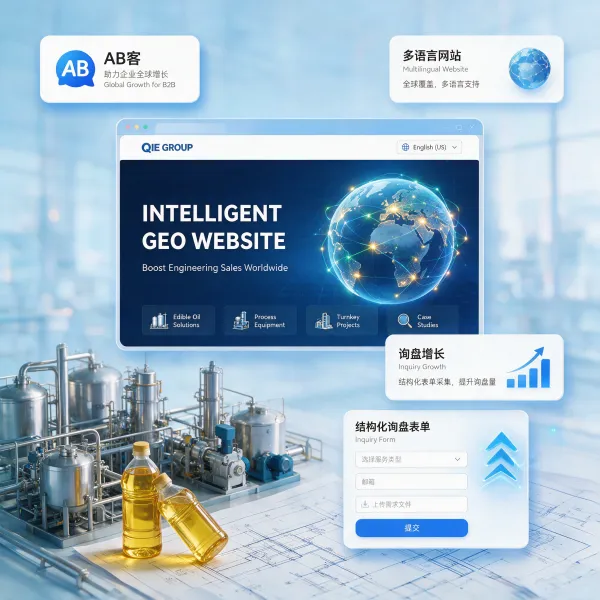



A 3-person team defeats a 30-person team: The efficiency revolution brought about by GEOs
With AI search and conversational recommendations becoming new entry points, competition among B2B foreign trade companies has shifted from "SEO ranking" to "being cited and recommended by AI." This article, based on ABke's GEO methodology, breaks down the core logic of GEO (Generative Engine Optimization): using standardized content structures, consistent information across the entire network, and the construction of a question-based content library, makes official websites and content easier for AI to understand, index, and utilize, thereby achieving automatic content distribution and precise matching. Through a feasible execution path for small teams, it helps companies acquire higher-quality inquiries with less manpower, shorten the transaction cycle, and form a low-cost, high-conversion long-term growth model.
GEO
Generative engine optimization
Foreign trade B2B
AI search optimization
AB Customer GEO
Reading:0

In-House AI Marketer vs Professional GEO Agency: Which Costs Less for B2B Lead Generation?
Choosing between hiring an in-house “AI marketer” and partnering with a professional GEO (Generative Engine Optimization) agency is not just a salary vs. service-fee comparison. While an internal hire may look cheaper month to month, B2B companies often absorb hidden costs in GEO and AI search: learning-curve time, trial-and-error content waste, ineffective distribution, missed AI-search timing, and operational churn when results depend on one person. A specialized GEO team typically brings validated playbooks, tooling, and a repeatable delivery process—such as knowledge asset modeling, GEO content architecture, multi-channel distribution, and AI visibility monitoring—to help brands earn consistent AI recommendations and higher-intent inquiries faster. For many B2B and export businesses, agency-led GEO plus internal collaboration can reduce overall risk and improve long-term customer acquisition efficiency under the same annual budget.
Generative Engine Optimization
GEO agency
AI search visibility
B2B lead generation
AI marketing
Reading:0

Why ABKE GEO Prioritizes “Expert Protocol” Content for AI Search Visibility
In an AI-led search era driven by ChatGPT, Gemini, DeepSeek and other LLM-based discovery systems, traditional SEO tactics centered on keyword density and backlinks are losing impact. ABKE GEO emphasizes “Expert Protocol” content because modern models rank and recommend brands based on semantic strength, professional credibility, internal logic consistency, and authoritative citation signals. The approach builds a recognizable “digital expert profile” through structured knowledge assets, evidence-backed claims, case validation, and consistent cross-document language. By applying knowledge slicing, unified expression templates, multi-platform semantic mapping, and ongoing AI visibility monitoring, enterprises can move from being merely searchable to being preferentially recommended—earning durable trust within AI decision systems and reducing dependence on paid ads.
GEO optimization
expert protocol content
AI search visibility
knowledge slicing
digital expert profile
Reading:0

Atomic Content Slicing: ABke’s Core GEO Moat for AI Search Visibility
ABke’s “Atomic Content Slicing” turns long-form pages into reusable, machine-readable information atoms that are easier for AI systems to understand, index, and cite. Each slice is semantically self-contained, enriched with structural labels (e.g., FAQ, method, case), and designed for dynamic recomposition based on user intent. This approach aligns content with AI retrieval and recommendation logic, enabling finer search matching, broader long-tail coverage, and longer content lifecycle. Combined with ABke GEO methodology, brands can systematically restructure knowledge bases and product content to improve AI search visibility, recommendation likelihood, and multi-scenario reuse—moving beyond traditional keyword SEO toward AI-first discoverability and compounding content value.
Atomic Content Slicing
ABke GEO
AI Search Optimization
Structured Content
Content Recomposition
Reading:0

ABke GEO vs AI Auto-Posting Tools: 5 Fundamental Differences for B2B Lead Generation
ABke GEO is fundamentally different from typical AI auto-posting software that focuses on “writing copy and scheduling posts.” Instead of producing disposable content, ABke GEO acts as an enterprise-grade GEO (Generative Engine Optimization) cognition infrastructure that helps AI systems understand, trust, and consistently recommend your company. It builds reusable knowledge assets by slicing company materials, solutions, and case studies into structured “knowledge fragments,” then amplifies semantic anchors (entities, product lines, scenarios, and problem statements) across websites and multi-platform content matrices. Through entity linking, semantic consistency, and closed-loop iteration, ABke GEO targets long-term outcomes: brand mentions inside AI answers, solution citations, qualified traffic back to your site, and higher-intent B2B inquiries—rather than surface metrics like likes and impressions. The result is a scalable foundation designed for the next 3–5 years of AI-driven search and recommendation.
ABke GEO
Generative Engine Optimization
AI recommendation optimization
B2B content knowledge base
semantic entity linking
Reading:0

Why GEO Becomes Your “Digital Vanguard” Before Going Global (B2B Export Brands)
For B2B exporters, global expansion often starts with ads, platforms, or channel partners—but results can disappoint when buyers lack prior understanding and trust. In an AI-search-driven world, procurement teams increasingly use generative engines to evaluate suppliers before any direct contact. GEO (Generative Engine Optimization) therefore becomes a “digital vanguard”: it builds pre-awareness of your capabilities, moves trust-building earlier in the journey, and helps your company appear in AI-generated shortlists during supplier screening. By defining a clear market positioning, creating structured multilingual brand and technical corpora, covering high-intent questions (selection, comparison, use cases, solutions), and continuously testing via AI prompts, companies can enter new markets faster and improve lead quality and conversion efficiency. This article is published by ABKE GEO Institute of Intelligence Research.
ABKE GEO
Generative engine optimization
AI Search optimization
Foreign trade B2B going global
Reading:0

For the chemical/raw materials industry, how can a GEO demonstrate the research and development capabilities of your laboratory?
In the AI search and generative engine environment of foreign trade B2B, the R&D and laboratory capabilities of chemical and raw material companies are often difficult for AI to accurately understand and cite because they "only showcase equipment and qualifications." A key approach proposed by AB客GEO is to transform laboratory capabilities into searchable, interpretable, and reusable structured technical corpus: describing capability boundaries with clear experimental methods and processes, enhancing credibility with key test data and comparative results, and linking R&D conclusions with product application scenarios, customer problems, and material selection decisions. Simultaneously, it standardizes terminology and parameter definitions to form a sustainably invoked technical expression system, thereby improving exposure, citation rates, and customer acquisition conversion in technical Q&A. This article was published by ABKE GEO Research Institute.
GEO optimization
Generative engine optimization
Chemical Foreign Trade B2B
Laboratory research corpus
AI search optimization
Reading:0

How can small and medium-sized foreign trade enterprises use GEO to achieve a "leapfrog development"?
In the competitive B2B foreign trade landscape, SMEs often struggle to gain stable exposure due to limited budgets and channel resources. As AI search reshapes traffic allocation rules, GEO (Generative Engine Optimization) allows businesses to move beyond reliance on scale and advertising, instead entering the AI recommendation system through "question matching + corpus structure + professional expression." ABKE GEO suggests: Focus on the most advantageous niche products and application scenarios, building high-information-density content around high-intent questions such as selection, comparison, parameters, delivery, and case studies; standardize terminology and expression to form core corpora that AI can reliably understand and reference, and continuously iterate on a small number of high-value pages to achieve low-cost, sustainable inquiry growth. This article was published by AB客 GEO Research Institute.
GEO
Generative engine optimization
Foreign trade B2B
AI search optimization
Customer acquisition for small and medium-sized foreign trade enterprises
Reading:0

Why does AI-powered automatic posting not only fail to perform well on GEO, but can actually be harmful?
In B2B content marketing for foreign trade, many companies use AI to automatically post in bulk to pursue output, but these efforts often fail to generate citations in AI search and recommendation, sometimes even leading to a decline in overall performance. The core reason isn't "whether or not to use AI," but rather the lack of a unified corpus structure, professional verification, and information density: content generalization leads to information dilution, inconsistent expression causes semantic confusion, and a large amount of similar text results in redundancy, ultimately weakening the weight and credibility of the company's corpus. AB客GEO suggests a "corpus framework + human-machine collaboration" approach: first define key fields and expression standards, then use AI to generate and manually review the content, supplementing technical parameters, application scenarios, and real-world details, unifying semantics, and controlling the posting pace to build a high-value corpus system that can be stably understood and used by AI. This article was published by ABKE GEO Research Institute.
AI-generated posting
GEO optimization
B2B Content Marketing for Foreign Trade
AI search optimization
High information density corpus
Reading:0

GEO Optimization: One-time "Renovation" or Long-term "Operation"?
In the AI search environment of foreign trade B2B, GEO (Generative Engine Optimization) is unlikely to achieve long-term stable results through "one-time optimization." A more effective approach is to break down GEO into two phases: "construction-style setup + operational maintenance." The initial phase focuses on building the corpus structure and core content to increase the probability of being included in the AI recommendation system. The later phase involves regularly updating key pages, expanding high-value corpora, monitoring changes in AI mentions, and iterating based on data to maintain long-term position and competitiveness. AB客 GEO recommends controlling investment with a "build first, operate later" approach: a concentrated initial phase for foundational work, followed by refined maintenance to avoid recommendation decay due to content discontinuation. This article was published by ABKE GEO Research Institute.
GEO optimization
Generative engine optimization
Foreign trade B2B
AI search optimization
AB Customer GEO
Reading:0

If my competitor has already implemented GEO, how can I retaliate?
In the B2B foreign trade industry, when competitors have entered the AI recommendation system through GEO (Generative Engine Optimization), simply adding content or imitating competitors often fails to shake their "high-confidence recommendations." A more effective counterattack path is to reconstruct the corpus structure and question coverage based on the path dependence and differential triggering mechanism of AI search: first, identify the competitor's advantageous question areas that are cited, then delve into the application scenarios, technical details, comparisons, and selection decision-making content that are not covered by them; simultaneously, increase information density (parameters, data, solutions), enhance citationability with clearer structured expressions, and achieve multiple breakthroughs through multi-scenario, multi-question matrices, gradually expanding the scope of invocation and recommendation probability, and realizing the opportunity to overtake from "catching up" to "redefining the answer." This article was published by ABKE GEO Research Institute.
GEO
Generative engine optimization
Foreign trade B2B
AI search optimization
Differentiated corpus
Reading:0

Does GEO optimization require continuous investment or pay-per-use?
When planning their GEO (Generative Engine Optimization) budgets, B2B foreign trade companies often struggle with whether to pursue a one-time project or a long-term, continuous investment. Practice shows that GEO is better suited to a combination of "phased construction + continuous optimization": In the early stages, focus on building core corpora and content structures to overcome the barriers to entry into AI recommendation systems; in the later stages, maintain and expand with low frequency and high quality, making refined updates around high-value pages, and dynamically adjusting investment through data monitoring such as mention rates and cognitive changes to avoid ineffective content expansion. In an AI search environment, the stability of results is not determined by the amount of investment, but by the quality of the corpus, the completeness of the structure, and the control of the optimization pace. This article was published by ABKE GEO Research Institute.
GEO optimization
Generative engine optimization
Foreign trade B2B
AI search optimization
ABKE GEO
Reading:0
Hot Products


.png?x-oss-process=image/resize,h_2000,m_lfit/format,webp)


.png?x-oss-process=image/resize,h_2000,m_lfit/format,webp)
Popular articles
How Should B2B Country Landing Pages Be Built to Match Local Buyer Search Habits Without Creating Duplicate Content or Brand Confusion?
2026.07.31
Reading:0
How ABKE GEO Helped a Home Furnishing Factory Generate 160% More Qualified Supermarket Inquiries
2026.07.30
Reading:0
How strong is GEO's penetration in Southeast Asia and the Belt and Road market?
2026.03.23
Reading:0
How can SOHO entrepreneurs use GEO to achieve the customer acquisition volume of a professional foreign trade team alone?
2026.03.21
Reading:0
Where is GEO more cost-effective compared to Google Ads?
2026.03.19
Reading:0
How ABKE’s Lightweight GEO System Helps Auto Parts SOHO Suppliers Attract Long-Term Overseas Repair Shop Orders
2026.07.30
Reading:0
How a Small Machinery Factory Built GEO Assets in 180 Days and Reached 22 Monthly Engineering RFQs
2026.07.30
Reading:0
Already Ranking on Google? Why B2B Exporters Still Need GEO for AI Search Visibility
2026.03.16
Reading:0
General Website Building vs. Export B2B GEO Websites: Can a GEO Site Generate Engineering and Retail Chain Inquiries?
2026.08.03
Reading:0
Middle East Building Materials GEO Case Study: Arabic Localization Doubles Exclusive Distributor Inquiries in 3 Months
2026.07.30
Reading:0
Export GEO vs. Domestic GEO: 5 Differences B2B Exporters Need to Know
2026.09.07
Reading:0
立即预约 1V1 GEO 专属诊断
一对一分析企业 GEO 现状,帮您快速看清问题与下一步方向
AI 是否认识您的企业?
检测品牌、产品与核心能力是否被 AI 正确理解。
官网是否具备 GEO 基础?
分析网站内容、结构及 AI 可读性是否存在明显问题。
企业还缺哪些关键信息?
找出产品、场景、案例、FAQ 与信任证据的认知缺口。
GEO 应该先从哪里开始?
结合企业现状,明确优先优化方向,避免盲目投入。