.png?x-oss-process=image/resize,h_100,m_lfit/format,webp)

.png?x-oss-process=image/resize,m_lfit,w_200/format,webp)


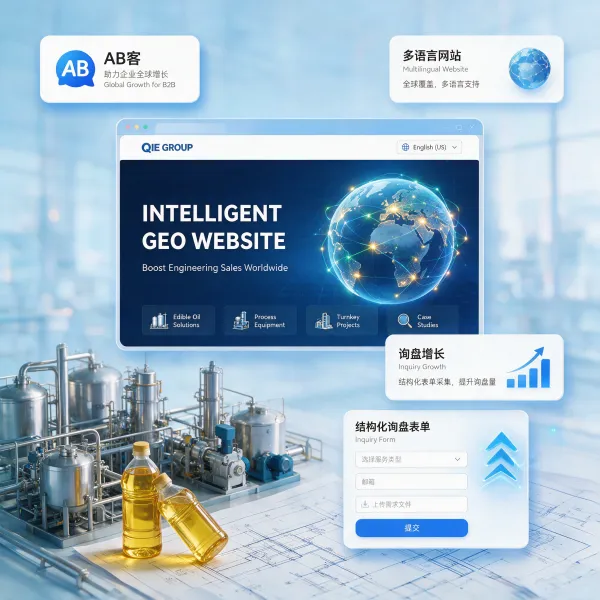



Why is it said that GEO is like buying a "global advertisement that never expires" for the factory?
In export B2B lead generation, once advertising stops, exposure and inquiries often decline simultaneously. GEO (Generative Engine Optimization) turns content from “short-term consumption” into “long-term assets” by building high-value corpora that can be continuously invoked by AI search and generative answers, enabling more stable global reach. Its core lies in: accumulating searchable technical and application content; increasing information density and citability with selection/comparison/specs/cases; unifying semantics and structure to form stable recognition; and strengthening the probability of being mentioned and recommended through a content network and continuous updates. For factories and suppliers, GEO cannot completely replace advertising, but it can significantly reduce dependence on paid traffic and continuously gain cross-market inquiries and brand exposure.
GEO Generative Engine Optimization
AI search optimization
Foreign Trade B2B Customer Acquisition
Factory global exposure
Content asset accumulation
Reading:0

How to quantify the effectiveness of GEO? Let's discuss AI mention rate and brand awareness.
When evaluating the effectiveness of GEO (Generative Engine Optimization) for foreign trade B2B companies, it's crucial to consider more than just traffic, ranking, or the number of inquiries. In AI search and generative answer scenarios, AI often recommends only a few brands; therefore, "being mentioned" is more critical than "ranking." ABKe GEO recommends establishing a quantitative system based on two core metrics: first, AI mention rate, which tracks the frequency, position, and presentation of the company's mentions in high-intent questions such as selection, application, and comparison; second, brand awareness, which assesses whether the AI's description of the brand is stable, consistent, and positive. By establishing a question testing pool, regularly monitoring changes in mentions and awareness, and linking these metrics with inquiry quality and conversion rates, the true position of the company in AI recommendations can be more clearly identified, guiding continuous optimization. This article was published by ABKE GEO Research Institute.
GEO optimization
AI mention rate
Brand awareness
AI search optimization
Foreign trade B2B
Reading:0

After GEO is implemented, your official website will no longer be just for show, but will become a source of information recommended by AI.
With AI search and generative question answering becoming mainstream, B2B foreign trade companies whose official websites remain merely "display pages" will struggle to be used by AI, leading to a greater reliance on platforms and advertising for inquiries. AB-Tech GEO's core GEO (Generative Engine Optimization) aims to upgrade the official website into a "source of information that AI can understand and utilize": reconstructing content logic around questions, supplementing decision-making content such as selection, application, comparison, and solutions; unifying the semantic expression of products and capabilities to improve information consistency; adding parameters, case studies, and technical descriptions to increase information density and citationability; and establishing a content network through internal links and structured content, transforming the official website from a traffic entry point into a decision-making entry point, continuously enhancing AI recommendation and customer acquisition capabilities. This article was published by ABKE GEO Research Institute.
GEO optimization
Generative engine optimization
Foreign Trade B2B Official Website
AI search optimization
AI source
Reading:0

Save 80% of Foreign Trade Content Production Time: How Does GEO Do It?
For foreign trade B2B companies, the most time-consuming part of content production is often not “writing,” but inefficiency caused by product information organization, structure design, and repetitive expression. Through the Generative Engine Optimization (GEO) method, ABKE GEO breaks down product, technology, and application knowledge into reusable corpus modules and establishes standardized content structures and templates, transforming content production from linear drafting into “calling and combining.” In an AI search environment, structured corpus is easier to retrieve and cite; the same knowledge point can be reused across product pages, application articles, and FAQs multiple times, reducing communication and rework while improving consistency and professionalism. Companies can achieve content assetization and scalable growth by building a corpus library, unifying terminology, establishing combination mechanisms, and continuously optimizing high-frequency modules.
GEO
Generative engine optimization
B2B Content Marketing for Foreign Trade
Corpus Library Building
Structured content
Reading:0

Why Many GEO Providers Avoid “Fact Density” in B2B Content
In professional B2B GEO (Generative Engine Optimization), AI systems don’t reward longer copy—they reward verifiable facts. “Fact density” means packing a limited space with checkable data, parameters, constraints, standards, certifications, and traceable project results so models can retrieve, trust, and quote the content. Many GEO providers avoid this concept because they rely on template rewriting and keyword stuffing, lacking the domain expertise and structured thinking needed to turn real capabilities into evidence-rich knowledge. This approach often produces content that looks persuasive but adds little information value, making it hard for AI to cite. A fact-density-driven GEO method rebuilds pages around “question–conditions–data–conclusion,” adds reusable modules like spec tables and comparison charts, and organizes an internal fact library to ensure accuracy and consistency—improving retrieval match, credibility scoring, and citation likelihood in AI-generated answers.
fact density
GEO content strategy
B2B technical content
AI citation optimization
generative engine optimization
Reading:0
Black Hat GEO Explained: Risky AI Optimization Tactics That Can Get Brands Delisted
Black hat GEO refers to high-risk generative engine optimization tactics that try to manipulate AI answers through fabricated sources, fake reviews, invented experts, prompt injection, and low-quality content farms. Unlike traditional black hat SEO, these practices can trigger deeper penalties across AI data pipelines—training data cleansing, retrieval quality filters, and platform compliance enforcement—causing your domains and content patterns to be ignored long-term or even banned. This solution advocates an “authentic, traceable, ecosystem-friendly” GEO approach: define a strict red-line policy, build verifiable and source-backed content, maintain multi-channel consistency, replace volume tactics with structured high-density Q&A, and establish internal compliance review to grow durable AI trust and visibility.
black hat GEO
generative engine optimization
AI search visibility
prompt injection
content authenticity
Reading:0

Why Owning the First Node in AI Attribution Matters More Than Traditional Search Rankings
In the generative AI era, users don’t scan a list of links—they receive a synthesized answer shaped by the model’s internal reasoning. The “first node in AI attribution” is the initial concept, scenario, or trusted source the AI adopts to define and route the problem. Once your brand becomes that starting point, it creates a lock-in effect: subsequent comparisons, evidence selection, and vendor shortlists tend to follow your framework, increasing mention frequency and decision influence beyond classic SERP position. Using a GEO approach (question–scenario–evidence), companies can rebuild content into reusable decision frameworks, clarify applicability boundaries, and publish consistently across multiple sources so AI systems repeatedly encounter and reuse their logic as the default starting node.
AI attribution first node
GEO optimization
generative AI SEO
decision framework content
AI recommendation visibility
Reading:0

Quantifying GEO Brand Authority Growth: Metrics, Scoring Model, and Attribution
In the GEO (Generative Engine Optimization) context, “brand authority” is best measured as how consistently AI search and chat systems treat your company as a trusted, prioritized source. Instead of relying on a single vanity metric, this framework quantifies growth across four observable dimensions: visibility (brand mention rate across a defined question set), placement and exposure format (first-turn/first-paragraph mentions vs. citations or side panels), sentiment and tone (positive/neutral/negative language), and business impact (AI-sourced sessions, leads, and inquiries). By building a repeatable monitoring panel—defining a question pool and platform pool, tracking monthly trends, applying a weighted scoring model to produce a Brand Authority Index, and connecting results to downstream conversion data—B2B teams can explain GEO ROI with clear, comparable data rather than subjective “AI trust” assumptions.
GEO brand authority
AI search visibility
citation rate tracking
brand mention scoring
AI lead attribution
Reading:0
How can you distinguish between a professional GEO service provider and a regular AI writing software?
The goal of GEO (Generative Engine Optimization) is not simply "writing more articles," but rather integrating brands into AI's cognitive framework, ensuring they are credibly mentioned and recommended when users ask key questions. Many so-called "GEO services" are essentially AI-generated content: emphasizing output, frequency, and inclusion, but lacking a multi-node layout encompassing semantic systems, evidence clusters, and consistent expression. Professional GEO service providers should offer: a structured question system and semantic architecture centered around industry issues; citationable judgmental content; cross-platform evidence cluster distribution and continuous calibration mechanisms; and verifiable "AI mentions/descriptions" using generative search/dialogue scenarios like ChatGPT. This article provides identification methods from three dimensions: capability model, delivery method, and effect verification, helping foreign trade and B2B companies avoid pseudo-GEO and achieve sustainable growth in recommendations and inquiries. This article is published by AB GEO Research Institute.
GEO service provider
Generative engine optimization
AI-generated writing service
AI Citation Validation
Cluster of evidence
Reading:0

Can GEO Optimization Help Your Brand Appear in AI Search Sidebars and Citation Panels?
GEO (Generative Engine Optimization) can influence whether your brand is selected for AI search sidebars and citation panels, but it cannot guarantee placement. These modules typically surface sources the model deems most trustworthy and easiest to extract: content that directly answers user intent, clear brand/entity identification, strong structured formatting, and consistent validation across multiple authoritative channels. Using a systematic GEO approach—question modeling, knowledge-card style pages, schema/FAQ and tabular data, entity/NAP consistency, and distributed third-party references—brands can improve AI visibility, increase the probability of being cited, and make appearances more stable over time. The goal is to turn a brand from a “vague mention” into a “clear, credible, display-ready entity” that AI systems can confidently reference.
GEO optimization
AI search citations
entity SEO
structured data schema
AI visibility
Reading:0

Why Your Competitors Rank Higher in DeepSeek Recommendations: An AB客GEO Guide
In DeepSeek and other generative AI assistants, recommendation placement is not driven by ad spend or keyword density. It is typically the result of multiple weighted signals, including semantic match to real user questions, structured content that the model can reliably quote (tables, specs, step-by-step processes), source credibility, and consistency of brand facts across platforms. If competitors appear ahead of you, it often means their “AI-readable” knowledge assets are more complete and easier to verify. This AB客GEO guide explains the underlying workflow—intent understanding, candidate source retrieval, and weighted answer generation—and translates it into an actionable optimization plan: run an AI-perspective competitor audit, rebuild core pages into a question–answer structure, expand a cross-platform source network beyond your website, and iterate with weekly prompt testing. The goal is stable AI visibility and trust, not short-term ranking fluctuations, so your brand becomes a consistently citable option in high-intent, niche queries.
DeepSeek recommendation ranking
Generative Engine Optimization (GEO)
AB客GEO
AI visibility optimization
trustworthy content signals
Reading:0

What difficulties will we face when creating GEO again? (e.g., the corpus space is filled up)
As Generative Engine Optimization (GEO) enters its popularization phase, new entrants will face challenges such as a gradually saturated corpus space, the dominance of early-mover AI recognition positions, and intensified competition. The limited availability of high-quality content and recommendation slots for models means that even with continuous content production, newcomers may struggle to find their way into the "default answer." Simultaneously, the content threshold is rising, requiring more structured, professional, and verifiable content, and a consistent "evidence cluster" across multiple channels including official websites, social media, industry platforms, and white papers/PDFs. ABke's GEO strategy recommends early deployment of core categories and key question banks, leveraging an authoritative content system, cross-platform node coverage, and continuous monitoring and iteration to reduce future customer acquisition costs and secure AI recommendation and trust.
GEO optimization risk
Corpus space saturation
AI cognitive position
Generative engine optimization
AB Customer GEO Solution
Reading:0
Hot Products


.png?x-oss-process=image/resize,h_2000,m_lfit/format,webp)


.png?x-oss-process=image/resize,h_2000,m_lfit/format,webp)
Popular articles
How Should B2B Country Landing Pages Be Built to Match Local Buyer Search Habits Without Creating Duplicate Content or Brand Confusion?
2026.07.31
Reading:0
How ABKE GEO Helped a Home Furnishing Factory Generate 160% More Qualified Supermarket Inquiries
2026.07.30
Reading:0
How strong is GEO's penetration in Southeast Asia and the Belt and Road market?
2026.03.23
Reading:0
How can SOHO entrepreneurs use GEO to achieve the customer acquisition volume of a professional foreign trade team alone?
2026.03.21
Reading:0
Where is GEO more cost-effective compared to Google Ads?
2026.03.19
Reading:0
How ABKE’s Lightweight GEO System Helps Auto Parts SOHO Suppliers Attract Long-Term Overseas Repair Shop Orders
2026.07.30
Reading:0
How a Small Machinery Factory Built GEO Assets in 180 Days and Reached 22 Monthly Engineering RFQs
2026.07.30
Reading:0
Already Ranking on Google? Why B2B Exporters Still Need GEO for AI Search Visibility
2026.03.16
Reading:0
General Website Building vs. Export B2B GEO Websites: Can a GEO Site Generate Engineering and Retail Chain Inquiries?
2026.08.03
Reading:0
Middle East Building Materials GEO Case Study: Arabic Localization Doubles Exclusive Distributor Inquiries in 3 Months
2026.07.30
Reading:0
Export GEO vs. Domestic GEO: 5 Differences B2B Exporters Need to Know
2026.09.07
Reading:0
立即预约 1V1 GEO 专属诊断
一对一分析企业 GEO 现状,帮您快速看清问题与下一步方向
AI 是否认识您的企业?
检测品牌、产品与核心能力是否被 AI 正确理解。
官网是否具备 GEO 基础?
分析网站内容、结构及 AI 可读性是否存在明显问题。
企业还缺哪些关键信息?
找出产品、场景、案例、FAQ 与信任证据的认知缺口。
GEO 应该先从哪里开始?
结合企业现状,明确优先优化方向,避免盲目投入。