.png?x-oss-process=image/resize,h_100,m_lfit/format,webp)

.png?x-oss-process=image/resize,m_lfit,w_200/format,webp)


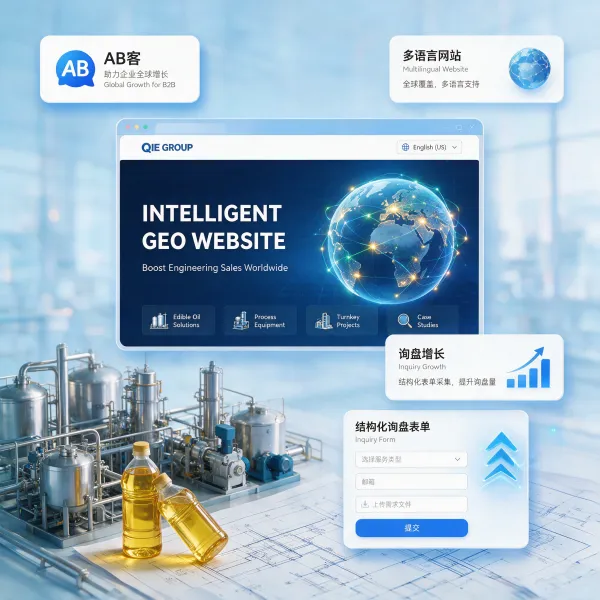



From 0 inquiries to being prioritized by Perplexity: A hardware factory's GEO turnaround journey
This case study explains how an export-oriented hardware manufacturer (hinges and connectors) went from years of near-zero inquiries to being cited—and sometimes prioritized—by AI search tools such as Perplexity, without increasing ad spend. The key shift was rebuilding the site from a “showcase website” into an “answer-ready corpus”: enriching product pages with technical specs, materials, tolerances, and use scenarios; expanding content around buyer questions (selection, outdoor suitability, industry fit); and standardizing naming and specs across multiple pages to form a consistent mention structure. In AI-driven search, citation and preference often go to the most complete, coherent, and reusable information. The result was steady, higher-quality inquiries and a shorter sales cycle. Published by AB客GEO Research Institute.
Generative Engine Optimization (GEO)
AI search optimization
B2B export marketing
hardware hinges manufacturer
Perplexity citation
Reading:0

Why is GEO said to be the "life-saving talisman" for obtaining foreign trade customers in the next five years?
In global B2B trade, customer acquisition is shifting fast from traditional SEO and marketplace listings to AI search and generative recommendations. As answer engines compress results into only a few suggested suppliers, companies that are not included in AI-readable corpora may lose visibility even if their websites rank well. GEO (Generative Engine Optimization) helps exporters build “AI-recommendable” presence by creating question-led content, increasing information density with specs, scenarios and proof, and establishing consistent semantic links between brand, products and industry terms across multiple assets. The goal is to move from traffic competition to corpus competition—so your company is continuously cited and recommended when buyers ask AI for solutions. This article is published by AB Guest GEO Institute of Intelligence Research.
Generative Engine Optimization (GEO)
AI search optimization
B2B export lead generation
AI-recommended suppliers
export marketing strategy
Reading:0

Where is GEO more cost-effective compared to Google Ads?
In B2B export marketing, Google Ads primarily “buys traffic” through bidding, delivering fast clicks but limited long-term trust and compounding costs once spend stops. GEO (Generative Engine Optimization) focuses on being “chosen” in AI-driven search by building reusable content assets and an entity/mention footprint that AI systems can cite as credible sources. By converting high-intent ad keywords into FAQs, technical guides, and case-based pages, brands improve citability, increase recommendation frequency in AI answers, and attract higher-quality leads with stronger purchase intent. A hybrid approach works best: use Google Ads for rapid market validation and short-term demand capture, then reinvest winning queries into GEO content to reduce dependency on paid media and lower customer acquisition cost over time. GEO’s advantage is a better cost per trust and a more stable pipeline as AI recommendations compound.
Generative Engine Optimization (GEO)
Google Ads
B2B lead generation
AI search optimization
export marketing
Reading:0

Key Pain Point: Why does AI always provide outdated information and fail to update your current status?
Many B2B foreign trade companies have upgraded their products, adjusted their positioning, or expanded their markets, yet customers still receive introductions and recommendations for older models from several years ago when searching with AI. The root cause is that AI doesn't "automatically follow company dynamics." It prefers stable, verifiable, easily accessible, and widely cited sources. If new content lacks structured expression, cross-platform consistency, and authoritative endorsement, it struggles to form sufficient signal strength and semantic binding, causing AI to naturally rely on old perceptions. This article dissects the mechanism and source preferences of AI information updates from a GEO (Generative Engine Optimization) perspective and presents the ABke GEO method: converting news updates into citationable knowledge, synchronizing across multiple platforms, strengthening the semantic association between brand, product, and capability, establishing a continuous update rhythm, and conducting regular AI verification. This helps companies improve information timeliness and AI cognitive update capabilities, achieving more accurate recommendations and customer acquisition.
GEO Generative Engine Optimization
AI Information Updates
AI source management
AI Search Optimization for Foreign Trade B2B
AB Customer GEO
Reading:0
How Much Can GEO Improve Global Brand Awareness?
In global B2B trade, brand awareness is shifting from impressions to AI-driven mentions. Generative Engine Optimization (GEO) helps brands enter the global content corpus so AI search and assistants can repeatedly cite the company name, products, and differentiators—even when website traffic does not spike. This approach focuses on building multi-scenario content (applications, selection guides, comparisons, FAQs), strengthening brand–keyword associations, and keeping messaging consistent across pages and channels to improve model confidence. By increasing content “quotability” through structured specifications, case studies, and clear answers, GEO creates persistent visibility at the moment buyers ask technical questions. Ultimately, GEO supports “search-time branding”: your brand is discovered and recommended when customers query AI, enabling sustainable awareness growth worldwide. Published by ABKE GEO Zhiyan Institute.
Generative Engine Optimization (GEO)
AI search optimization
B2B brand awareness
AI mentions and citations
global content corpus
Reading:0
Why GEO Builds Trust Before the First Meeting in B2B Export Sales
In B2B international trade, buyer decisions increasingly start inside AI search—before any email, call, or meeting. This article explains how Generative Engine Optimization (GEO) helps prospects pre-qualify suppliers and build trust early through multi-source consistency, broader query coverage, and high-specificity content. When your company’s capabilities, specifications, certifications, delivery workflow, and real application cases are repeatedly referenced across pages and channels, AI systems treat you as a reliable source and surface you more often in generated answers. GEO shifts trust-building from sales conversations to “being cited” by AI: unify product naming and technical parameters, publish problem-led FAQs and selection guides, and add verifiable proof points that reduce perceived risk. The result is clearer inbound inquiries, shorter sales cycles, and higher conversion efficiency—because prospects arrive already informed and confident in your credibility.
Generative Engine Optimization (GEO)
AI search optimization
B2B trust building
international trade lead generation
ABKE GEO
Reading:0
Is Your Brand “Invisible” in the AI Universe? A Practical GEO Presence Test for B2B Exporters
Many B2B exporters still rank in traditional SEO yet remain “invisible” in AI-generated answers. The root cause is not traffic, but corpus readiness: your brand and solutions are not expressed in a form AI models can reliably extract, cite, and reuse. This article explains GEO (Generative Engine Optimization) through three drivers of AI visibility—mention frequency, semantic binding between brand and product/industry terms, and information usability for answering real questions. It also provides a practical self-test: run problem-based queries around your core products and use-cases, then check whether AI can identify who you are, what you offer, and what problems you solve. Finally, it outlines actionable improvements such as adding FAQ and application scenarios, standardizing product naming and technical wording across pages, and building cross-page “mention paths” via guides, cases, and knowledge content—so your brand becomes callable in AI search. Published by ABKE GEO Research Institute.
generative engine optimization
AI search visibility
B2B export marketing
AI content strategy
ABKE GEO
Reading:0
Why is it that your official website loads quickly and has a good ranking, but still has no AI traffic?
In B2B export marketing, page speed and strong Google rankings help you get indexed and seen—but they don’t guarantee AI traffic. Generative AI search works by extracting and citing answer-ready snippets, not by rewarding pages that simply rank well. Many corporate sites rely on showcase-style product pages filled with images and marketing copy, which lack the granular, structured information AI systems can reuse. AB客GEO’s GEO approach focuses on “mentionability” and corpus value: increasing information density (specs, use cases, constraints), improving structure (definitions, parameters, comparisons, FAQs), and building question-led content hubs (selection guides, troubleshooting, application notes). When each section is designed to directly answer real buyer and engineer queries, your pages become citable sources—making AI visibility and qualified inbound leads more achievable beyond traditional SEO.
generative engine optimization
AI search optimization
B2B export marketing
AI traffic
ABKE GEO
Reading:0
Is your company's digital persona ambiguous? No wonder AI can't trust you.
In the era of GEO (Generative Engine Optimization), whether AI can trust and recommend a foreign trade B2B company depends on the clarity and consistency of its "digital personality": identity positioning (manufacturer/supplier/solution provider), core products and advantages, experience data and qualification endorsements, and consistent expression across platforms. If there are conflicts in wording, unstable tags, or divergent themes across the official website, B2B platform, and social media content, AI will reduce credibility and citation probability, leading to the brand's absence from AI search and recommendations. This article, combining the ABKe GEO methodology, provides a path for building a digital personality: unified positioning and propositions, establishing core semantic tags, focusing on industry and scenarios, forming repeatable brand memory expressions, and helping companies become the "certain answer" in the eyes of AI through consistent governance across the entire network. This article is published by the ABKe GEO Research Institute.
GEO Generative Engine Optimization
Corporate Digital Persona
AI Trust Mechanism
Foreign trade B2B marketing
AB Customer GEO
Reading:0
A Brief Discussion on "Digital Junk" of Foreign Trade Websites: Why is Content with Low Fact Density Being Blocked by Large Models?
Many B2B export websites still rely on high-volume, low-value copy that repeats product descriptions, uses vague marketing language, and lacks verifiable proof. In the AI search era, this low fact-density “content pollution” is increasingly filtered out, ignored, or deprioritized by large language models because it cannot be verified, fails to answer specific buyer questions, and conflicts with signals across the web. This article explains why such pages reduce trust and visibility, and provides a GEO (Generative Engine Optimization) solution: increase fact density with specs, test data, certifications, and case studies; restructure content into reusable, atomic knowledge blocks that map “question → evidence → conclusion”; build an evidence cluster across your website, B2B platforms, and social channels to ensure consistency; and keep content continuously updated to maintain AI citation and recommendation potential. The goal is to turn “digital noise” into structured, credible content assets that AI can quote—improving authority, recommendations, and qualified inbound leads.
low fact-density content
content pollution
GEO optimization
AI search visibility
B2B export website
Reading:0

The GEO Transition Pain for SEO Teams: Why “Keyword Logic” Can Kill AI Recommendations
Many SEO teams still optimize for rankings by repeating target keywords in titles, headings, and body copy. In the era of AI search and Generative Engine Optimization (GEO), that keyword-first logic can reduce trust and weaken AI recommendations because models prioritize factual clarity, structured knowledge, and verifiable signals over keyword density. This article explains the conflict between traditional SEO tactics and AI understanding, highlighting four GEO drivers: fact density (specs, certifications, case data), structured information (Q&A-style, atomized content blocks), cross-channel consistency (website, B2B platforms, social profiles), and a trust loop built on multi-source validation and citations. It also outlines common transition pains—mindset shift, content restructuring, and new measurement standards—and provides a practical GEO path: move from keywords to customer questions, rebuild pages into reusable knowledge slices, create a consistent evidence cluster across the web, and iterate by updating proof points and monitoring AI mentions and recommendation weight.
Generative Engine Optimization (GEO)
SEO to GEO transition
AI recommendations
keyword stuffing
B2B lead generation
Reading:0

Don’t Get Fooled by “Pretty Rankings”: In the GEO Era, Mention Share Beats Clicks
In the AI search era, traditional SEO KPIs like rankings and clicks can mislead B2B exporters: buyers often get supplier shortlists directly from AI-generated answers without visiting websites. This article explains why “mention rate” (how often your brand, data, or expertise is cited in AI responses) is the core GEO measurement. Being mentioned means entering the buyer’s decision set and gaining implicit trust endorsement, while clicks may reflect low-intent traffic with weak conversion value. To increase mention rate, GEO should make your content easy for AI to reuse: create atomic Q&A knowledge slices, raise factual density with specs, case studies, and numbers, structure content for clear extraction, and build a consistent cross-platform evidence cluster to improve credibility signals. Track brand appearance, cited viewpoints, supplier-list inclusion, and frequency across multiple query types to assess real GEO performance and drive higher-quality leads.
GEO mention rate
AI search optimization
generative engine optimization
B2B export marketing
AI supplier recommendations
Reading:0
Hot Products


.png?x-oss-process=image/resize,h_2000,m_lfit/format,webp)


.png?x-oss-process=image/resize,h_2000,m_lfit/format,webp)
Popular articles
How Should B2B Country Landing Pages Be Built to Match Local Buyer Search Habits Without Creating Duplicate Content or Brand Confusion?
2026.07.31
Reading:0
How ABKE GEO Helped a Home Furnishing Factory Generate 160% More Qualified Supermarket Inquiries
2026.07.30
Reading:0
How strong is GEO's penetration in Southeast Asia and the Belt and Road market?
2026.03.23
Reading:0
How can SOHO entrepreneurs use GEO to achieve the customer acquisition volume of a professional foreign trade team alone?
2026.03.21
Reading:0
Where is GEO more cost-effective compared to Google Ads?
2026.03.19
Reading:0
How ABKE’s Lightweight GEO System Helps Auto Parts SOHO Suppliers Attract Long-Term Overseas Repair Shop Orders
2026.07.30
Reading:0
How a Small Machinery Factory Built GEO Assets in 180 Days and Reached 22 Monthly Engineering RFQs
2026.07.30
Reading:0
Already Ranking on Google? Why B2B Exporters Still Need GEO for AI Search Visibility
2026.03.16
Reading:0
General Website Building vs. Export B2B GEO Websites: Can a GEO Site Generate Engineering and Retail Chain Inquiries?
2026.08.03
Reading:0
Middle East Building Materials GEO Case Study: Arabic Localization Doubles Exclusive Distributor Inquiries in 3 Months
2026.07.30
Reading:0
Export GEO vs. Domestic GEO: 5 Differences B2B Exporters Need to Know
2026.09.07
Reading:0
立即预约 1V1 GEO 专属诊断
一对一分析企业 GEO 现状,帮您快速看清问题与下一步方向
AI 是否认识您的企业?
检测品牌、产品与核心能力是否被 AI 正确理解。
官网是否具备 GEO 基础?
分析网站内容、结构及 AI 可读性是否存在明显问题。
企业还缺哪些关键信息?
找出产品、场景、案例、FAQ 与信任证据的认知缺口。
GEO 应该先从哪里开始?
结合企业现状,明确优先优化方向,避免盲目投入。