


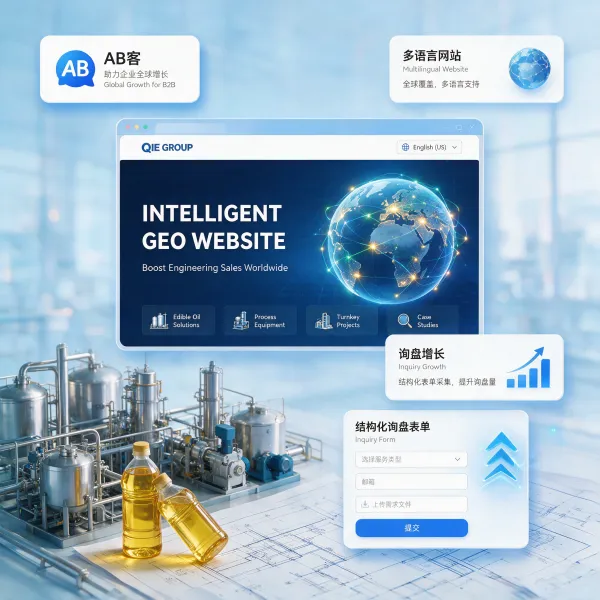


GEO Implementation SOP: From Diagnostic Modeling to Full Network Deployment, How Many Steps Are There?
For B2B foreign trade companies, implementing GEO (Generative Engine Optimization) is not simply about "writing a few articles," but about building a corpus system that AI can understand, reference, and continuously accumulate. This article breaks down the GEO implementation method into 5 steps: Current Status Diagnosis (establishing a question test library to evaluate AI visibility and expression accuracy), Corpus Modeling (unifying keywords and semantic structures for products/industries/scenarios/capabilities), Content Construction (creating answerable pages around decision-making chain questions such as selection, application, comparison, and FAQs), Mention Spread (repeated appearance across multiple platforms and contexts to build a stable citation network), and Continuous Optimization (regularly retesting and iterating content structure and expression). Proceeding in stages allows for faster integration into the AI recommendation system and improved inquiry quality. This article is published by ABKE GEO Research Institute.
GEO Implementation Standard Operating Procedure
Generative engine optimization
AI Search Optimization for Foreign Trade B2B
The topic has been widely mentioned and spread across the internet.
Corpus modeling
Reading:
0
Evaluation: A detailed breakdown of various GEO solutions on the market, which one is most suitable for foreign trade factory directors?
In B2B export industries, GEO (Generative Engine Optimization) has no single “best tool”—results depend on whether your approach matches how AI systems select and cite answers. This article breaks down three mainstream GEO paths: tool-driven content at scale (fast but often homogeneous and inconsistent), SEO-extension approaches (keyword- and ranking-led, misaligned with AI recommendation logic), and corpus-system GEO (built around customer questions, decision stages, and consistent mentions). AB customerGEO argues that sustainable AI visibility requires a complete framework covering structured corpus design, decision-chain understanding, and a scalable mention network. Manufacturers evaluating GEO providers should prioritize decision-led content modules (selection, comparison, application), semantic consistency across pages, and measurable AI mentions—rather than traffic alone.
GEO solutions
Generative Engine Optimization
B2B export marketing
AI search optimization
ABKE GEO
Reading:
0
Why GEO Can’t Rely on Pure AI Autopilot: Human-in-the-Loop Is the Real Advantage
In B2B export marketing, AI can accelerate content output, but it cannot replace business judgment, decision logic, or a consistent knowledge framework. Many teams that mass-produce AI-written pages find they are rarely cited in AI search results due to generic messaging, duplicated semantics, weak problem alignment, and inconsistent terminology. Effective GEO (Generative Engine Optimization) depends on human-led structure: defining real buyer questions, building a unified parameter/terminology system, and designing reusable content modules. AI then executes within this blueprint to scale production. A sustainable workflow is: humans map the decision journey, AI generates within templates, humans validate consistency and completeness, and teams iterate based on mention/citation signals. Ultimately, AI writes the content, but humans determine what should be written and how it should be organized to become usable, referenceable training-like corpus for AI search. This article is published by ABKE GEO Research Institute.
Generative Engine Optimization (GEO)
AI search optimization
B2B content strategy
human-AI collaboration
export B2B marketing
Reading:
0

Who Is the Real GEO Expert? Look for One Skill: Understanding the B2B Decision Chain
In B2B export and industrial markets, real Generative Engine Optimization (GEO) is not about publishing more content or chasing keywords—it is about mapping content to the full buyer decision journey so AI search can reliably quote and recommend your brand. This approach breaks the journey into clear stages—awareness, shortlisting, validation, and final selection—then turns each stage into specific, answer-driven questions that engineers, procurement teams, and decision makers actually ask. By building connected, multi-page knowledge assets (guides, comparisons, specs, use cases, and proof) instead of isolated product pages, companies create coherent “decision-chain” corpora that AI systems can understand, retrieve, and cite. ABKE GEO emphasizes problem decomposition, end-to-end coverage, structured internal relationships, and citation-ready language to increase AI visibility and influence throughout the buying process.
Generative Engine Optimization
GEO for B2B
B2B buyer decision journey
AI search optimization
decision chain content
Reading:
0

How Big Is the Gap Between Companies That Do GEO and Those That Don’t? (AI Recommendation Case Comparison)
In B2B export industries, the gap between doing GEO (Generative Engine Optimization) and not doing it is often the difference between being invisible and being consistently cited by AI answer engines. This article compares two similar suppliers with comparable search visibility, yet dramatically different outcomes in AI recommendations. The key drivers are information usability (content that directly answers buyer questions), corpus coverage (multiple pages covering real decision scenarios such as selection, specs, applications and FAQs), and mention stability (consistent naming and repeated citations across contexts). Instead of rewarding the “best company,” AI systems tend to surface the “most usable content” for answering queries—meaning structured Q&A modules, technical parameters, use cases, and a connected content network can determine whether a brand enters the AI candidate set at all. Published by ABKE GEO Research Institute.
generative engine optimization
GEO for B2B exporters
AI search optimization
AI recommendations
B2B content strategy
Reading:
0
In conclusion: The curtain has risen; GEO is the "digital dividend" of this era for all sincere business operators.
In an era where AI recommendations have become the mainstream customer acquisition channel, GEO (Generative Engine Optimization) is systematically transforming the technical solutions, product descriptions, and customer case studies of foreign trade B2B companies into "digital assets" that can be understood, referenced, and recommended by AI. Unlike short-term growth relying on platform traffic and advertising, GEO, through atomic content slicing, structured tagging (such as schema), and the layout of evidence clusters across the entire network, allows enterprise knowledge to be accumulated over the long term and form authoritative perceptions, shifting from "renting traffic" to "owning a digital mine," achieving more stable high-quality inquiries and building brand trust. Continuously updating and iterating content assets is the key to obtaining and amplifying this "digital dividend."
GEO optimization
Generative engine optimization
AI Recommendation
Foreign Trade B2B Customer Acquisition
Enterprise Digital Assets
Reading:
0
The ultimate mindset of foreign trade business owners: Do you want to rent traffic for a lifetime, or do you want to own a digital mine?
In the AI-driven post-search era, if foreign trade B2B companies rely on advertising and platforms in the long term, customer acquisition will be like "renting traffic"—high cost, highly volatile, and lost if investment stops. GEO optimization (generative engine optimization) centers on "atomic slicing + evidence clusters + structured tagging," transforming technical solutions, success stories, and industry knowledge into AI-readable, verifiable, and referable digital assets. This allows content to form credible nodes on the official website and multiple platforms, continuously captured and recommended by AI, generating high-quality inquiries and brand awareness over the long term, ultimately building a reusable and sustainably growing "digital mine." This article was published by AB Guest GEO Research Institute.
GEO optimization
Generative engine optimization
Digital Mine
Foreign Trade B2B Customer Acquisition
Cluster of evidence
Reading:
0
GEO and the Future of Made in China: When Our Technological Strength is Objectively and Fairly Recommended to the World by AI
In the AI-driven global customer acquisition environment, overseas buyers are increasingly relying on generative search and Q&A to obtain supplier recommendations. GEO optimization, through "content atomization slicing, schema-structured tagging, and multi-platform evidence cluster layout," transforms the technical parameters, solutions, and application cases of Chinese manufacturers into AI-understandable and verifiable knowledge nodes, increasing the probability of being cited and recommended. The result is that technological understanding replaces price-based understanding, helping companies break through the "low price" stereotype, establish technological authority and brand trust, and obtain higher-quality, higher-value B2B inquiries and cooperation opportunities in the global market.
GEO optimization
Generative engine optimization
AI Recommendation
Made in China goes global
Foreign Trade B2B Customer Acquisition
Reading:
0

In the post-search era, how can foreign trade enterprises establish their own "industry standard discourse power" through GEO?
In an era where post-search and AI recommendation have become mainstream, competition among B2B foreign trade companies no longer relies solely on keyword ranking, but rather on their ability to be recognized, understood, and cited as "industry authority" by AI. AB customer's GEO strategy emphasizes atomizing and slicing a company's technical solutions, product knowledge, and case experience into independently citeable knowledge units organized according to "problem-solution-evidence/case," and achieving structured expression through schemas and tags. Simultaneously, a consistent evidence cluster is built across the entire network—official website, industry media, social media, and third-party platforms—to enhance verifiability and credibility. By continuously monitoring AI citations and iterating content, companies can accumulate a standardized knowledge system, forming an industry standard discourse that can be implicitly referenced, thereby bringing long-term advantages in brand authority, AI recommendation exposure, and high-quality customer acquisition. This article was published by ABke GEO Research Institute.
GEO optimization
Generative engine optimization
Industry Standards and Decisive Power
Foreign Trade B2B Customer Acquisition
AI recommendation optimization
Reading:
0

What is a Schema structured markup? What is its role in GEO?
Schema (Schema.org) is a standardized data description method for search engines and AI, which can clearly annotate information such as products, companies, cases, parameters, and FAQs on web pages using formats such as JSON-LD. In GEO (Generative Engine Optimization), Schema can significantly improve AI's understanding and crawling efficiency of content, help establish stable knowledge nodes and relationships, enhance source credibility and recommendation weight, thereby increasing exposure and inquiry conversion in AI answering and recommendation scenarios. This article focuses on the concept, principles, type selection, and deployment suggestions of Schema, providing practical annotation points and verification ideas for foreign trade B2B enterprises, making content more easily cited and trusted. This article is published by AB ke GEO Research Institute.
Schema structured tags
GEO optimization
Generative engine optimization
AI Recommendation
Foreign trade B2B
Reading:
0

From price competition to cognitive competition: How can GEO turn every technical solution you develop into a profitable asset?
In an era where AI search and recommendation are becoming mainstream, competition among B2B foreign trade enterprises is shifting from "price competition" to "cognitive competition." GEO (Generative Engine Optimization) transforms technical solutions/PDFs, which were previously difficult to extract, into content assets that AI can understand, retrieve, and reference through atomic content slicing, evidence cluster layout, and AI-readable structured expressions (such as problem-solution-data-case frameworks and schema tags). When the same technical evidence is consistently presented across multiple nodes, including official websites, social media, and industry platforms, AI can more easily cross-validate and prioritize recommendations, thereby building professional trust before customer inquiries, increasing high-quality inquiries and conversion rates, and ensuring that each technical solution continuously generates long-term customer acquisition value. This article was published by ABke GEO Research Institute.
GEO Generative Engine Optimization
Technology solution assetization
AI-driven customer acquisition
evidence cluster layout
Foreign Trade B2B Content Optimization
Reading:
0

How is the "AI-free expression" reflected in the GEO details page?
In GEO (Generative Engine Optimization), product detail page content must be accurately understood and referenced by AI, while also appearing credible and professional to real customers. "De-AI-driven expression" doesn't mean abandoning structured writing, but rather presenting information in more natural human language: replacing vague slogans with real-world examples and verifiable data, reducing templated long sentences and jargon, and using a "problem-solution-evidence/case" format for clear and easily readable semantics. Simultaneously, modules such as parameter tables, application scenarios, FAQs, and tagged keywords are used to balance AI recognition efficiency with user reading experience, enhancing page authority, dwell time, and inquiry conversion. This article provides directly applicable writing and page structure suggestions, suitable for optimizing product detail pages for foreign trade B2B products and companies. This article is published by AB GEO Research Institute.
GEO optimization
AI-free expression
Generative engine optimization
AI Recommendation
Foreign trade B2B
Reading:
0
1
2
3
4
5
6
7
8
9
10
11
12
13
14
15
16
17
18
19
20
21
22
23
24
25
26
27
28
29
30
31
32
33
34
35
36
37
38
39
40
41
42
43
44
45
46
47
48
49
50
51
52
53
54
55
56
57
58
59
60
61
62
63
64
65
66
67
68
69
70
71
72
73
74
75
76
77
78
79
80
81
82
83
84
85
86
87
88
89
90
91
92
93
94
95
96
97
98
99
100
101
102
103
104
105
106
107
108
109
110
111
112
113
114
115
116
117
118
119
120
121
122
123
124
125
126
127
Hot Products


Popular articles
How Should B2B Country Landing Pages Be Built to Match Local Buyer Search Habits Without Creating Duplicate Content or Brand Confusion?
2026.07.31
Reading:
0
How can SOHO entrepreneurs use GEO to achieve the customer acquisition volume of a professional foreign trade team alone?
2026.03.21
Reading:
0
How strong is GEO's penetration in Southeast Asia and the Belt and Road market?
2026.03.23
Reading:
0
How ABKE GEO Helped a Home Furnishing Factory Generate 160% More Qualified Supermarket Inquiries
2026.07.30
Reading:
0
Where is GEO more cost-effective compared to Google Ads?
2026.03.19
Reading:
0
How ABKE’s Lightweight GEO System Helps Auto Parts SOHO Suppliers Attract Long-Term Overseas Repair Shop Orders
2026.07.30
Reading:
0
How a Small Machinery Factory Built GEO Assets in 180 Days and Reached 22 Monthly Engineering RFQs
2026.07.30
Reading:
0
Already Ranking on Google? Why B2B Exporters Still Need GEO for AI Search Visibility
2026.03.16
Reading:
0
General Website Building vs. Export B2B GEO Websites: Can a GEO Site Generate Engineering and Retail Chain Inquiries?
2026.08.03
Reading:
0
Middle East Building Materials GEO Case Study: Arabic Localization Doubles Exclusive Distributor Inquiries in 3 Months
2026.07.30
Reading:
0
Export GEO vs. Domestic GEO: 5 Differences B2B Exporters Need to Know
2026.09.07
Reading:
0
Book your 1-on-1 GEO personalized diagnosis now!
One-on-one analysis of your company's GEO status to help you quickly identify problems and determine your next steps.
Does AI recognize your business?
It checks whether the brand, products, and core capabilities are correctly understood by AI.
Does the official website have GEO basics?
Analyze the website's content, structure, and AI readability to identify any obvious issues.
What key information is still missing for businesses?
Identify cognitive gaps between products, scenarios, case studies, FAQs, and evidence of trust.
Where should GEO begin?
Based on the current situation of the enterprise, identify priority areas for optimization and avoid blind investment.