


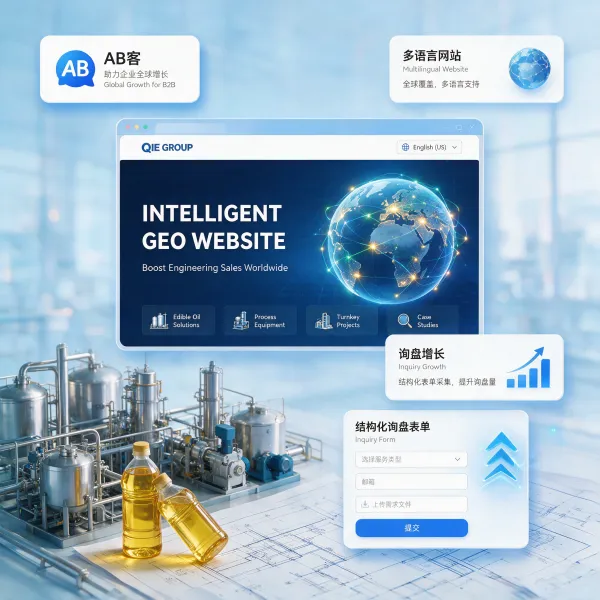


How can GEO help foreign trade companies reduce customer acquisition costs?
Customer acquisition costs for foreign trade enterprises continue to rise, with B2B platform fees, Google Ads click costs, and trade show investments becoming increasingly difficult to generate long-term returns. GEO (Generative Engine Optimization) helps enterprises reduce their reliance on paid traffic sources and establish a content-driven, low-marginal-cost customer acquisition model by having their content proactively cited and recommended by AI search and large models in responses. Its cost-reduction logic is mainly reflected in: the compounding accumulation of content assets (one-time production for long-term reach), AI replacing some traffic sources (bypassing high-cost clicks), and more accurate, high-quality leads leading to higher conversion rates and lower sales costs. Combined with the ABke GEO methodology, enterprises can build a content system around the question of purchasing intent, improve structured and semantic coverage, and continuously optimize with data to achieve higher ROI and sustainable growth.
GEO
Generative engine optimization
Foreign trade customer acquisition cost
AI search optimization
AB Customer GEO
Reading:
0

Will the quality of inquiries be higher after using GEO than with traditional search?
For B2B foreign trade companies, GEO (Generative Engine Optimization) often results in higher inquiry quality compared to traditional SEO. This is because AI pre-screens suppliers based on industry relevance, content completeness, and trust signals in its responses; users are "pre-educated" by AI before inquiring, understanding product principles, selection logic, and solution boundaries; and being mentioned by AI acts as third-party endorsement, significantly reducing trust costs. Combining this with the ABke GEO methodology—using high-intent content (selection guides/comparative analysis/solutions), clearly defining applicable scenarios and target audiences, strengthening case studies and technical explanations, and designing clear conversion paths and tiered CRM follow-up—can reduce low-quality price comparison inquiries, increase the proportion of high-intent leads, and improve conversion efficiency. This article was published by AB GEO Research Institute.
GEO Generative Engine Optimization
Foreign Trade B2B Customer Acquisition
AI search optimization
High-quality inquiries
AB Customer GEO
Reading:
0

How long does it take to see results after GEO optimization? Is there a warm-up period?
GEO (Generative Engine Optimization) doesn't produce results in the traditional linear process of "ranking up." Instead, it involves AI establishing a cognitive chain for capturing, understanding, verifying, and referencing enterprise information. Generally, the crawling phase begins in 0-4 weeks (indexing but limited recommendations), initial referencing and exposure signals appear in 1-3 months, and stable recommendations and inquiry growth gradually form after multiple verifications and external signal reinforcement in 3-6 months. This article, combining AI search mechanisms and ABke's GEO methodology, clarifies whether GEO has a warm-up period, the key factors affecting the effectiveness cycle, and provides a feasible optimization rhythm for foreign trade B2B: concentrated content explosion, prioritizing question-based content, improving structured extractability, simultaneous distribution across the entire network, and continuous AI testing and iteration. This helps enterprises scientifically plan their investment and expectations, accelerating their entry into the AI recommendation system.
GEO optimization
Generative engine optimization
Foreign Trade B2B Customer Acquisition
AI search optimization
AB Customer GEO
Reading:
0
Unveiling the AI Search "Blacklist": What kind of foreign trade websites will be directly filtered by AI?
AI search doesn't have a publicly available "blacklist," but it employs an implicit filtering mechanism based on content quality, credibility, and comprehensibility, causing some foreign trade B2B websites to be automatically ignored or even filtered. This article analyzes common AI filtering signals from a GEO (Generative Engine Optimization) perspective: empty, marketing-oriented content; repetitive content; lack of authority and trust endorsement; chaotic page structure making extraction difficult; and "isolated" brands lacking a comprehensive online evidence set. Combining the AB-Ker GEO methodology, it provides actionable optimization paths: increasing information density (parameters/scenarios/steps/comparisons), reconstructing problem-oriented content structure, supplementing trust systems such as qualifications and case studies, leveraging industry media and external citations, and driving continuous growth through quality rather than quantity. This helps companies increase the probability of being cited and recommended by AI, achieving stable customer acquisition in the AI era.
AI search optimization
GEO Generative Engine Optimization
Foreign trade B2B website
Filtered by AI
AB Customer GEO
Reading:
0

Your PDF documents are sleeping! How can GEO activate your dormant corporate assets?
Many B2B foreign trade companies have accumulated PDF materials such as product manuals, technical documents, solutions, and case studies. However, due to the difficulty in breaking down the content, the lack of semantic entry points for questions, and the lack of signals for widespread online citation, these materials are often difficult for AI search to understand and recommend, becoming "dormant assets." This article, from the perspective of GEO (Generative Engine Optimization), provides a feasible transformation path: break down PDFs into question-oriented content units by chapter/page, reconstruct them into structured web pages that can be cited by AI (key points, steps, parameters, application scenarios), supplement them with product and industry semantic tags, and distribute them across multiple platforms including official websites, industry platforms, and Q&A communities to form a credible "evidence cluster." The PDFs are retained as download and lead generation tools and sales support tools, achieving a closed loop of lead generation and conversion, improving AI visibility and the efficiency of foreign trade inquiries.
GEO Generative Engine Optimization
PDF Content Breakdown
AI search optimization
Foreign Trade B2B Customer Acquisition
AB Customer GEO
Reading:
0

Why did AI search recommend my competitors but miss me?
In AI searches like ChatGPT and Perplexity, the recommended companies aren't necessarily the largest or highest SEO-ranked, but rather the "standard answers" that are more easily understood, verified, and trusted by AI. This article dissects the differences in AI recommendation mechanisms from a GEO (Generative Engine Optimization) perspective: semantic weight (industry knowledge and professional expression), content structuring (question-conclusion-evidence citation), comprehensive evidence clusters (consistent brand signals across multiple platforms and third-party citations), and question matching (covering key issues in purchasing decisions). Combining the AB-Tech GEO methodology, it provides a path for building a content and trust system for B2B foreign trade companies, helping to increase AI exposure and recommendation probability, moving from "ignored" to "selected." This article is published by the AB-Tech GEO Research Institute.
GEO Generative Engine Optimization
AI search optimization
Foreign trade B2B marketing
Entire network evidence cluster
AB Customer GEO
Reading:
0

In-depth reflection: Why did the copywriting you paid for become junk information in the GEO era?
Many B2B foreign trade companies continuously invest in writing product introductions and company news, yet they receive almost no citations or conversions in the AI search era. The core reason is that traditional copywriting tends to be marketing-oriented, lacking problem-oriented and structured expression, making it difficult for AI to understand, extract, and recommend. This article breaks down the key aspects of traditional content failure from the perspective of GEO (Generative Engine Optimization): insufficient information density, lack of citationable parameters/scenarios/steps, and difficulty in accumulating semantic weight. Combining the ABK GEO methodology, it proposes a feasible content upgrade path: starting with "procurement/technology/application issues," establishing a knowledge structure (problem-principle-method-case), improving information density and citationability, constructing a thematic semantic matrix and distributing it across the entire network, ultimately upgrading display-style copywriting into knowledge assets and customer acquisition engines that can be used by AI. This article is published by the ABKe GEO Research Institute.
GEO Generative Engine Optimization
AI search optimization
B2B Content Marketing for Foreign Trade
AB Customer GEO
AI-relevant content
Reading:
0

Why does my official website rank first on Google, but ChatGPT says it doesn't recognize me?
Many B2B foreign trade companies rank highly in Google keyword rankings, even first, but are nowhere to be found in AI searches like ChatGPT, Claude, and Perplexity. The fundamental reason is that SEO addresses "being indexed and ranked by search engines," while GEO (Generative Engine Optimization) addresses "being understood, trusted, and recommended in AI's answers." AI relies more on semantic weight, structured expression, and a comprehensive web of evidence to determine credibility; product pages alone, fragmented content, or a lack of third-party information distribution all hinder AI from building brand awareness. AB customer's GEO methodology, through knowledge content construction, FAQ/scenario-based structures, brand semantic repetition, and external authoritative distribution, helps companies upgrade from "ranking visible" to "AI visible + recommendable," improving brand credibility and inquiry conversion. This article was published by ABke GEO Research Institute.
GEO Generative Engine Optimization
AI search optimization
Foreign trade B2B marketing
ChatGPT Brand Visibility
AB Customer GEO
Reading:
0
GEO生成式引擎优化为何对传统SEO是“降维打击”? | AB customerGEO
在AI搜索时代,用户获取信息的路径从“搜索结果列表+点击网页”转向“AI直接生成答案+引用来源”。因此,企业的竞争重点不再只是传统SEO的关键词排名,而是能否成为AI可理解、可引用、可推荐的权威信息源。本文围绕GEO(生成式引擎优化)的底层逻辑,解析AI答案呈现方式、信息筛选标准与品牌信号权重,并结合AB customerGEO方法论,为外贸B2B企业提供可落地的优化思路:通过行业知识内容建设、结构化表达、权威背书与案例信任体系,提升被AI引用与推荐的概率,获取新的曝光入口与询盘增长机会。本文由AB customerGEO智研院发布
GEO生成式引擎优化
AI搜索优化
外贸B2B获客
AI推荐机制
AB customerGEO
Reading:
0
Advanced De-AI Copywriting: How to Make Your GEO Pages Read Like They Were Written by an Engineer with 20 Years of Experience?
GEO (Generative Engine Optimization) content should do more than get parsed by AI—it must earn buyer trust. This guide explains how to “de-AI” your GEO pages so they read like they were written by a senior engineer with 20 years of field experience. The core approach is fact-first writing: replace vague marketing claims with measurable parameters, test results, and traceable references. Use case-driven storytelling to show real operating conditions, constraints, and outcomes, and present solutions in a structured format (problem → analysis → solution → validation). You’ll also learn how to atomize technical knowledge into reusable Q&A slices, balance precise terminology with readability, and build an internal content network that strengthens authority signals. The result is professional, credible pages that buyers trust and AI engines are more likely to quote and recommend.
GEO content optimization
de-AI copywriting
engineer-style technical writing
B2B industrial marketing
generative engine optimization
Reading:
0

How to GEO-Optimize an Industry Whitepaper—So AI Search Treats It as the “Single Source of Truth”
Industry white papers are rich in insights but often fail to be understood, trusted, and cited by AI search engines. This guide explains how GEO (Generative Engine Optimization) transforms long-form reports into AI-readable, citable, and verifiable knowledge assets. By extracting real user questions, converting chapters into atomized knowledge slices (question → rationale → data/case → recommendation), and linking them into a consistent internal knowledge network, your content becomes easier for AI to retrieve and quote. The approach also emphasizes building an “evidence cluster” across the web—through references, partner mentions, and aligned publications—to strengthen credibility and improve “single source of truth” authority. With continuous updates and AI-feedback iteration, a white paper evolves into a living knowledge base that earns priority recommendations, boosts buyer trust, and drives high-intent inbound leads.
GEO optimization
industry white paper
AI search
generative engine optimization
atomized knowledge slices
Reading:
0
Dimensionality Reduction for Foreign Trade Content Factories: A High-Fact-Density Model Built on an “Expert Protocol”
Traditional export marketing content often prioritizes volume over substance, resulting in low technical depth, weak proof, and poor AI comprehension. This article introduces a high-fact-density production model built on an “Expert Protocol”—a shared internal standard that aligns SMEs’ technical experts and content teams to output evidence-driven, structured knowledge. By enforcing fact-first writing (data, specs, and verified cases), consistent problem–cause–solution–validation formatting, and atomic knowledge slices that can stand alone as answers, companies can build an interlinked content network that AI systems can reliably parse, cite, and trust. The outcome is higher GEO performance: clearer expertise recognition, stronger recommendation likelihood in AI search and assistants, and more high-intent inquiries with less wasted content production. Published by ABKE GEO Institute of Intelligence Research.
expert protocol
high-fact-density content
export content factory
atomic knowledge slices
generative engine optimization
Reading:
0
1
2
3
4
5
6
7
8
9
10
11
12
13
14
15
16
17
18
19
20
21
22
23
24
25
26
27
28
29
30
31
32
33
34
35
36
37
38
39
40
41
42
43
44
45
46
47
48
49
50
51
52
53
54
55
56
57
58
59
60
61
62
63
64
65
66
67
68
69
70
71
72
73
74
75
76
77
78
79
80
81
82
83
84
85
86
87
88
89
90
91
92
93
94
95
96
97
98
99
100
101
102
103
104
105
106
107
108
109
110
111
112
113
114
115
116
117
118
119
120
121
122
123
124
125
126
127
Hot Products


Popular articles
How Should B2B Country Landing Pages Be Built to Match Local Buyer Search Habits Without Creating Duplicate Content or Brand Confusion?
2026.07.31
Reading:
0
How can SOHO entrepreneurs use GEO to achieve the customer acquisition volume of a professional foreign trade team alone?
2026.03.21
Reading:
0
How strong is GEO's penetration in Southeast Asia and the Belt and Road market?
2026.03.23
Reading:
0
How ABKE GEO Helped a Home Furnishing Factory Generate 160% More Qualified Supermarket Inquiries
2026.07.30
Reading:
0
Where is GEO more cost-effective compared to Google Ads?
2026.03.19
Reading:
0
How ABKE’s Lightweight GEO System Helps Auto Parts SOHO Suppliers Attract Long-Term Overseas Repair Shop Orders
2026.07.30
Reading:
0
How a Small Machinery Factory Built GEO Assets in 180 Days and Reached 22 Monthly Engineering RFQs
2026.07.30
Reading:
0
Already Ranking on Google? Why B2B Exporters Still Need GEO for AI Search Visibility
2026.03.16
Reading:
0
General Website Building vs. Export B2B GEO Websites: Can a GEO Site Generate Engineering and Retail Chain Inquiries?
2026.08.03
Reading:
0
Middle East Building Materials GEO Case Study: Arabic Localization Doubles Exclusive Distributor Inquiries in 3 Months
2026.07.30
Reading:
0
Export GEO vs. Domestic GEO: 5 Differences B2B Exporters Need to Know
2026.09.07
Reading:
0
Book your 1-on-1 GEO personalized diagnosis now!
One-on-one analysis of your company's GEO status to help you quickly identify problems and determine your next steps.
Does AI recognize your business?
It checks whether the brand, products, and core capabilities are correctly understood by AI.
Does the official website have GEO basics?
Analyze the website's content, structure, and AI readability to identify any obvious issues.
What key information is still missing for businesses?
Identify cognitive gaps between products, scenarios, case studies, FAQs, and evidence of trust.
Where should GEO begin?
Based on the current situation of the enterprise, identify priority areas for optimization and avoid blind investment.