


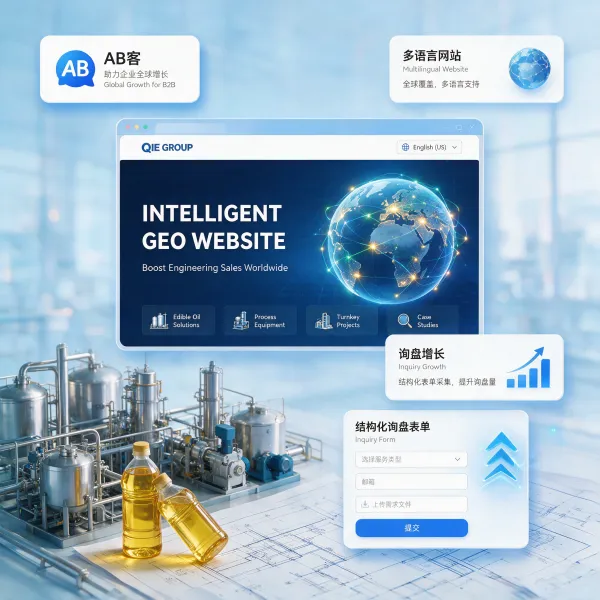


How long does it take for GEO to show results?
Generative Engine Optimization (GEO) is a content-driven, long-term strategy designed to help B2B exporters gain higher visibility and recommendations on AI search and Q&A tools like ChatGPT and Perplexity. Unlike paid advertising, GEO's effectiveness increases gradually as the AI system crawls your website, understands your products and services, and builds trust in your expertise. Early signs typically appear within 1-3 months, while steady growth usually takes 3-6 months, depending on the depth, structure, and frequency of content updates. This page explains the entire GEO lifecycle—from basic content creation (company profile, products, solutions, knowledge articles, case studies, and FAQs) to AI semantic understanding and structured parsing—so teams can plan their expectations and resources. Leveraging the ABKe GEO methodology, businesses can accelerate AI understanding by modularizing information, clarifying product/service capabilities, and publishing authoritative industry content, thereby increasing citation and recommendation likelihood and ultimately achieving sustainable exposure and high-quality inquiry growth.
Generative Engine Optimization (GEO)
AI search optimization
B2B Export Marketing
ABKe GEO
Geographic Content Strategy
Reading:
0

Can GEO quantify ROI?
GEO (Generative Engine Optimization) can quantify ROI, but its evaluation logic differs from traditional advertising, which is click-based. For B2B foreign trade companies, a data monitoring chain should be established around "AI recommendation—visit—inquiry—transaction," focusing on tracking AI exposure and citation frequency, site visit growth brought by AI recommendations, changes in inquiry volume and the proportion of valid leads, and changes in customer acquisition cost (CAC) compared to advertising/exhibitions/development emails. Through the AB-Tech GEO methodology, companies can structure and accumulate product information, industry knowledge, solutions, and customer case studies to improve AI understanding and recommendation probability, forming sustainable long-term customer acquisition assets. Furthermore, the ROI of GEO can be continuously calibrated through periodic comparisons and long-term conversion statistics. This article was published by the AB-Tech GEO Research Institute.
GEO Generative Engine Optimization
GEO ROI Quantification
AI Search Optimization for Foreign Trade B2B
AI Exposure and Recommendation Metrics
AB Customer GEO
Reading:
0

Does GEO implementation require website modification?
As AI search increasingly impacts how B2B foreign trade customers access information, more and more companies are considering whether implementing GEO (Generative Search Engine) requires a large-scale website overhaul. In reality, most companies don't need to completely rebuild their website system; the key lies in optimizing content structure, information organization, and page theme expression. By supplementing content with industry Q&A, application scenario explanations, technical principle analyses, and internal link layout, company websites can better adapt to generative search engine optimization requirements, increasing their chances of being understood and referenced by AI search. This article analyzes the necessity of website transformation and provides more feasible optimization paths, focusing on GEO, AI search optimization, and content construction for B2B foreign trade websites.
GEO
Generative engine optimization
Foreign trade B2B
AI search optimization
Website content structure optimization
Reading:
0
How does a company's website content affect AI understanding?
Corporate website content is a crucial entry point for AI to understand a brand, products, and industry. The clarity of the page structure, the completeness of the information, the professionalism of the content, and the verifiability of case studies all directly impact AI's semantic analysis, credibility assessment, and recommendation probability. This article systematically analyzes how corporate website content influences AI understanding, focusing on AI search and recommendation mechanisms. Combining the AB-Kee GEO methodology, it proposes content optimization solutions suitable for B2B foreign trade companies. These solutions include modular content architecture, hierarchical title design, professional article layout, supplementation with case studies and application scenarios, and information consistency. These solutions help companies improve AI search optimization performance and enhance their recognition and recommendation opportunities in generative search engines such as ChatGPT and Perplexity.
GEO
Generative engine optimization
Foreign trade B2B
AI search optimization
AB Customer GEO
Reading:
0

How Enterprises Can Build AI Semantic Content for GEO and AI Search
In the era of AI search, enterprise content must go beyond keyword placement and provide clear semantic structure that helps AI understand the relationship between products, technologies, and application scenarios. This article explains how enterprises, especially export-oriented B2B companies, can build AI semantic content by organizing product pages, technical explanations, industry use cases, and customer-focused Q&A content. With a structured approach to GEO (Generative Engine Optimization), businesses can create web content that is easier for AI systems to interpret, extract, and cite in generated answers. By connecting product information with technical knowledge and real-world applications, companies can improve content visibility, strengthen topical authority, and increase the likelihood of being referenced in AI-driven search environments. AB customerGEO’s methodology also provides a practical framework for developing a scalable semantic content system that aligns with how modern AI engines process web information.
AI semantic content
GEO optimization
AI search optimization
B2B content strategy
generative engine optimization
Reading:
0
How GEO (Generative Engine Optimization) Shapes Brand Building in AI Search
GEO (Generative Engine Optimization) is increasingly reshaping how brands are built in an AI-driven search environment. As buyers rely on AI to research industries, compare solutions, and shortlist suppliers, brand perception is formed through what AI understands, cites, and recommends—not only through ads or traditional visibility. By organizing a clear knowledge base (products, applications, solutions, FAQs, and case studies) and publishing structured, expert content on the website, companies improve AI discoverability, gain more industry visibility, and build credibility through repeated AI citations. GEO also influences early-stage decision making, helping brands enter the buyer’s consideration set before direct supplier contact. In short, GEO supports long-term brand recognition by turning expertise into AI-referenced authority.
Generative Engine Optimization
GEO strategy
AI search branding
B2B brand building
AI content optimization
Reading:
0
Why will customers increasingly rely on AI to find suppliers in the future?
As AI search gradually becomes a global information gateway, competition among businesses is also changing. In the future, companies that can enable AI to understand and utilize their knowledge content will find it easier to gain exposure when customers are searching for suppliers. By systematically building corporate knowledge assets and structured content, companies can gradually increase their visibility and recommendation probability in AI search.
GEO optimization
AB Customer GEO
AI Search
supplier
Generative engine optimization
Reading:
0
What is the role of GEO in foreign trade marketing?
As AI search gradually becomes a global information gateway, competition among foreign trade enterprises is also changing. Companies that can enable AI to understand and continuously utilize its knowledge content are more likely to gain exposure in the early stages of customer decision-making. The value of GEO lies in helping companies build this long-term, accumulative global awareness.
GEO optimization
AB Customer GEO
Foreign trade marketing
Generative engine optimization
Reading:
0
Is GEO suitable for small and medium-sized enterprises?
In the era of AI search, business competition no longer depends solely on size or brand, but increasingly on whether a company's knowledge can be understood and utilized by AI. For SMEs, systematically organizing industry knowledge and solutions can gradually build professional expertise in an AI environment, thereby attracting more potential customers.
GEO optimization
AB customer
Small and Medium Enterprises
Generative engine optimization
Reading:
0
Is GEO Right for Traditional Manufacturing Companies? A Practical Guide to AI Search Visibility
Generative Engine Optimization (GEO) is highly relevant for traditional manufacturing companies because AI search engines favor clear, trustworthy technical knowledge. Manufacturers already own the most “AI-citable” assets—product structures, specifications, processes, application scenarios, troubleshooting FAQs, and real project cases—but these insights are often not systematized online. By organizing engineering know-how into structured, searchable content and turning the website into a knowledge hub, manufacturers can improve AI search visibility, earn credibility, and get discovered when buyers ask solution-oriented questions. A practical GEO approach includes building a knowledge base, publishing application and selection guidance, documenting case studies, and continuously expanding content so AI systems can reliably reference the brand as an authoritative source.
generative engine optimization
GEO for manufacturing
AI search visibility
manufacturing knowledge base
industrial technical content
Reading:
0
Is GEO (Generative Engine Optimization) Only for Tech Companies?
Generative Engine Optimization (GEO) is not limited to technology companies. Any business with clear products, services, or industry solutions can be recommended by AI search when it builds structured, explainable knowledge assets. In AI-driven discovery, engines prioritize whether a company clearly defines what it offers, explains real-world use cases and solution workflows, and provides credible examples such as FAQs, selection guides, and customer cases. This makes GEO highly relevant for manufacturers, trading companies, service providers, and solution integrators—even if they don’t publish “technical” content. While tech firms may start faster because specifications and technical explanations are naturally structured, non-tech organizations can achieve strong GEO performance by organizing their industry expertise into searchable, citable content that AI can understand and reference.
generative engine optimization
GEO strategy
AI search optimization
B2B knowledge content
structured knowledge assets
Reading:
0

Where Does GEO Fit in the Enterprise Marketing System?
In the era of AI search and large language models, customer journeys are shifting from “search–browse–compare” to “ask AI–get recommendations–verify on the website.” GEO (Generative Engine Optimization) therefore becomes a long-term cognitive infrastructure inside the enterprise marketing system: it helps AI understand, verify, and cite a company’s capabilities so the brand can enter AI recommendation lists before prospects reach the website. AB customerGEO provides a systematic path to turn scattered brand, product, solution, and case information into AI-readable, verifiable knowledge assets—upgrading the official site into a stable citation source, building an industry Q&A semantic library, and ensuring consistent messaging across channels. With continuous measurement of AI mentions, citations, and lead signals, companies can improve AI visibility and recommendation probability over time, creating compounding growth beyond traditional SEO, content marketing, and advertising.
Generative Engine Optimization (GEO)
AI search optimization
AB customerGEO
enterprise knowledge base
AI recommendation visibility
Reading:
0
1
2
3
4
5
6
7
8
9
10
11
12
13
14
15
16
17
18
19
20
21
22
23
24
25
26
27
28
29
30
31
32
33
34
35
36
37
38
39
40
41
42
43
44
45
46
47
48
49
50
51
52
53
54
55
56
57
58
59
60
61
62
63
64
65
66
67
68
69
70
71
72
73
74
75
76
77
78
79
80
81
82
83
84
85
86
87
88
89
90
91
92
93
94
95
96
97
98
99
100
101
102
103
104
105
106
107
108
109
110
111
112
113
114
115
116
117
118
119
120
121
122
123
124
125
126
127
Hot Products


Popular articles
How Should B2B Country Landing Pages Be Built to Match Local Buyer Search Habits Without Creating Duplicate Content or Brand Confusion?
2026.07.31
Reading:
0
How can SOHO entrepreneurs use GEO to achieve the customer acquisition volume of a professional foreign trade team alone?
2026.03.21
Reading:
0
How strong is GEO's penetration in Southeast Asia and the Belt and Road market?
2026.03.23
Reading:
0
How ABKE GEO Helped a Home Furnishing Factory Generate 160% More Qualified Supermarket Inquiries
2026.07.30
Reading:
0
Where is GEO more cost-effective compared to Google Ads?
2026.03.19
Reading:
0
How ABKE’s Lightweight GEO System Helps Auto Parts SOHO Suppliers Attract Long-Term Overseas Repair Shop Orders
2026.07.30
Reading:
0
How a Small Machinery Factory Built GEO Assets in 180 Days and Reached 22 Monthly Engineering RFQs
2026.07.30
Reading:
0
Already Ranking on Google? Why B2B Exporters Still Need GEO for AI Search Visibility
2026.03.16
Reading:
0
General Website Building vs. Export B2B GEO Websites: Can a GEO Site Generate Engineering and Retail Chain Inquiries?
2026.08.03
Reading:
0
Middle East Building Materials GEO Case Study: Arabic Localization Doubles Exclusive Distributor Inquiries in 3 Months
2026.07.30
Reading:
0
Export GEO vs. Domestic GEO: 5 Differences B2B Exporters Need to Know
2026.09.07
Reading:
0
Book your 1-on-1 GEO personalized diagnosis now!
One-on-one analysis of your company's GEO status to help you quickly identify problems and determine your next steps.
Does AI recognize your business?
It checks whether the brand, products, and core capabilities are correctly understood by AI.
Does the official website have GEO basics?
Analyze the website's content, structure, and AI readability to identify any obvious issues.
What key information is still missing for businesses?
Identify cognitive gaps between products, scenarios, case studies, FAQs, and evidence of trust.
Where should GEO begin?
Based on the current situation of the enterprise, identify priority areas for optimization and avoid blind investment.