


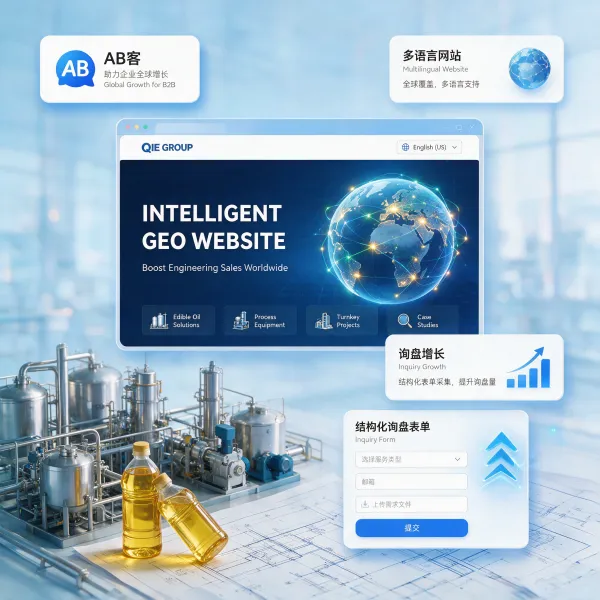


A major OEM manufacturer's digital awakening: Retrieving high-net-worth customers lost in AI searches through GEO
Many OEM exporters have not lost customers—they have lost the “discovery entrance” in AI search. As high-value B2B buyers increasingly use generative AI to shortlist suppliers, manufacturers with generic website copy (e.g., “OEM service”, “factory”) are often excluded from AI recommendations. GEO (Generative Engine Optimization) rebuilds visibility by turning manufacturing capabilities into answer-ready content: clearly describing processes, equipment, tolerances, capacity, certifications, and QC; expanding coverage across industry applications; and creating problem-based assets such as FAQs, selection guides, and comparison pages. By strengthening structured mentions across multiple pages and contexts, OEM brands re-enter the buyer’s decision path and attract fewer but more qualified inquiries. Published by ABKE GEO Research Institute.
GEO
AI search optimization
OEM manufacturer marketing
B2B lead generation
generative engine visibility
Reading:
0

When a purchaser asks, "Who are the experts in this field?", why did AI choose this little-known factory?
In B2B export trade, AI engines decide “who is an expert” based less on brand awareness and more on structured, verifiable evidence across the web. This article explains why a low-profile factory can be recommended over famous suppliers: it consistently answers buyer questions with measurable specs, constraints, comparisons, and application details, and it repeats the same professional positioning across multiple pages. We break down the three core expert signals in Generative Engine Optimization (GEO)—question coverage, information specificity, and consistent mentions—and provide practical steps to strengthen expert recognition through FAQ clusters, selection guides, use-case documentation, and unified semantic tagging. The goal is not to claim expertise, but to make expertise legible to AI through high-quality, consistent content architecture. This article is published by ABKE GEO Research Institute.
Generative Engine Optimization
GEO for B2B
AI search optimization
expert signals
B2B supplier marketing
Reading:
0

Manufacturing Transformation Log: How GEO Builds a Technical Moat and Helps You Exit Destructive Price Wars
In B2B manufacturing and export markets, price wars often start when buyers can’t clearly judge technical differences. In an AI-search era, the problem is no longer whether you have real advantages—it’s whether AI can accurately explain those advantages before a prospect contacts you. This article explains how GEO (Generative Engine Optimization) helps manufacturers create a “technical moat” by rebuilding high-density technical content and stable multi-page mentions. Key methods include upgrading product pages from basic specs to a structured format (principle + parameters + applications + constraints), publishing selection and comparison guides for different materials/specs and use cases, adding industry-specific application cases to validate performance, and standardizing terminology across pages to form consistent semantics. When AI can synthesize your technical logic across decision scenarios, buyers shift from price-only comparisons to solution-fit evaluation—reducing price sensitivity and improving lead quality. Published by ABKE GEO Research Institute.
GEO
generative engine optimization
B2B manufacturing exports
AI search optimization
technical content strategy
Reading:
0

How a 3-Person B2B Export Team Used GEO to Beat Top-3 Giants in a Niche
In B2B export marketing, small teams don’t lose because they lack traffic tools—they lose because they rarely become the “recommended answer.” In AI search and generative engines, only a few sources are cited, and selection is driven by query-fit and information completeness rather than brand size. This article explains how a 3-person team can win a niche by using GEO (Generative Engine Optimization): pick one high-value application scenario, build a focused question matrix (selection, specs, comparisons, FAQs), publish compact but complete pages with strong parameter and use-case depth, and reinforce consistent terminology across multiple pages to increase citation probability. The core shift is from budget scale to corpus efficiency—turning limited resources into dense, structured, reusable content that AI can easily retrieve and recommend. Published by ABKE GEO Research Institute.
Generative Engine Optimization (GEO)
B2B export marketing
AI search optimization
niche B2B SEO
GEO content strategy
Reading:
0

Why haven't your technological advantages been captured by AI? Discuss semantic weights in GEO.
Many B2B foreign trade companies possess advantages in patents, processes, and performance, yet they are "absent" from AI search and recommendation. The root cause is often not a lack of technology, but rather the absence of "semantic weight" in their technical expressions that allows the model to recognize and reference them. This article analyzes how GEO (Generative Engine Optimization) helps AI assess a company's capabilities through frequency of occurrence, semantic concentration, and authoritative sources. It also provides a practical path based on the AB-Ke GEO methodology: structurally breaking down technological advantages into principles, parameters, scenarios, and comparative content; consistently reusing core terminology across multiple pages and content formats to increase concentration; establishing source endorsement through case studies, certifications, and data; and forming stable perception through a "brand + technology" binding. Ultimately, this allows AI to see, remember, and recommend the company's technological strength, improving the conversion rate of accurate inquiries. This article is published by the AB-Ke GEO Research Institute.
GEO
Semantic weight
Generative engine optimization
AI Search Optimization for Foreign Trade B2B
AB Customer GEO
Reading:
0

From 0 inquiries to being prioritized by Perplexity: A hardware factory's GEO turnaround journey
This case study explains how an export-oriented hardware manufacturer (hinges and connectors) went from years of near-zero inquiries to being cited—and sometimes prioritized—by AI search tools such as Perplexity, without increasing ad spend. The key shift was rebuilding the site from a “showcase website” into an “answer-ready corpus”: enriching product pages with technical specs, materials, tolerances, and use scenarios; expanding content around buyer questions (selection, outdoor suitability, industry fit); and standardizing naming and specs across multiple pages to form a consistent mention structure. In AI-driven search, citation and preference often go to the most complete, coherent, and reusable information. The result was steady, higher-quality inquiries and a shorter sales cycle. Published by AB customerGEO Research Institute.
Generative Engine Optimization (GEO)
AI search optimization
B2B export marketing
hardware hinges manufacturer
Perplexity citation
Reading:
0

Why is GEO said to be the "life-saving talisman" for obtaining foreign trade customers in the next five years?
In global B2B trade, customer acquisition is shifting fast from traditional SEO and marketplace listings to AI search and generative recommendations. As answer engines compress results into only a few suggested suppliers, companies that are not included in AI-readable corpora may lose visibility even if their websites rank well. GEO (Generative Engine Optimization) helps exporters build “AI-recommendable” presence by creating question-led content, increasing information density with specs, scenarios and proof, and establishing consistent semantic links between brand, products and industry terms across multiple assets. The goal is to move from traffic competition to corpus competition—so your company is continuously cited and recommended when buyers ask AI for solutions. This article is published by AB Guest GEO Institute of Intelligence Research.
Generative Engine Optimization (GEO)
AI search optimization
B2B export lead generation
AI-recommended suppliers
export marketing strategy
Reading:
0

Where is GEO more cost-effective compared to Google Ads?
In B2B export marketing, Google Ads primarily “buys traffic” through bidding, delivering fast clicks but limited long-term trust and compounding costs once spend stops. GEO (Generative Engine Optimization) focuses on being “chosen” in AI-driven search by building reusable content assets and an entity/mention footprint that AI systems can cite as credible sources. By converting high-intent ad keywords into FAQs, technical guides, and case-based pages, brands improve citability, increase recommendation frequency in AI answers, and attract higher-quality leads with stronger purchase intent. A hybrid approach works best: use Google Ads for rapid market validation and short-term demand capture, then reinvest winning queries into GEO content to reduce dependency on paid media and lower customer acquisition cost over time. GEO’s advantage is a better cost per trust and a more stable pipeline as AI recommendations compound.
Generative Engine Optimization (GEO)
Google Ads
B2B lead generation
AI search optimization
export marketing
Reading:
0

Key Pain Point: Why does AI always provide outdated information and fail to update your current status?
Many B2B foreign trade companies have upgraded their products, adjusted their positioning, or expanded their markets, yet customers still receive introductions and recommendations for older models from several years ago when searching with AI. The root cause is that AI doesn't "automatically follow company dynamics." It prefers stable, verifiable, easily accessible, and widely cited sources. If new content lacks structured expression, cross-platform consistency, and authoritative endorsement, it struggles to form sufficient signal strength and semantic binding, causing AI to naturally rely on old perceptions. This article dissects the mechanism and source preferences of AI information updates from a GEO (Generative Engine Optimization) perspective and presents the ABke GEO method: converting news updates into citationable knowledge, synchronizing across multiple platforms, strengthening the semantic association between brand, product, and capability, establishing a continuous update rhythm, and conducting regular AI verification. This helps companies improve information timeliness and AI cognitive update capabilities, achieving more accurate recommendations and customer acquisition.
GEO Generative Engine Optimization
AI Information Updates
AI source management
AI Search Optimization for Foreign Trade B2B
AB Customer GEO
Reading:
0

Can GEO optimization be quantified through data? What are the indicators?
In B2B export marketing, GEO (Generative Engine Optimization) can be measured—but not with traditional SEO metrics like rankings or raw traffic. As AI search engines generate direct answers instead of link lists, the key question becomes whether your brand is mentioned, cited, and correctly matched to high-intent queries. This guide outlines a practical GEO measurement framework across three layers: corpus-level indicators (content volume, scenario coverage, information density), mention-level indicators (brand/product mention rate, position in recommendations, accuracy and stability), and conversion-level indicators (AI-attributed inquiries, lead quality, and deal impact). It also recommends building a repeatable “question test library” to track changes over time and connect content coverage to AI visibility. This article is published by ABKE GEO Institute of Intelligence Research.
GEO optimization
generative engine optimization
AI search visibility
brand mentions
B2B lead conversion
Reading:
0
How Much Can GEO Improve Global Brand Awareness?
In global B2B trade, brand awareness is shifting from impressions to AI-driven mentions. Generative Engine Optimization (GEO) helps brands enter the global content corpus so AI search and assistants can repeatedly cite the company name, products, and differentiators—even when website traffic does not spike. This approach focuses on building multi-scenario content (applications, selection guides, comparisons, FAQs), strengthening brand–keyword associations, and keeping messaging consistent across pages and channels to improve model confidence. By increasing content “quotability” through structured specifications, case studies, and clear answers, GEO creates persistent visibility at the moment buyers ask technical questions. Ultimately, GEO supports “search-time branding”: your brand is discovered and recommended when customers query AI, enabling sustainable awareness growth worldwide. Published by ABKE GEO Zhiyan Institute.
Generative Engine Optimization (GEO)
AI search optimization
B2B brand awareness
AI mentions and citations
global content corpus
Reading:
0
Why GEO Builds Trust Before the First Meeting in B2B Export Sales
In B2B international trade, buyer decisions increasingly start inside AI search—before any email, call, or meeting. This article explains how Generative Engine Optimization (GEO) helps prospects pre-qualify suppliers and build trust early through multi-source consistency, broader query coverage, and high-specificity content. When your company’s capabilities, specifications, certifications, delivery workflow, and real application cases are repeatedly referenced across pages and channels, AI systems treat you as a reliable source and surface you more often in generated answers. GEO shifts trust-building from sales conversations to “being cited” by AI: unify product naming and technical parameters, publish problem-led FAQs and selection guides, and add verifiable proof points that reduce perceived risk. The result is clearer inbound inquiries, shorter sales cycles, and higher conversion efficiency—because prospects arrive already informed and confident in your credibility.
Generative Engine Optimization (GEO)
AI search optimization
B2B trust building
international trade lead generation
ABKE GEO
Reading:
0
1
2
3
4
5
6
7
8
9
10
11
12
13
14
15
16
17
18
19
20
21
22
23
24
25
26
27
28
29
30
31
32
33
34
35
36
37
38
39
40
41
42
43
44
45
46
47
48
49
50
51
52
53
54
55
56
57
58
59
60
61
62
63
64
65
66
67
68
69
70
71
72
73
74
75
76
77
78
79
80
81
82
83
84
85
86
87
88
89
90
91
92
93
94
95
96
97
98
99
100
101
102
103
104
105
106
107
108
109
110
111
112
113
114
115
116
117
118
119
120
121
122
123
124
125
126
127
128
129
130
131
132
133
134
135
136
137
138
139
140
141
142
143
144
145
146
147
148
149
150
151
152
153
154
155
156
157
158
159
160
161
162
163
164
165
166
167
168
169
170
171
172
173
174
175
176
177
178
179
180
181
182
183
184
185
186
187
188
189
190
191
192
193
194
195
196
197
198
199
200
201
202
203
204
205
206
207
208
209
210
211
212
213
214
215
216
217
218
219
220
221
222
223
224
225
226
227
228
229
230
231
232
233
234
235
236
237
238
239
240
241
242
243
244
245
246
247
248
249
250
251
252
253
254
255
256
257
258
259
260
261
262
263
264
265
266
267
268
269
270
271
272
273
274
275
276
277
278
279
280
281
282
283
284
285
286
287
288
289
Popular articles
How Should B2B Country Landing Pages Be Built to Match Local Buyer Search Habits Without Creating Duplicate Content or Brand Confusion?
2026.07.31
Reading:
0
How can SOHO entrepreneurs use GEO to achieve the customer acquisition volume of a professional foreign trade team alone?
2026.03.21
Reading:
0
How ABKE GEO Helped a Home Furnishing Factory Generate 160% More Qualified Supermarket Inquiries
2026.07.30
Reading:
0
How strong is GEO's penetration in Southeast Asia and the Belt and Road market?
2026.03.23
Reading:
0
Where is GEO more cost-effective compared to Google Ads?
2026.03.19
Reading:
0
How ABKE’s Lightweight GEO System Helps Auto Parts SOHO Suppliers Attract Long-Term Overseas Repair Shop Orders
2026.07.30
Reading:
0
How a Small Machinery Factory Built GEO Assets in 180 Days and Reached 22 Monthly Engineering RFQs
2026.07.30
Reading:
0
Already Ranking on Google? Why B2B Exporters Still Need GEO for AI Search Visibility
2026.03.16
Reading:
0
General Website Building vs. Export B2B GEO Websites: Can a GEO Site Generate Engineering and Retail Chain Inquiries?
2026.08.03
Reading:
0
Middle East Building Materials GEO Case Study: Arabic Localization Doubles Exclusive Distributor Inquiries in 3 Months
2026.07.30
Reading:
0
Export GEO vs. Domestic GEO: 5 Differences B2B Exporters Need to Know
2026.09.07
Reading:
0
Book your 1-on-1 GEO personalized diagnosis now!
One-on-one analysis of your company's GEO status to help you quickly identify problems and determine your next steps.
Does AI recognize your business?
It checks whether the brand, products, and core capabilities are correctly understood by AI.
Does the official website have GEO basics?
Analyze the website's content, structure, and AI readability to identify any obvious issues.
What key information is still missing for businesses?
Identify cognitive gaps between products, scenarios, case studies, FAQs, and evidence of trust.
Where should GEO begin?
Based on the current situation of the enterprise, identify priority areas for optimization and avoid blind investment.