.png?x-oss-process=image/resize,h_100,m_lfit/format,webp)

.png?x-oss-process=image/resize,m_lfit,w_200/format,webp)



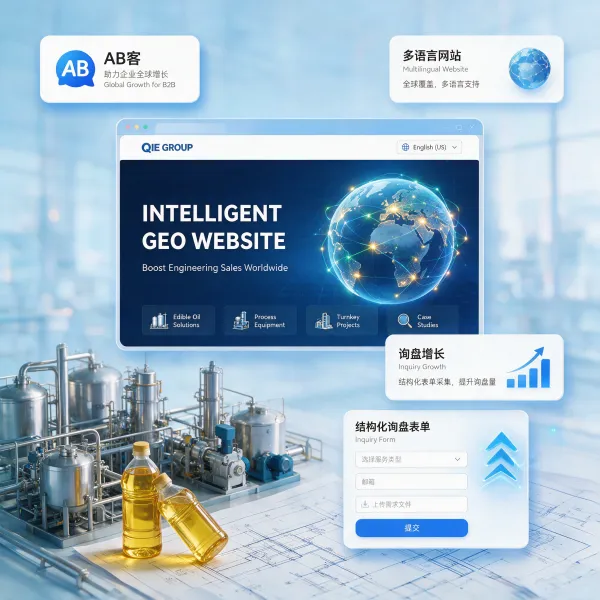



How long will it take to implement GEO?
Generative Engine Optimization (GEO) is a long-term content-driven strategy designed to help AI search engines and question-answering engines understand, reference, and recommend your business. For most B2B exporters, GEO typically shows initial results within 1-3 months and stabilizes within 3-6 months, depending on the depth, structure, and update frequency of the content. This page outlines a practical timeline for GEO: (1) Content Foundation (1-4 weeks): Organizing company information, products, solutions, industry knowledge, and case studies; (2) AI Recognition (1-3 months): The platform crawls and semantically interprets your materials and begins limited referencing; (3) Recommendation Growth (3-6 months): As authoritative signals increase and AI recommendations grow; (4) Continuous Optimization (6+ months): Building sustainable customer acquisition assets. With the AB Customer GEO methodology, businesses can accelerate AI understanding through modular information architecture, clear headlines, scenario-based content, and continuous iteration, thereby predictably increasing exposure and lead conversion rates over time.
Generative engine optimization
AI search optimization
B2B Export Marketing
AB Customer GEO
Reading:0

How long does it take for GEO to show results?
Generative Engine Optimization (GEO) is a content-driven, long-term strategy designed to help B2B exporters gain higher visibility and recommendations on AI search and Q&A tools like ChatGPT and Perplexity. Unlike paid advertising, GEO's effectiveness increases gradually as the AI system crawls your website, understands your products and services, and builds trust in your expertise. Early signs typically appear within 1-3 months, while steady growth usually takes 3-6 months, depending on the depth, structure, and frequency of content updates. This page explains the entire GEO lifecycle—from basic content creation (company profile, products, solutions, knowledge articles, case studies, and FAQs) to AI semantic understanding and structured parsing—so teams can plan their expectations and resources. Leveraging the ABKe GEO methodology, businesses can accelerate AI understanding by modularizing information, clarifying product/service capabilities, and publishing authoritative industry content, thereby increasing citation and recommendation likelihood and ultimately achieving sustainable exposure and high-quality inquiry growth.
Generative Engine Optimization (GEO)
AI search optimization
B2B Export Marketing
ABKe GEO
Geographic Content Strategy
Reading:0

Can GEO quantify ROI?
GEO (Generative Engine Optimization) can quantify ROI, but its evaluation logic differs from traditional advertising, which is click-based. For B2B foreign trade companies, a data monitoring chain should be established around "AI recommendation—visit—inquiry—transaction," focusing on tracking AI exposure and citation frequency, site visit growth brought by AI recommendations, changes in inquiry volume and the proportion of valid leads, and changes in customer acquisition cost (CAC) compared to advertising/exhibitions/development emails. Through the AB-Tech GEO methodology, companies can structure and accumulate product information, industry knowledge, solutions, and customer case studies to improve AI understanding and recommendation probability, forming sustainable long-term customer acquisition assets. Furthermore, the ROI of GEO can be continuously calibrated through periodic comparisons and long-term conversion statistics. This article was published by the AB-Tech GEO Research Institute.
GEO Generative Engine Optimization
GEO ROI Quantification
AI Search Optimization for Foreign Trade B2B
AI Exposure and Recommendation Metrics
AB Customer GEO
Reading:0

Can GEO be implemented and launched quickly?
With AI search continuously impacting customer acquisition methods in foreign trade, an increasing number of B2B foreign trade companies are focusing on the speed of GEO implementation. In reality, generative engine optimization is not suitable for a one-time, rushed approach, but rather relies heavily on content structure, industry issue coverage, technical explanations, and case studies. This article, focusing on the foreign trade B2B scenario, outlines a feasible path for rapid GEO launch and proposes a phased deployment strategy prioritizing core product pages, articles on key industry issues, and a basic content framework. This helps companies complete the basic launch in a short period and gradually improve AI search visibility and potential customer reach efficiency through subsequent case expansion, internal link optimization, and data feedback iteration.
GEO Implementation
Generative engine optimization
Foreign trade B2B
AI search optimization
Content Deployment Strategy
Reading:0

How does GEO compare to advertising ROI?
This article compares the ROI differences between GEO (Generative Engine Optimization) and traditional advertising, pointing out that while advertising is effective quickly, it is highly dependent on budget, and its effectiveness stops once investment ceases. In contrast, GEO, centered on content assets, uses AI-driven data capture, understanding, and recommendation mechanisms to ensure continuous exposure for businesses in AI search and Q&A scenarios such as ChatGPT and Perplexity, forming a long-term, stable customer acquisition channel for B2B foreign trade. The article, combined with ABke's GEO methodology, introduces key actions such as content system construction, structured expression, industry knowledge and case study accumulation, continuous iteration, and performance evaluation, helping businesses improve AI recommendation probability, optimize customer acquisition costs and conversion efficiency, and achieve a more sustainable long-term ROI. This article was published by ABke GEO Research Institute.
GEO
Generative engine optimization
Foreign Trade B2B Customer Acquisition
AI search optimization
AB Customer GEO
Reading:0

How to Continuously Optimize GEO Projects for B2B Export Marketing
As Generative Engine Optimization (GEO) becomes increasingly important in B2B export marketing, many companies are realizing that GEO is not a one-time setup but an ongoing content operation. Continuous optimization helps businesses stay visible in AI search environments by expanding topic coverage, updating outdated pages, improving technical depth, and strengthening internal content structure. For B2B exporters, this means turning customer questions, product applications, and industry knowledge into a long-term content asset. By building a stable update workflow and refining content over time, companies can improve information completeness, strengthen topical authority, and increase the likelihood of being referenced by AI-powered search systems.
GEO optimization
B2B export marketing
AI search optimization
content operations
Generative Engine Optimization
Reading:0

Does GEO implementation require brand building?
With AI search gradually becoming a new customer acquisition channel for B2B foreign trade enterprises, the relationship between GEO implementation and brand building is receiving increasing attention. Compared to traditional SEO, which only emphasizes keywords and traffic, generative engine optimization places greater emphasis on the credibility of information sources, content consistency, industry relevance, and cross-platform consistency. Enterprises that consistently produce technical articles, case studies, and knowledge explanations related to industry issues, and establish a stable brand signal, are more likely to be recognized as reliable information sources by AI systems. This article analyzes the practical role of brand building in GEO from the perspective of AI search trust mechanisms and provides content building strategies suitable for B2B foreign trade enterprises to implement.
GEO
Generative engine optimization
Foreign trade B2B
AI search optimization
Brand Building
Reading:0
How to evaluate the effectiveness of GEO?
The evaluation of GEO (Generative Engine Optimization) should not only focus on short-term traffic, but also establish a systematic indicator system based on "AI visibility—recommendation—conversion". This article breaks down the GEO goals commonly faced by B2B foreign trade companies into five key indicators: AI exposure/mention frequency, AI recommendation frequency and citation, website visit growth from AI and search platforms, changes in inquiry and lead quality, and increased brand mentions and influence in industry issues. Furthermore, combining the AB Guest GEO methodology, it is recommended to regularly test core industry issues, track content citation paths, compare traffic and inquiry data before and after optimization, and continuously improve the structure of industry knowledge and case studies to form a sustainable and iterative AI search optimization evaluation loop, thereby increasing the probability of AI recommendations and stabilizing customer acquisition.
GEO Effect Evaluation
Generative engine optimization
AI Search Optimization Metrics
Foreign Trade B2B Customer Acquisition
AB Customer GEO
Reading:0

Does GEO implementation require data analysis?
Generative Engine Optimization (GEO) typically requires data analysis, but its focus differs from traditional SEO. For B2B foreign trade companies, GEO should prioritize key metrics such as industry issue coverage, content credibility, AI search citation likelihood, and customer inquiry sources, rather than just keyword rankings and traffic changes. This article outlines the content evaluation logic in an AI search environment, outlining the data observation mechanisms companies should establish during GEO implementation. This helps companies more scientifically assess content value and optimization effectiveness through content structure optimization, visitor behavior analysis, and potential customer feedback.
GEO
Generative engine optimization
Foreign trade B2B
AI search optimization
AB Customer GEO
Reading:0

Does GEO need multilingual content?
Against the backdrop of rapid development in AI search and generative engine optimization, whether B2B foreign trade companies need to build multilingual content depends on their target market coverage and customer search habits. For companies operating in multiple countries, multilingual pages help improve language matching accuracy and enhance content visibility and citation opportunities in local language search scenarios. This article analyzes GEO (Generative Engine Optimization), multilingual content strategies, AI search mechanisms, and practical applications for foreign trade companies, and provides actionable suggestions such as key market selection, core content translation, terminology standardization, and language structure construction to help companies build a content system more suitable for global customer acquisition.
GEO
Multilingual content
Foreign trade B2B
AI search optimization
Generative engine optimization
Reading:0

Does GEO implementation require website modification?
As AI search increasingly impacts how B2B foreign trade customers access information, more and more companies are considering whether implementing GEO (Generative Search Engine) requires a large-scale website overhaul. In reality, most companies don't need to completely rebuild their website system; the key lies in optimizing content structure, information organization, and page theme expression. By supplementing content with industry Q&A, application scenario explanations, technical principle analyses, and internal link layout, company websites can better adapt to generative search engine optimization requirements, increasing their chances of being understood and referenced by AI search. This article analyzes the necessity of website transformation and provides more feasible optimization paths, focusing on GEO, AI search optimization, and content construction for B2B foreign trade websites.
GEO
Generative engine optimization
Foreign trade B2B
AI search optimization
Website content structure optimization
Reading:0

Does GEO Require Internal Team Collaboration?
In B2B export industries, GEO implementation often depends on internal collaboration across sales, technical, marketing, and management teams. Sales teams understand customer questions and buying concerns, technical teams provide product logic and application knowledge, while marketing teams turn that expertise into structured website content. Without this coordination, many companies publish only basic product pages and miss opportunities to build industry authority in AI search. This article explains why internal collaboration matters for Generative Engine Optimization, how cross-functional content workflows improve knowledge output, and what practical steps B2B exporters can take to create a sustainable GEO content system.
GEO
Generative Engine Optimization
B2B export marketing
AI search optimization
internal content collaboration
ABKE GEO
Reading:0
1
2
3
4
5
6
7
8
9
10
11
12
13
14
15
16
17
18
19
20
21
22
23
24
25
26
27
28
29
30
31
32
33
34
35
36
37
38
39
40
41
42
43
44
45
46
47
48
49
50
51
52
53
54
55
56
57
58
59
60
61
62
63
64
65
66
67
68
69
70
71
72
73
74
75
76
77
78
79
80
81
82
83
84
85
86
87
88
89
90
91
92
93
94
95
96
97
98
99
100
101
102
103
104
105
106
107
108
109
110
111
112
113
114
115
116
117
118
119
120
121
122
123
124
125
126
127
128
129
130
131
132
133
134
135
136
137
138
139
140
141
142
143
144
145
146
147
148
149
150
151
152
153
154
155
156
157
158
159
160
161
162
163
164
165
166
167
168
169
170
171
172
173
174
175
176
177
178
179
180
181
182
183
184
185
186
187
188
189
190
191
192
193
194
195
196
197
198
199
200
201
202
203
204
205
206
207
208
209
210
211
212
213
214
215
216
217
218
219
220
221
222
223
224
225
226
227
228
229
230
231
232
233
234
235
236
237
238
239
240
241
242
243
244
245
246
247
248
249
250
251
252
253
254
255
256
257
258
259
260
261
262
263
264
265
266
267
268
269
270
271
272
273
274
275
276
277
278
Hot Products


.png?x-oss-process=image/resize,h_2000,m_lfit/format,webp)


.png?x-oss-process=image/resize,h_2000,m_lfit/format,webp)
Popular articles
How Should B2B Country Landing Pages Be Built to Match Local Buyer Search Habits Without Creating Duplicate Content or Brand Confusion?
2026.07.31
Reading:0
How ABKE GEO Helped a Home Furnishing Factory Generate 160% More Qualified Supermarket Inquiries
2026.07.30
Reading:0
How can SOHO entrepreneurs use GEO to achieve the customer acquisition volume of a professional foreign trade team alone?
2026.03.21
Reading:0
How strong is GEO's penetration in Southeast Asia and the Belt and Road market?
2026.03.23
Reading:0
Where is GEO more cost-effective compared to Google Ads?
2026.03.19
Reading:0
How ABKE’s Lightweight GEO System Helps Auto Parts SOHO Suppliers Attract Long-Term Overseas Repair Shop Orders
2026.07.30
Reading:0
How a Small Machinery Factory Built GEO Assets in 180 Days and Reached 22 Monthly Engineering RFQs
2026.07.30
Reading:0
Already Ranking on Google? Why B2B Exporters Still Need GEO for AI Search Visibility
2026.03.16
Reading:0
General Website Building vs. Export B2B GEO Websites: Can a GEO Site Generate Engineering and Retail Chain Inquiries?
2026.08.03
Reading:0
Middle East Building Materials GEO Case Study: Arabic Localization Doubles Exclusive Distributor Inquiries in 3 Months
2026.07.30
Reading:0
Export GEO vs. Domestic GEO: 5 Differences B2B Exporters Need to Know
2026.09.07
Reading:0
立即预约 1V1 GEO 专属诊断
一对一分析企业 GEO 现状,帮您快速看清问题与下一步方向
AI 是否认识您的企业?
检测品牌、产品与核心能力是否被 AI 正确理解。
官网是否具备 GEO 基础?
分析网站内容、结构及 AI 可读性是否存在明显问题。
企业还缺哪些关键信息?
找出产品、场景、案例、FAQ 与信任证据的认知缺口。
GEO 应该先从哪里开始?
结合企业现状,明确优先优化方向,避免盲目投入。