


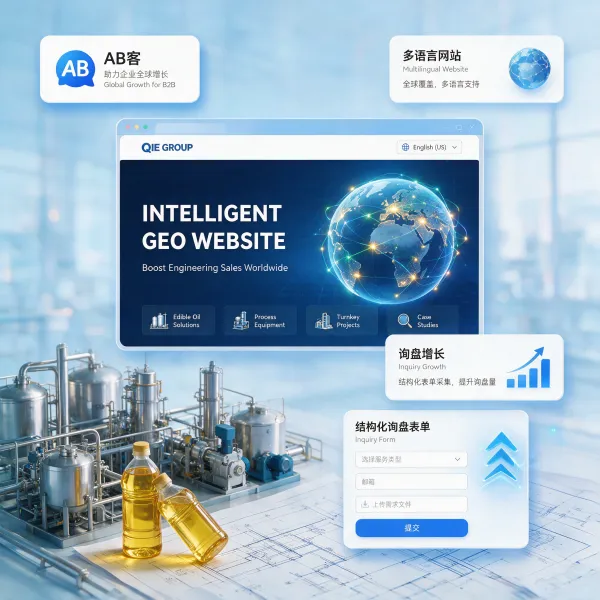


AB customer Unveils GEO: Transforming B2B Lead Generation in the AI Era
AB customer, a leader in intelligent foreign trade lead generation, has successfully launched its strategic new product, marking a comprehensive AI-era upgrade. The highlight is the introduction of the GEO (Generative Engine Optimization) cognitive system, shifting外贸 B2B lead generation from 'buying traffic' to 'nurturing cognitive assets' and entering a new era of 'cognitive asset operation'.
GEO
Generative Engine Optimization
AI B2B Lead Generation
外贸获客
AI推荐红利
Reading:
0

How to Build an AI-Friendly Knowledge Base for Foreign Trade Companies: A Practical Guide to Structured Content Asset Management
This article provides a step-by-step guide for foreign trade enterprises to transform product specifications, solutions, and case studies into structured, verifiable digital assets that are easily understood by generative AI. It covers tag system design, relationship graph construction, and standardized content expression—key technical foundations for enhancing discoverability in AI-powered search and recommendation systems. Real-world implementation steps include multilingual auto-mapping and cross-channel content distribution, ensuring higher visibility and conversion rates in B2B AI-driven customer acquisition scenarios. SEO strategies tailored for both traditional search engines and generative AI are also discussed to maximize long-term content value.
AI-friendly knowledge base
structured content for B2B
foreign trade digital assets
generative AI content optimization
multilingual content mapping
Reading:
0

The latest 2026 Foreign Trade GEO White Paper is released: Seize the AI recommendation dividend and break through the bottleneck of customer acquisition in foreign trade!
Download the free "2026 Authoritative First Release: Foreign Trade GEO White Paper," a deep analysis of how foreign trade B2B companies can be prioritized, trusted, and recommended through Generative Engine Optimization (GEO) in the AI era. The content covers industry trends, practical methods, case studies, and AB-Customer's Foreign Trade B2B GEO Intelligent Customer Acquisition Solution, helping companies break through customer acquisition bottlenecks and seize the AI traffic dividends of the next three years.
2026 Latest Foreign Trade GEO White Paper
The latest 2026 GEO White Paper on Foreign Trade is released for the first time.
GEO White Paper
AI Search Optimization White Paper
Foreign Trade GEO White Paper
Foreign Trade B2B Customer Acquisition
AB Customer GEO
AB Customer's Foreign Trade B2B GEO Intelligent Customer Acquisition Solution
Reading:
0

GEO线索生成:B2B外贸企业如何利用生成引擎优化精准客户触达
在B2B外贸市场,获取优质客户越来越依赖于智能工具。“GEO线索生成”是一种先进的方法,它利用生成式引擎优化(GEO)技术,精准识别并触达潜在的采购决策者。通过分析企业知识资产、用户搜索意图和行业语义节点,GEO可以帮助外贸企业获得人工智能在关键问题上的推荐,从而实现高效的客户获取。借助AB customer·外贸B2B GEO智能线索生成解决方案,企业可以系统地构建品牌和产品信息,并在国际搜索和人工智能问答场景中精准触达目标客户,显著提升询盘转化率和业务增长潜力。
生成式引擎优化
B2B外贸线索生成
AI推荐逻辑
GEO线索生成
AB customerGEO
AB customer·外贸B2B GEO智能获客解决方案
Reading:
0

Why Your B2B Foreign Trade Website Needs a Dedicated Blog Section
Discover how a well-structured blog on your B2B外贸 website boosts SEO long-term lead generation, enhances user trust, and drives global traffic—especially with AI-powered multilingual content and GEO optimization. Learn why smart builders like you are turning to tools like AB customer for faster, smarter blog deployment across markets.
B2B foreign trade blog
SEO long-term lead generation
multilingual SEO optimization
GEO适配建站
AB customer智能建站
Reading:
0

AB 客· 外贸B2B GEO智能建站工具:精准获客时代的AI推荐引擎优化
在人工智能驱动的流量分配时代,ChatGPT 和 Bing AI 等推荐引擎主导着流量分配,外贸 B2B 企业如何确保其网站能够被这些大型模型识别和信任?本文深入探讨了生成式引擎优化 (GEO) 的核心原则——从结构化语义标签到多语言内容一致性,揭示了传统 SEO 的局限性以及 GEO 的突破性优势。通过真实案例研究和实用指导,本文帮助企业构建符合人工智能理解模式的内容架构,充分利用人工智能推荐的优势,并实现精准的全球客户获取。
地理优化
B2B网站建设
人工智能推荐引擎
多语言搜索引擎优化
B2B网站优化
Reading:
0

Leveraging Knowledge Bases to Help AI Understand Your B2B Export Enterprise’s Expertise: Structured Content Strategy
This guide explains how B2B export companies can build AI-readable enterprise knowledge bases to accurately showcase product advantages and professional image. It systematically covers methodologies for structured content creation, including tag systems, relationship graphs, and standardized expressions. Combining practical steps, it helps companies transform core competencies into AI-friendly digital assets and achieve multilingual automatic mapping along with multi-channel distribution. This enhances visibility and conversion in generative AI search and recommendation, enabling intelligent customer acquisition and sustainable growth.
B2B export
enterprise knowledge base
structured content creation
AI-driven customer acquisition
generative AI
Reading:
0

A 5-Step Guide to Building AI-Trusted Content Assets and GEO Customer Acquisition Systems for B2B Manufacturing Enterprises in Foreign Trade
In an era where AI search is gradually replacing traditional procurement portals, foreign trade B2B companies need to transform their knowledge and expertise into AI-understandable and trustworthy content assets. This article proposes a five-step practical approach: First, build a systematic enterprise knowledge base, structuring information such as products, solutions, cases, and technical processes; second, optimize geographical layout so that AI can prioritize recommending enterprise information to answer industry-related questions; third, deploy intelligent website construction, automatically generating geographically friendly pages from knowledge base content to achieve long-term asset accumulation; fourth, utilize dedicated AI agents and global content channels for full-link recommendations and customer outreach; fifth, streamline lead conversion, continuously collect data to optimize knowledge structure, and build a composite customer acquisition system. Through these five steps, manufacturing companies can not only enhance their exposure and credibility in the field of AI Q&A but also establish a long-term, replicable growth foundation, perfectly aligning with the entire process of AB customer·Foreign Trade B2B GEO Intelligent Customer Acquisition Solution.
Generative engine optimization
Foreign Trade B2B Customer Acquisition
AI-Trusted Content
Enterprise Knowledge Base
AB Customer GEO
AB Customer's Foreign Trade B2B GEO Intelligent Customer Acquisition Solution
GEO Customer Acquisition Practical Guide
Reading:
0

Traditional Platforms VS GEO! How does GEO break the "platform dependence" of traditional foreign trade customer acquisition?
With the platform dividend gradually fading and customer acquisition costs continuing to rise, foreign trade B2B enterprises are facing serious risks of platform dependence. This article, from the perspective of enterprise decision-makers, deeply compares the underlying customer acquisition logic of traditional foreign trade platforms and GEO (Generative Engine Optimization), analyzes how GEO, through AI recommendation mechanisms, helps enterprises build an independent customer acquisition system that does not rely on third-party platforms, and naturally leads to ABker's GEO intelligent customer acquisition solution for foreign trade B2B, helping enterprises take control of customer acquisition in the AI search era.
GEO Generative Engine Optimization
Foreign Trade B2B Customer Acquisition
AI Recommendation
AI Search
AB Customer GEO
AB Customer's Foreign Trade B2B GEO Intelligent Customer Acquisition Solution
Foreign trade platform dependence
Foreign Trade B2B GEO
Foreign Trade GEO
Reading:
0

Why is GEO the "digital ID card" for foreign trade B2B companies?
In the era of procurement decision-making dominated by generative AI such as ChatGPT and Gemini, how can foreign trade B2B enterprises be correctly identified and continuously recommended by AI? This article starts from semantic anchors and enterprise knowledge structure, systematically analyzes how GEO (Generative Engine Optimization) helps enterprises build a stable digital identity and enter the global procurement decision-making chain, and illustrates the long-term value of GEO for international customer acquisition and industry influence through practical cases.
GEO Generative Engine Optimization
Digital ID Card for Foreign Trade B2B
AI recommendation mechanism
semantic anchor
AI search optimization
GEO Foreign Trade Website
AB Customer GEO
AB Customer's Foreign Trade B2B GEO Intelligent Customer Acquisition Solution
Reading:
0
Daily Insights on Foreign Trade Website Building: Why Your Website Lacks 'Trust Buffer Pages'?
Many foreign trade websites have low conversion rates not because of the products, but the lack of 'trust buffer pages'. Before entering product pages or making inquiries, customers usually need an intermediate page to confirm three things: your professionalism, experience in similar projects, and worthiness for further communication. If a website only has a homepage and product pages, customers may leave directly due to uncertainty. In practice, 'trust buffer pages' generally include solution pages, application scenario pages, case pages, technical description pages, or FAQ pages. These pages don't directly sell products but help customers quickly understand 'what problems you're good at solving', 'if you have real - world experience', and 'if you're suitable for them'. Their function is to reduce decision - making risks rather than create sales pressure. Through AB customer's Foreign Trade B2B GEO Intelligent Customer Acquisition Solution, enterprises can unify and structure product, solution, case, and technical content into a knowledge base, and automatically generate these high - trust buffer pages. This not only improves user stay time and inquiry conversion rates but also makes it easier for AI to recognize you as a reliable, professional, and selectable answer source when recommending suppliers.
Foreign trade intelligent website building
AB customer intelligent website building
Foreign trade B2B website construction
Multilingual website building
Overseas market customer acquisition
Reading:
0

How can foreign trade enterprises "seize" AI recommendation slots and seize the benefits of the fourth Golden Window (GEO)?
In an era where AI search is replacing traditional search, B2B foreign trade enterprises are ushering in their fourth golden window. This article starts with Alibaba, SEO, and the evolution of social media dividends, and deeply analyzes how GEO (Generative Engine Optimization) helps enterprises build an AI-understandable, trustworthy, and recommendable digital identity. It also demonstrates how AB-Ke's B2B foreign trade GEO intelligent customer acquisition solution can help enterprises seize AI recommendation opportunities and achieve long-term sustainable customer acquisition.
Foreign Trade B2B GEO
AI Recommendation Slot
Generative engine optimization
GEO optimization
AI-powered search customer acquisition
AB Customer GEO
AB Customer's Foreign Trade B2B GEO Intelligent Customer Acquisition Solution
Reading:
0
1
2
3
4
5
6
7
8
9
10
11
12
13
14
15
16
17
18
19
20
21
22
23
24
25
26
27
28
29
30
31
32
33
34
35
36
37
38
39
40
41
42
43
44
45
46
47
48
49
50
51
52
53
54
55
56
57
58
59
60
61
62
63
64
65
66
67
68
69
70
71
72
73
74
75
76
77
78
79
80
81
82
83
84
85
86
87
88
89
90
91
92
93
94
95
96
97
98
99
100
101
102
103
104
105
106
107
108
109
110
111
112
113
114
115
116
117
118
119
120
121
122
123
124
125
126
127
128
129
130
131
132
133
134
135
136
137
138
139
140
141
142
143
144
145
146
147
148
149
150
151
152
153
154
155
156
157
158
159
160
161
162
163
164
165
166
167
168
169
170
171
172
173
174
175
176
177
178
179
180
181
182
183
184
185
186
187
188
189
190
191
192
193
194
195
196
197
198
199
200
201
202
203
204
205
206
207
208
209
210
211
212
213
214
215
216
217
218
219
220
221
222
223
224
225
226
227
228
229
230
231
232
233
234
235
236
237
238
239
240
241
242
243
244
245
246
247
248
249
250
251
252
253
254
255
256
257
258
259
260
261
262
263
264
265
266
267
268
269
270
271
272
273
274
275
276
277
278
279
280
281
282
283
284
285
286
287
288
289
Popular articles
How Should B2B Country Landing Pages Be Built to Match Local Buyer Search Habits Without Creating Duplicate Content or Brand Confusion?
2026.07.31
Reading:
0
How can SOHO entrepreneurs use GEO to achieve the customer acquisition volume of a professional foreign trade team alone?
2026.03.21
Reading:
0
How ABKE GEO Helped a Home Furnishing Factory Generate 160% More Qualified Supermarket Inquiries
2026.07.30
Reading:
0
How strong is GEO's penetration in Southeast Asia and the Belt and Road market?
2026.03.23
Reading:
0
Where is GEO more cost-effective compared to Google Ads?
2026.03.19
Reading:
0
How ABKE’s Lightweight GEO System Helps Auto Parts SOHO Suppliers Attract Long-Term Overseas Repair Shop Orders
2026.07.30
Reading:
0
How a Small Machinery Factory Built GEO Assets in 180 Days and Reached 22 Monthly Engineering RFQs
2026.07.30
Reading:
0
Already Ranking on Google? Why B2B Exporters Still Need GEO for AI Search Visibility
2026.03.16
Reading:
0
General Website Building vs. Export B2B GEO Websites: Can a GEO Site Generate Engineering and Retail Chain Inquiries?
2026.08.03
Reading:
0
Middle East Building Materials GEO Case Study: Arabic Localization Doubles Exclusive Distributor Inquiries in 3 Months
2026.07.30
Reading:
0
Export GEO vs. Domestic GEO: 5 Differences B2B Exporters Need to Know
2026.09.07
Reading:
0
Book your 1-on-1 GEO personalized diagnosis now!
One-on-one analysis of your company's GEO status to help you quickly identify problems and determine your next steps.
Does AI recognize your business?
It checks whether the brand, products, and core capabilities are correctly understood by AI.
Does the official website have GEO basics?
Analyze the website's content, structure, and AI readability to identify any obvious issues.
What key information is still missing for businesses?
Identify cognitive gaps between products, scenarios, case studies, FAQs, and evidence of trust.
Where should GEO begin?
Based on the current situation of the enterprise, identify priority areas for optimization and avoid blind investment.