.png?x-oss-process=image/resize,h_100,m_lfit/format,webp)

.png?x-oss-process=image/resize,m_lfit,w_200/format,webp)

Hot Products

.png?x-oss-process=image/resize,h_2000,m_lfit/format,webp)

.png?x-oss-process=image/resize,h_2000,m_lfit/format,webp)

Popular articles
Recommended Reading
How to Evaluate GEO Growth Investment Beyond Leads and Revenue
ABKE explains how B2B exporters can evaluate GEO growth investment through knowledge assets, AI visibility, target visitor behavior, lead quality, and CRM opportunity progress.
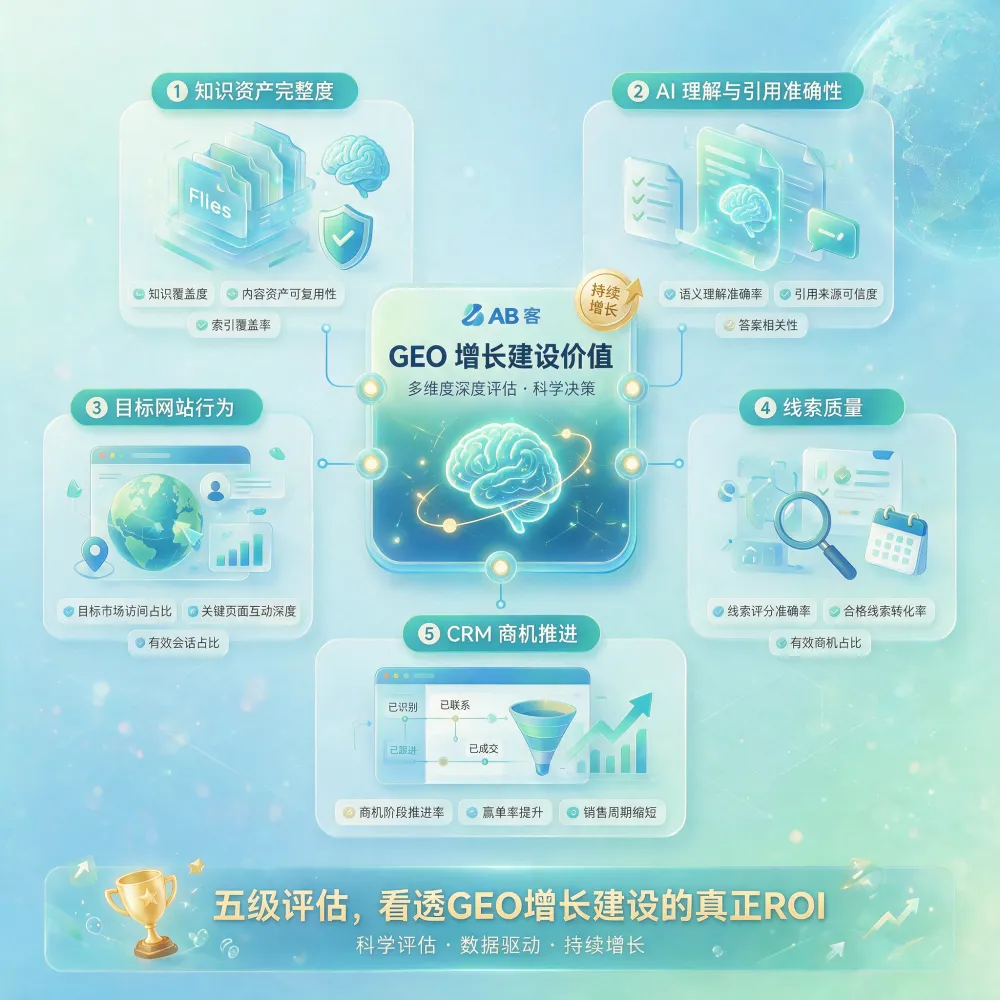
Evaluating whether GEO growth development is worth the investment should not rely only on the number of new inquiries or closed revenue in a single period. For export-oriented B2B businesses, customer decision cycles, product value, market competition, sales follow-up capability, and other factors can all affect final outcomes. A more practical approach is to build a layered measurement framework—from digital asset development to opportunity progression—and compare results continuously with baseline data established before the project begins.
1. Knowledge Asset Completeness: Building a Reusable Growth Foundation
Start by assessing whether information about products, application scenarios, technical capabilities, case studies, FAQs, certifications, and service experience has been organized into structured, maintainable, and reusable enterprise knowledge assets.
Key areas to review include:
- Coverage of core product lines, industry scenarios, and solutions;
- Whether content is based on real business materials rather than generalized descriptions;
- Whether a sustainable mechanism exists for content and knowledge updates;
- Whether established assets can support the website, AI content, sales communication, and future global brand communication at the same time.
These assets are long-term value in themselves. Compared with one-off promotion or fragmented content, enterprise knowledge assets can continue to accumulate as products evolve and markets expand.
2. Accuracy of AI Understanding and Citation: Can Business Information Be Correctly Recognized?
GEO development is not only about how often a company appears. It also concerns whether AI and relevant search environments can understand who the company is, what it provides, which customers it serves, and whether the information presented is accurate and consistent.
Key areas to review include:
- Whether brand, product, industry terminology, and application-scenario descriptions are consistent;
- Whether company information is correctly understood and cited in AI search or question-and-answer scenarios;
- Whether cited information accurately reflects product capabilities, applicable scope, and differentiating information;
- Whether fragmented information, inconsistent descriptions, or missing critical materials create fewer understanding gaps.
AI platform exposure and recommendations are affected by algorithms and external conditions. A single appearance or a fixed recommendation should not be treated as the only measure. It is more meaningful to observe information quality and visibility trends over time.
3. Target Website Behavior: Are Visits Coming From Relevant Markets and Buyers?
Traffic alone does not equal value. Evaluation should consider target countries or regions, industries, product-page visits, and visitor behavior to determine whether visits are moving closer to the company’s actual customer-acquisition objectives.
Key areas to review include:
- Changes in visits related to target markets, languages, and industries;
- Visits and engagement on high-value pages, such as key product, solution, and case-study pages;
- Whether visitors go on to view technical materials, contact details, inquiry entry points, or related content;
- Differences in visit quality generated by different content types and channels.
This helps businesses avoid pursuing traffic volume alone while overlooking alignment with their target customer profile.
4. Lead Quality: Do Inquiries Have Real Follow-Up Value?
Inquiry volume is only a surface-level outcome. More importantly, a business should determine whether leads come from target customers, whether the requirement is clear, and whether they meet the conditions to enter the sales process.
It is advisable to record and classify leads using consistent criteria, including:
- Customer market, industry, and company type;
- Required products, purchasing purpose, expected quantity, or project background;
- Completeness and authenticity of contact information;
- Whether the lead matches the target customer profile and merits continued sales follow-up.
Lead grading enables businesses to identify which content, pages, or markets generate prospects that are closer to genuine business opportunities, rather than treating every form submission as an equally valid inquiry.
5. CRM Opportunity Progression: Is Growth Entering a Manageable Sales Funnel?
For B2B companies, the final assessment should examine whether leads are received promptly, followed up effectively, and progressively moved into opportunity stages such as quotation, sample requests, technical communication, project evaluation, or negotiation.
Key areas to review include:
- Response and initial follow-up after leads are entered into the CRM;
- The proportion of qualified leads that become sales opportunities;
- The time opportunities remain in, and progress through, different stages;
- Sales-team feedback on lead quality, information completeness, and communication efficiency.
This stage helps distinguish whether a performance issue lies in traffic and content, lead qualification, or sales follow-up and customer relationship management. It can reduce the misjudgment of having inquiries without conversion.
Use Stage-Based Validation Rather Than a Single Outcome Metric
As a GEO growth development service brand for export-oriented B2B businesses, AB客 (ABKE) focuses on building a sustainable growth foundation through enterprise knowledge assets, AI visibility optimization, website content, and CRM coordination. Businesses can review these indicators monthly or by project stage, then assess them in combination with baseline data, sales cycles, and target-market conditions.
A practical value path is: more complete knowledge, more accurate AI understanding, more concentrated target visits, more qualified leads, and clearer CRM opportunity progression. Closed revenue remains important, but it results from the combined effects of product competitiveness, pricing strategy, sales execution, and market conditions. It should not be the sole standard for evaluating GEO growth development.


