.png?x-oss-process=image/resize,h_100,m_lfit/format,webp)

.png?x-oss-process=image/resize,m_lfit,w_200/format,webp)

Hot Products
.png?x-oss-process=image/resize,h_2000,m_lfit/format,webp)
.png?x-oss-process=image/resize,h_2000,m_lfit/format,webp)

Popular articles
Recommended Reading
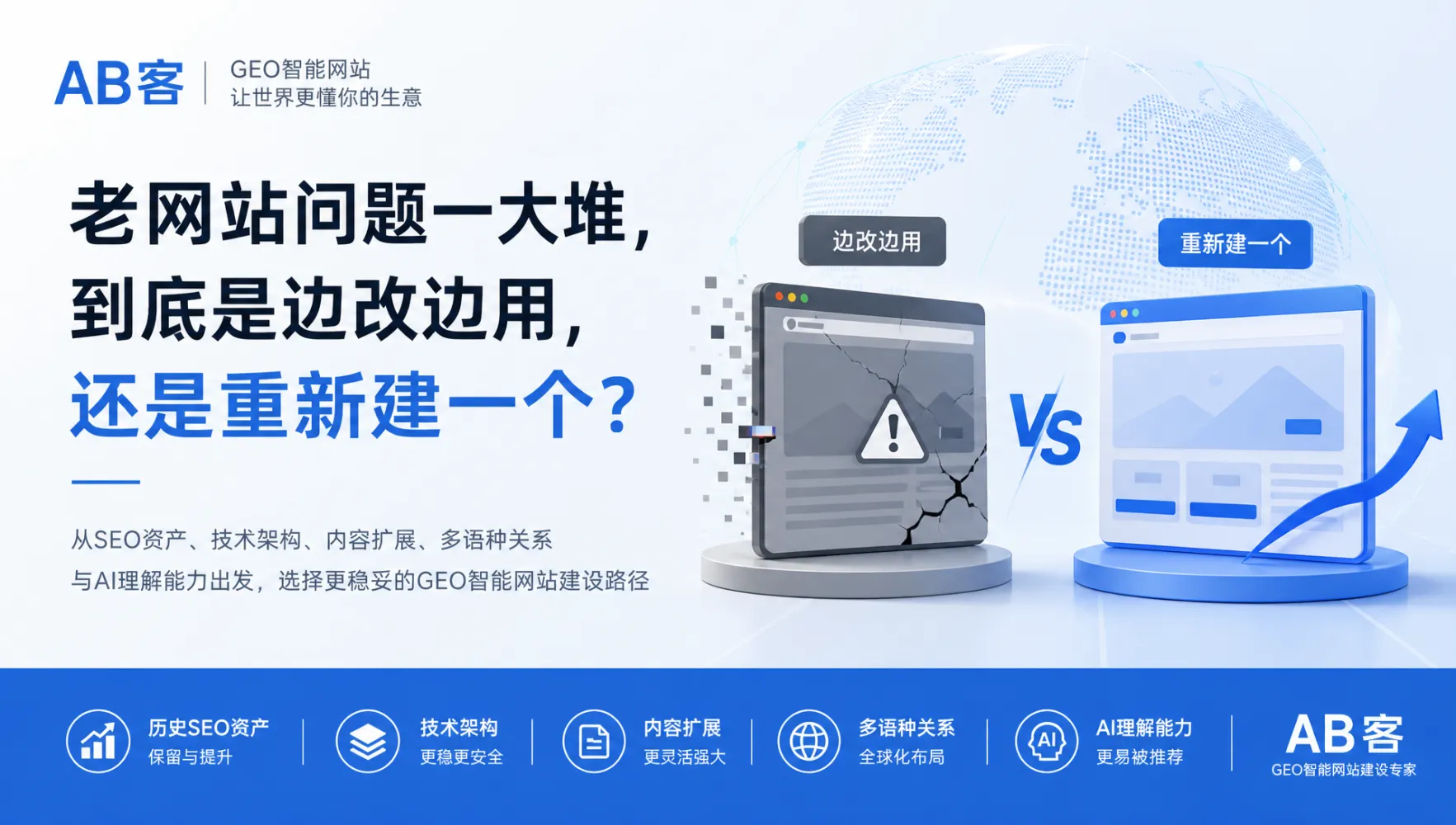
What GEO Website Assets Can Be Exported or Transferred?
Learn which GEO intelligent website assets ABKE can support for export, transfer, and migration upon contract completion, subject to agreed terms and technical conditions.
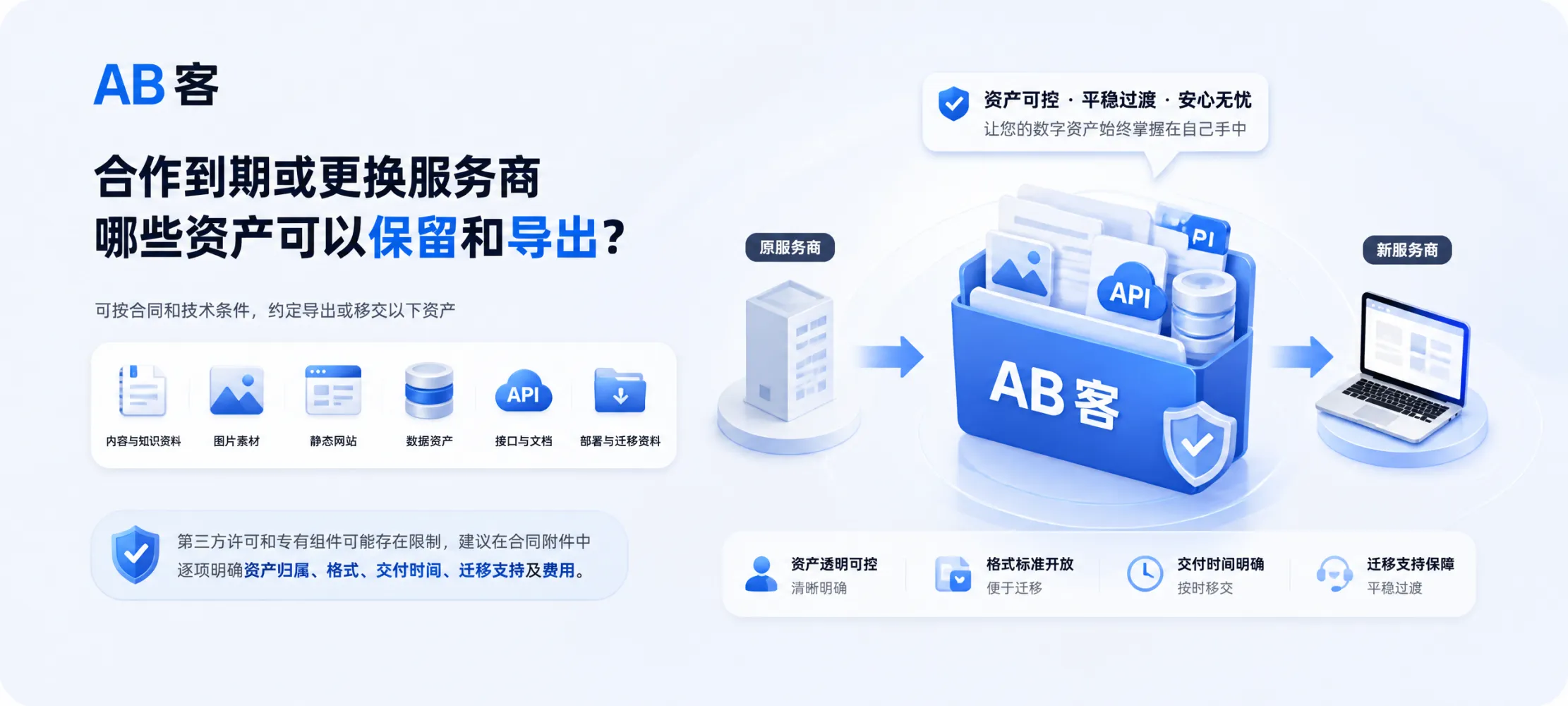
GEO intelligent website assets can be retained, exported, or transferred after a cooperation term ends, subject to the agreed contract terms and actual technical conditions. For export-oriented B2B companies, a website is more than a presentation layer: it carries long-term digital assets including brand information, products, solutions, cases, FAQs, professional content, conversion paths, and operational data. Defining asset boundaries before a project starts is therefore an important way to reduce risks when changing service providers or moving to in-house operation.
ABKE focuses on the controllability of enterprise digital assets in its GEO intelligent website projects. Based on contractual agreements and technical feasibility, content, knowledge materials, static website files, images, data, interfaces, and migration or deployment documentation may be supported for export, handover, or migration assistance.
Assets That Can Commonly Be Agreed for Retention or Export
The following asset categories can be defined individually in the contract or its appendix:
1. Content and Knowledge Materials
This may include approved and published brand introductions, product information, solutions, application scenarios, cases, engineering projects, FAQs, news, downloadable materials, and other page copy.
2. Images and Media Assets
This may include product images, company images, documents, and media materials provided by the client, owned by the client, or explicitly agreed as transferable in the contract. The original source and copyright ownership of materials should be identified separately.
3. Static Website Files or Page Materials
Under applicable deployment methods and technical conditions, delivery of static page files, HTML pages, stylesheets, and related publishing materials may be agreed for backup, migration, or future maintenance.
4. Website Data and Operational Materials
Depending on connected systems and permission scopes, the parties may agree to export form leads, traffic analytics, event tracking, source records, page inventories, URL mappings, redirect rules, and content version records.
5. Interface and Deployment Migration Materials
Depending on the project architecture, interface documentation, deployment instructions, domain resolution recommendations, server configuration requirements, migration checklists, and necessary handover materials may be agreed to support a smooth transition to an internal team or a new service provider.
Items That May Be Subject to Limitations
The following items generally require confirmation based on third-party rules, account ownership, and the technical architecture:
- Third-party software, plugins, themes, fonts, image libraries, or SaaS service licenses: usage rights, renewal arrangements, and transfer conditions are governed by the original provider’s terms and may not be directly transferable.
- Proprietary components or platform capabilities: for functions developed by the service provider or dependent on a specific system, whether source code, independent deployment capability, or an alternative solution is available should be determined by the contract.
- Third-party account and data permissions: the transferability of accounts for analytics tools, CRM systems, cloud services, advertising platforms, or AI platforms depends on the registered account owner, administrator permissions, and platform policies.
- Historical data completeness: data retention periods, export formats, and interface capabilities differ by system. Exportable fields, time ranges, and file formats should be confirmed in advance.
What Should Be Specified in the Contract Appendix?
To avoid misunderstandings at the end of a cooperation period, asset handover requirements should be included in the contract appendix or project delivery checklist. At a minimum, the following items should be clarified:
| Agreement Item | Recommended Clarification |
|---|---|
| Asset name and ownership | Specify who owns, or holds what usage rights for, page content, images, code, data, accounts, and interface materials. |
| Export scope and format | For example: Word, Excel, CSV, JSON, HTML, original image files, database backups, or interface documentation. |
| Delivery timing | Define specific delivery milestones during the cooperation term, at project acceptance, or after contract completion. |
| Delivery method | Online download, cloud storage, code repository, server migration, written handover, or another agreed method. |
| Migration support | Clarify whether URL mapping, 301 redirects, deployment assistance, launch verification, and a support period are included. |
| Fees and responsibilities | Clarify whether standard delivery is included and how custom development, third-party renewals, or additional migration support are charged. |
| Third-party limitations | List in advance any components, licenses, or accounts that require renewal, cannot be transferred, or need to be repurchased. |
Key Risks to Review When Changing Service Providers
A provider transition should not be limited to exporting page files. Website continuity should also be considered. For companies with existing organic traffic and indexation foundations, the following items should be reviewed carefully:
- Whether a complete inventory of existing URLs, page hierarchies, and internal links is available.
- Whether a URL mapping and 301 redirect plan is required after the redesign or migration.
- Whether technical configurations such as canonical tags, hreflang, sitemaps, robots directives, and Schema can be continued.
- Whether multilingual pages, forms, CRM systems, analytics tools, and conversion events can remain operational.
- Whether images, downloadable files, case materials, and historical content have been backed up completely.
- Whether the client retains core access rights to the domain, server, DNS, code repository, and third-party accounts.
Important Boundary
ABKE can provide export, handover, or migration assistance within the agreed scope. However, it does not guarantee that third-party search engines or generative AI platforms will maintain fixed crawling, indexing, citation, ranking, or inquiry results after a website migration. Post-migration performance can also be affected by page quality, technical implementation, market competition, platform algorithms, and subsequent operations.
Recommended approach: Treat “asset ownership and exit handover” as a separate confirmation item during project discussions. Based on the company’s existing domain, server, accounts, data systems, and target technical architecture, both parties should confirm the details item by item and incorporate them into the contract.


